
When musicians say a song is “in the key of C,” they mean more than a starting note. They mean a pool of chords that belong together. Those chords are diatonic chords. Understanding them makes chord charts readable, practice focused, and key changes less mysterious.
What Diatonic Means
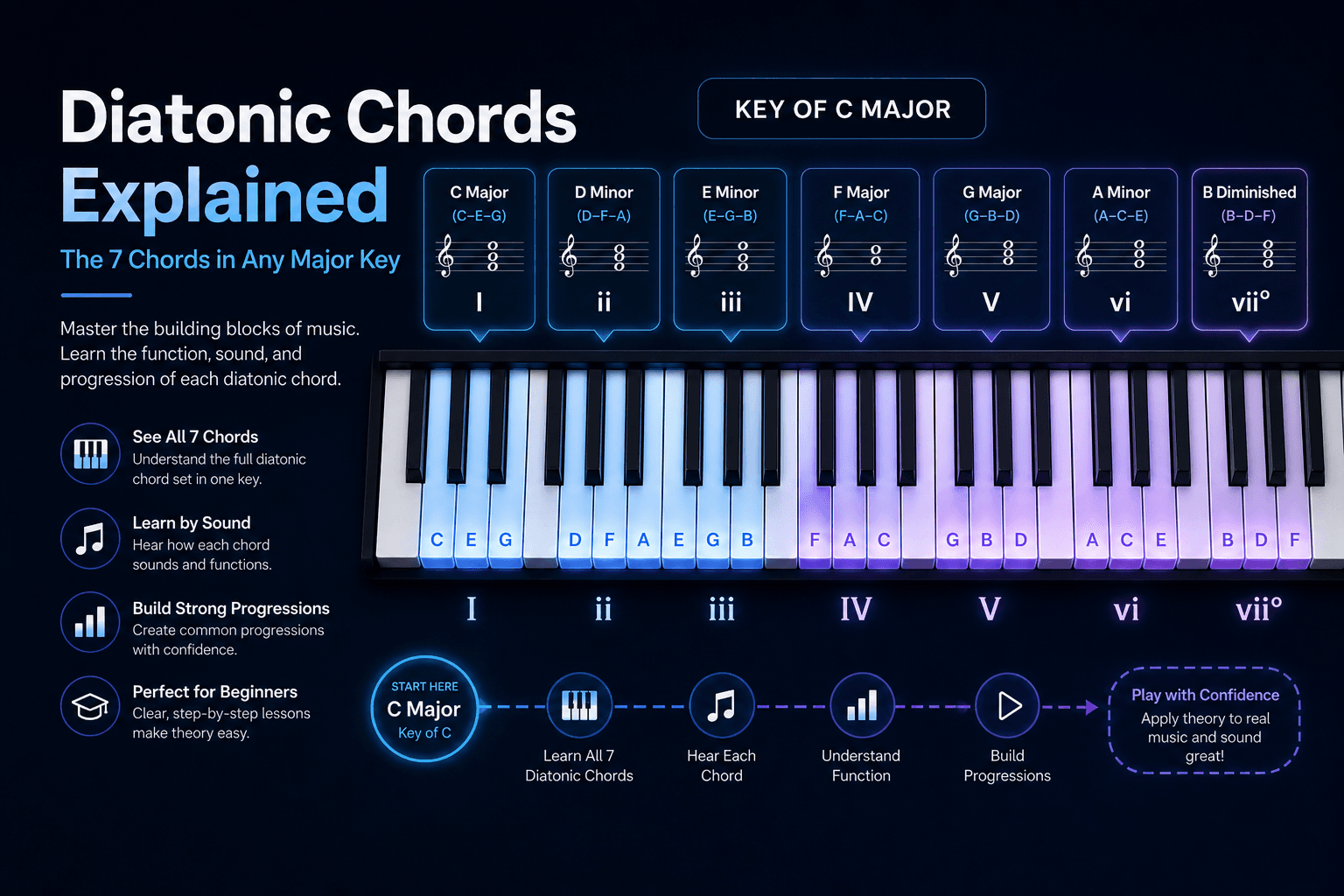
Diatonic means “within the scale.” A diatonic chord uses only notes from the key’s major scale. In C major, every diatonic chord is built from the white keys only.
Songs can use chords outside the key for color, but most beginner and intermediate chord charts stay mostly diatonic. Learning the diatonic set in each key covers a huge share of real music.
The Seven Chords in a Major Key
Every major key has seven diatonic triads—one built on each scale degree. In C major they are C, Dm, Em, F, G, Am, and B diminished.
Looty Chords focuses practice on seven essential chord types per key—including major, minor, and other common qualities used in popular music. That matches how players actually encounter chords in songs.
See how roots and types work in Learn Piano Chords by Key.
Roman Numerals
Roman numerals label chords by scale position: I is the home chord, IV is the subdominant, V is the dominant, vi is the relative minor, and so on. Uppercase means major quality; lowercase means minor.
Numerals let you talk about progressions in any key. I–V–vi–IV in C is C–G–Am–F. The same pattern in G is G–D–Em–C. The relationships stay identical.
Study common patterns in Piano Chord Progressions.
Why Songs Stay Inside a Key
Diatonic chords share scale notes, so transitions feel smooth. The V chord pulls toward I. The vi chord adds emotional contrast while staying in the family. The IV chord moves away from home without breaking the key.
When a chart suddenly uses a chord outside the key, you hear it as tension or surprise. Beginners should master diatonic movement first—that is the foundation for most chord progressions you will play.
Example Using C Major
In C major, the diatonic triads are C (I), Dm (ii), Em (iii), F (IV), G (V), Am (vi), and Bdim (vii°). A classic pop progression like I–V–vi–IV becomes C–G–Am–F.
Try playing that progression slowly with a metronome. Notice how each chord prepares the next even though the shapes change.
For a key-specific practice guide, read Piano Chords in C Major.
Open C major chords instantly on the chord reference (key of C).
How to Practice Diatonic Chords
Learn all seven chord types in one key before jumping across keys. Use randomized drills so you recognize each chord name on its own—not only in one fixed order.
Add progression practice once individual shapes feel familiar. Loop I–IV–V or I–V–vi–IV at a slow tempo, then gradually increase speed.
Launch timed practice in Practice Mode.
Explore Any Key with Looty Chords Tools
The Circle of Fifths tool shows diatonic chords, scale notes, and beginner progressions for every major key. Click a key and study how the chord family changes.
The chord reference page lets you inspect individual shapes and switch keys instantly—useful when a song modulates or when you compare C to G or F.
Start with the Interactive Circle of Fifths, then drill shapes on Piano and Guitar Chords.
When you are ready for all twelve tonal centers, read Piano Chords in All 12 Keys.
Practice diatonic chords in your first key
Pick a key, learn its seven essential chords, and use Looty Chords for randomized metronome practice.