
A piano chord progression is a sequence of chords that repeats through a verse, chorus, or entire song. Knowing individual chords is step one; moving through progressions on tempo is what makes you performance-ready. If you are new to progressions, start with the beginner progressions guide linked below.
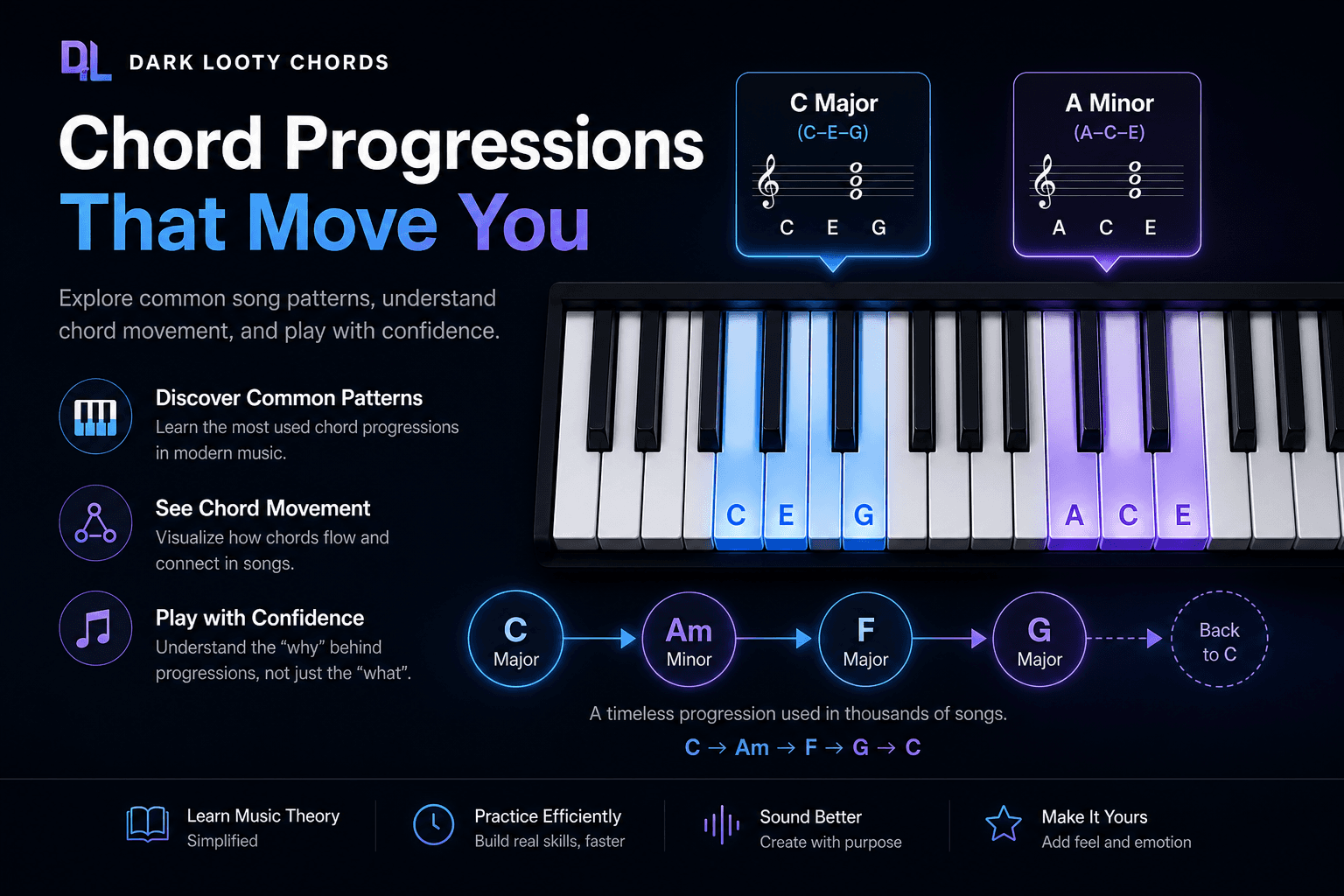
What Is a Chord Progression?
Progressions use Roman numerals or chord names. A I–V–vi–IV movement in C might play C major, G major, A minor, and F major in order. Hundreds of hits share a small set of familiar patterns.
Progressions matter because your hand learns transitions: C to G feels different from G to Am. Practicing those pairs is as important as memorizing each chord alone.
Looty Chords includes practice for common chord progressions so you train realistic changes—not only single random chords.
New to progressions? Read Piano Chord Progressions for Beginners first, then return here for deeper practice strategies.
Why Progression Practice Helps
Random single-chord drills build shape memory. Progressions build flow memory—how long you stay on a chord and which finger paths repeat in songs.
Many beginners can play chords slowly in isolation but stumble when a chart moves every two beats. Progression practice closes that gap.
Combining progression practice with metronome timing teaches you to commit to the next chord before the beat arrives.
Practicing Progressions in Looty Chords
After you are comfortable with the seven essential chords in a key, use progression practice to simulate song-like movement. Looty Chords supports practicing common chord progressions as part of your subscription features.
Start slow. Loop the same progression until your left hand anticipates the next symbol on the chart.
When you use a MIDI keyboard, progression practice maps directly to how you will accompany singers or play from lead sheets.
- Master individual chords in a key with randomized drills first.
- Switch to progression practice for realistic transitions.
- Increase metronome tempo only when the whole loop stays clean.
- Try progressions in a new key once the current key feels easy.
From Progressions to Full Songs
Once a few progressions feel natural in one key, you can follow chord charts for actual songs in that key. Your job is to keep tempo and land each symbol—Looty Chords trained the shapes and changes underneath.
Expand to additional keys when you want to play charts that modulate or use capo-free originals in other tonal centers.
Practice chord progressions with timing
Explore chord shapes on the interactive keyboard, then loop progressions in Practice Mode to build song-like flow.