
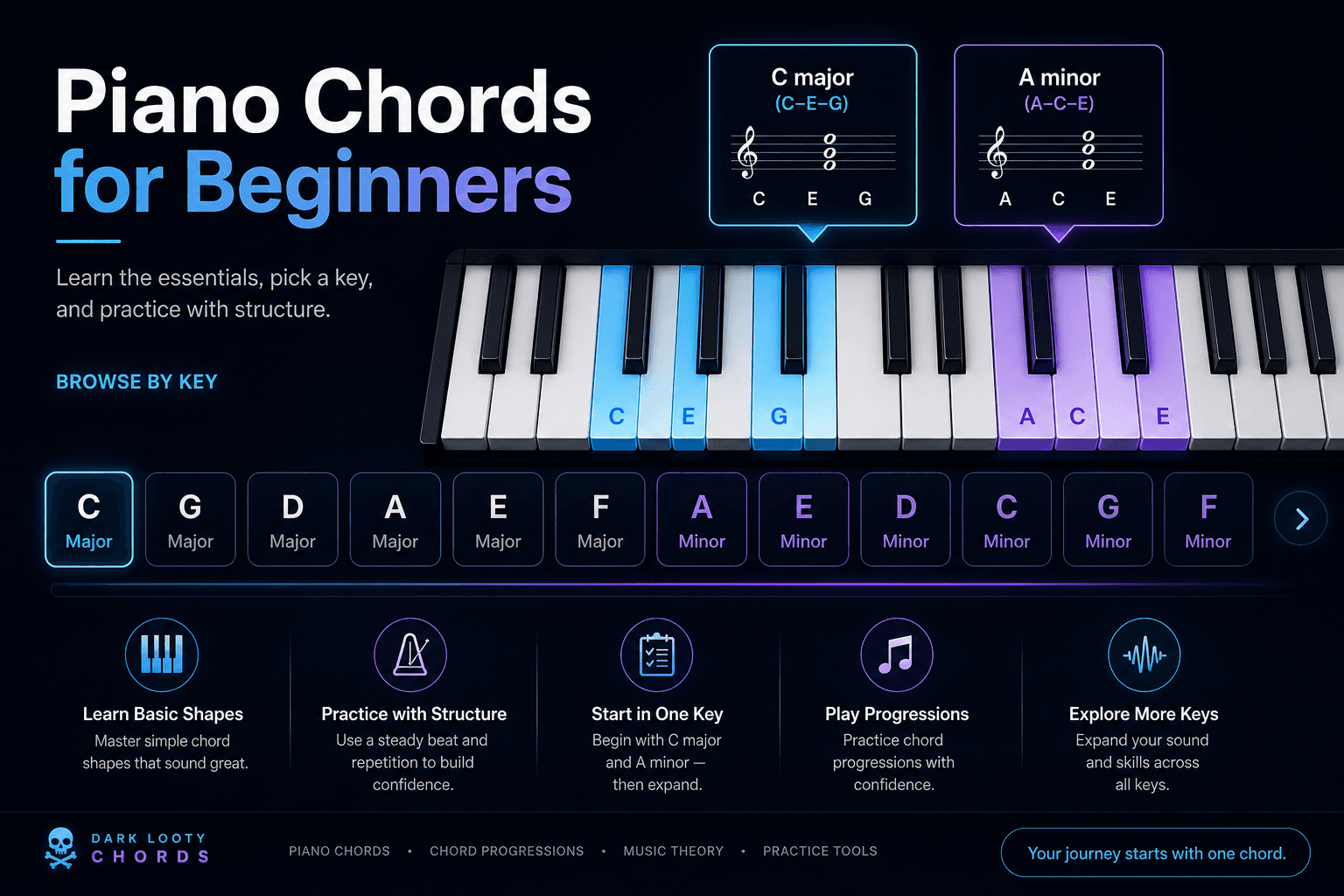
If you have ever wondered why C Major uses C, E, and G while A Minor uses A, C, and E, you are already thinking in terms of root keys and chord types. Once you understand that pattern, every new chord becomes easier to learn, recognize, and play in real music.
What Is a Root Key?
The root key is the starting note—the foundation of the chord. When you see C Major, C is the root. When you see F#m7, F# is the root. Every other note in the chord is measured from that starting pitch.
On piano, changing the root moves the entire chord shape up or down the keyboard. A C Major triad uses C, E, and G. Move the root to G and you get G Major: G, B, and D. The relationship between the notes stays the same; only the starting position changes.
Looty Chords lets you pick any of the twelve root keys—C through B, including sharps—so you can compare how the same chord type looks and feels in different positions on the keyboard.
For the full mechanics of intervals, triads, and how chords work from the ground up, see How Piano Chords Work.
How Chord Types Change the Notes
The chord type tells you which intervals to stack on top of the root. A major triad adds a major 3rd and a perfect 5th. A minor triad lowers the 3rd, giving you a darker sound. Seventh chords add one more note—the 7th—which changes the character again.
Two chords can share the same root but sound completely different because of their type. C Major (C, E, G) and C Minor (C, Eb, G) both start on C, but the middle note defines the mood. Dominant 7th, major 7th, and minor 7th chords each add their own color on top of the basic triad.
Learning chord types as formulas—not just fixed finger positions—helps you transpose confidently. Once you know that a major chord is 1–3–5, you can build it on any root key without memorizing eighty-four separate shapes from scratch.
Why Intervals Matter
Intervals describe the distance from the root to each other note in the chord. The root is 1. A major third is 3. A minor third is b3 (flattened third). The fifth is 5, and seventh chords add 7 or b7 depending on the type.
When you understand intervals, chord names start to make sense. "Am7" means A as the root, a minor third, a fifth, and a flattened seventh. "Fmaj7" means F major triad plus a major seventh. Interval thinking connects theory labels to what you actually play.
On the Looty Chords interactive reference, interval badges appear on highlighted keys so you can see how each note relates to the root at a glance. That visual link between name, number, and key is especially helpful when you are learning your first seventh or suspended chords.
Common Chord Types Explained
Most popular music relies on a handful of chord types. Here are the essential shapes you will encounter on the Chords tool and in real songs:
- Major (1, 3, 5) — bright, stable triads like C Major and G Major.
- Minor (1, b3, 5) — darker triads like A Minor and E Minor.
- 7 / Dominant 7th (1, 3, 5, b7) — tense, resolving chords like G7 and C7.
- m7 / Minor 7th (1, b3, 5, b7) — smooth minor chords like Am7 and Dm7.
- maj7 / Major 7th (1, 3, 5, 7) — lush, jazzy chords like Fmaj7 and Cmaj7.
- sus2 (1, 2, 5) and sus4 (1, 4, 5) — suspended chords that replace the 3rd for an open, unresolved sound.
- dim / Diminished (1, b3, b5) — narrow, tense chords often used as passing tones.
- add9 (1, 3, 5, 9) — triads with an added ninth for extra color without full seventh-chord weight.
- 6 (1, 3, 5, 6) and m6 (1, b3, 5, 6) — triads with an added sixth, common in jazz and pop arrangements.
You do not need to memorize every formula overnight. Start with major and minor triads, then add sevenths and suspended chords as they appear in the music you want to play.
Use the Interactive Chords Page
The Looty Chords interactive Chords tool is built for exploration. Choose a root key from the dropdown, pick a chord type, and the piano keyboard immediately highlights the correct notes. The details card lists note names, intervals, and common aliases such as CM, Cmaj, or Am7.
Popular quick-select buttons—C Major, G Major, F Major, common minors, and frequently used seventh chords—let you jump to the chords you hear most often in beginner songs. Everything updates in place without leaving the page.
Use the tool when you are learning a new song and need to confirm which notes belong in a chord, or when you want to compare how a dominant 7th differs from a major 7th on the same root. It is a reference, not a substitute for practice—but it makes practice much more informed.
Move From Learning Chords Into Practicing Changes
Understanding how chords are built is the first step. Playing them smoothly in time is the next. Songs rarely stay on one chord—they move through progressions, often at a steady tempo. That is where guided practice matters.
Looty Chords practice mode presents chords in randomized sequences with a metronome so you build muscle memory for changes, not just static shapes. You can start in one key, master the essential chord types there, and expand to all twelve keys when you are ready.
A practical workflow: use the interactive Chords tool to learn and confirm a new shape, then head to Practice Mode to drill changes at a comfortable tempo. Repeat daily—even fifteen minutes—and chord names start to match what your hands already know.
From chord theory to real practice
Use the interactive Chords tool to explore any key and chord type, then move into timed practice when you are ready to build speed and confidence.