
Seventh piano chords extend the basic three-note triad with an extra tone—often the seventh scale degree. They show up in blues, jazz, gospel, funk, and modern pop. If you want fuller-sounding accompaniment, sevenths are essential.
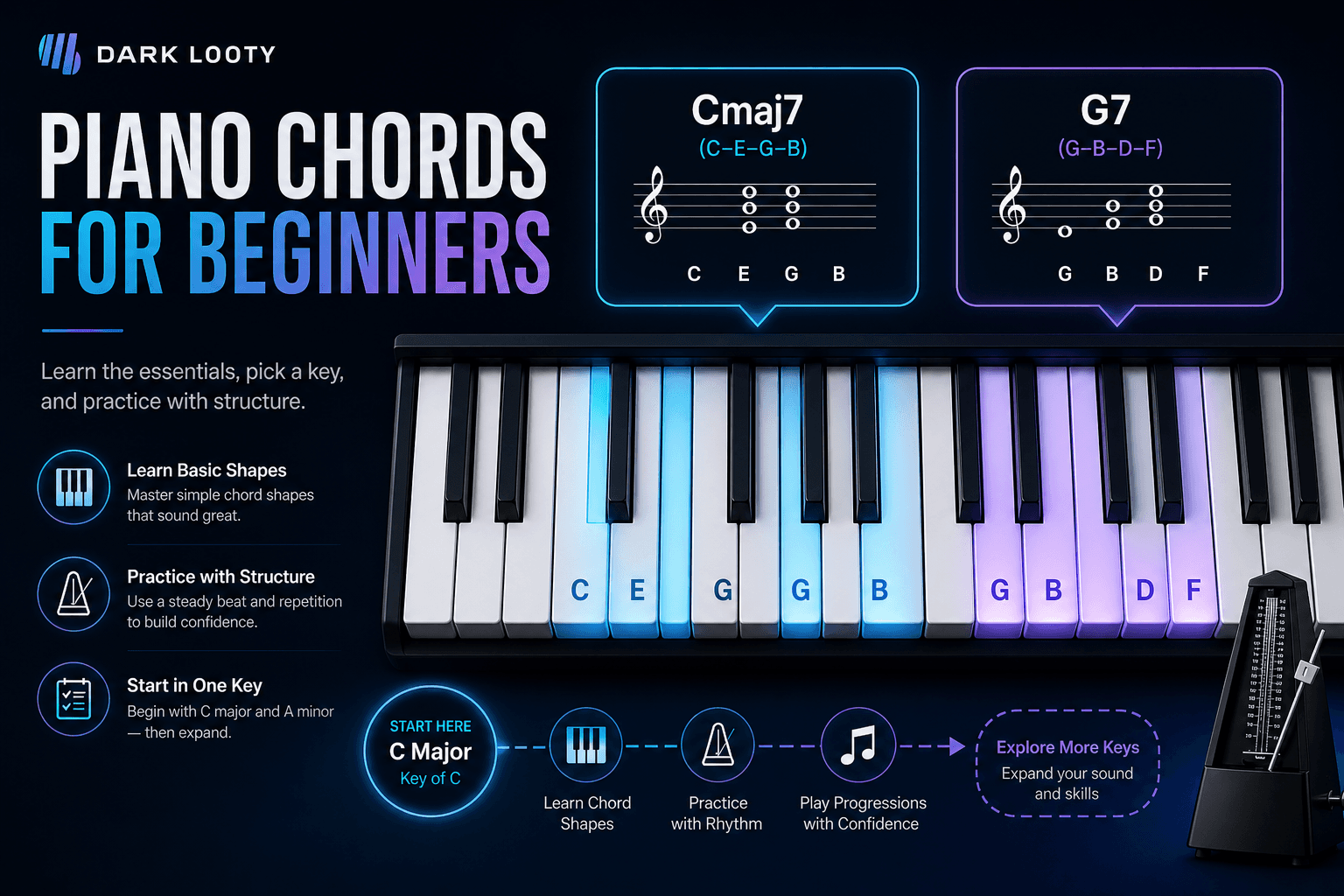
Common Seventh Chords on Piano
Dominant sevenths (such as G7) create forward motion—they want to resolve to another chord. Major sevenths (such as Cmaj7) sound smooth and sophisticated. Minor sevenths (such as Dm7) blend minor color with extra depth.
Looty Chords includes seventh and other advanced essential shapes as part of the seven chord types you learn in each key—you practice them in the same randomized flow as major and minor chords.
You learn by name and diagram, building reflexes through repetition rather than theory worksheets. The Seventh Chords category groups every dominant, major, and minor seventh page in one place if you want to browse a specific shape first.
How a Seventh Chord Is Built
A seventh chord is a triad with one more note stacked on top: the seventh scale degree above the root. Which triad you start from, and whether that seventh is flattened, determines the seventh chord’s type.
Start from a major triad and add a flattened seventh (b7) and you get a dominant seventh, like G7 (G, B, D, F). Add the natural seventh instead and you get a major seventh, like Gmaj7 (G, B, D, F#). Start from a minor triad and add a flattened seventh and you get a minor seventh, like Gm7 (G, Bb, D, F).
The How Piano Chords Work guide covers roots, intervals, and triads in more depth if any of those terms are unfamiliar — sevenths make more sense once the underlying triad is solid.
Where Seventh Chords Appear
Blues progressions lean heavily on dominant sevenths. Jazz standards stack maj7 and m7 chords. Even pop ballads use maj7 for a polished sound.
If a chord chart shows G7 or Fmaj7, you need the seventh shape ready—not just the triad you might default to.
The classic jazz ii–V–I turnaround leans on seventh chords at every step — a minor seventh, a dominant seventh, then a major seventh. The Piano Chord Progressions guide walks through how progressions like that are built and named.
How to Practice Seventh Chords
- Make sure major and minor shapes in a key are comfortable first—sevenths build on that foundation.
- Watch for extra fingers in seventh diagrams; accuracy matters more than speed early on.
- Keep random practice on so you cannot guess the next quality from order alone.
- Slow the metronome when a seventh shape lags, then speed up only when clean.
- Use MIDI input to feel the wider hand spans some sevenths require.
Seventh chords are not a separate app mode—they are part of the complete chord set per key that Looty Chords trains through timed, randomized sessions.
To check a specific shape before you practice it, open its page directly — for example G7, C major 7, or D minor 7 — each one shows notes, fingering, and inversions on the interactive keyboard.
Explore and practice seventh chords
View seventh chord shapes and intervals on the interactive keyboard, then drill them in Practice Mode alongside major and minor chords.