
Piano chords in C major are where many learners begin, and for good reason. The key uses only white keys, chord names look straightforward, and a huge share of beginner chord charts start here. This guide covers the seven essential chords in C, how they appear in common progressions, and how to practice them with structure instead of guesswork.
Why C Major Is a Good First Key
C major has no sharps or flats in its scale. On piano that means the C major scale runs across white keys only—C, D, E, F, G, A, B. Beginners can focus on finger shapes without juggling black-key roots at the same time.
Many teaching methods and song arrangements use C because chord names match what you see on a basic keyboard diagram. That lowers friction while you build timing and muscle memory.
If you are brand new to chords, pair this guide with Piano Chords for Beginners.
The Seven Diatonic Chords in C
The diatonic triads in C major are C (I), Dm (ii), Em (iii), F (IV), G (V), Am (vi), and Bdim (vii°). Looty Chords practice focuses on seven essential chord types per key—including major, minor, and other common qualities you hear in popular music.
You do not need to master every extension on day one. Learn the core major and minor shapes first, then add seventh chords and other types as your ears recognize them in songs.
Understand why these chords belong together in Diatonic Chords Explained.
- C major — home chord (I)
- D minor — ii
- E minor — iii
- F major — IV
- G major — V (dominant pull back to C)
- A minor — vi (relative minor)
- B diminished — vii° (less common in simple pop, still useful to recognize)
Basic Piano Chord Shapes in C
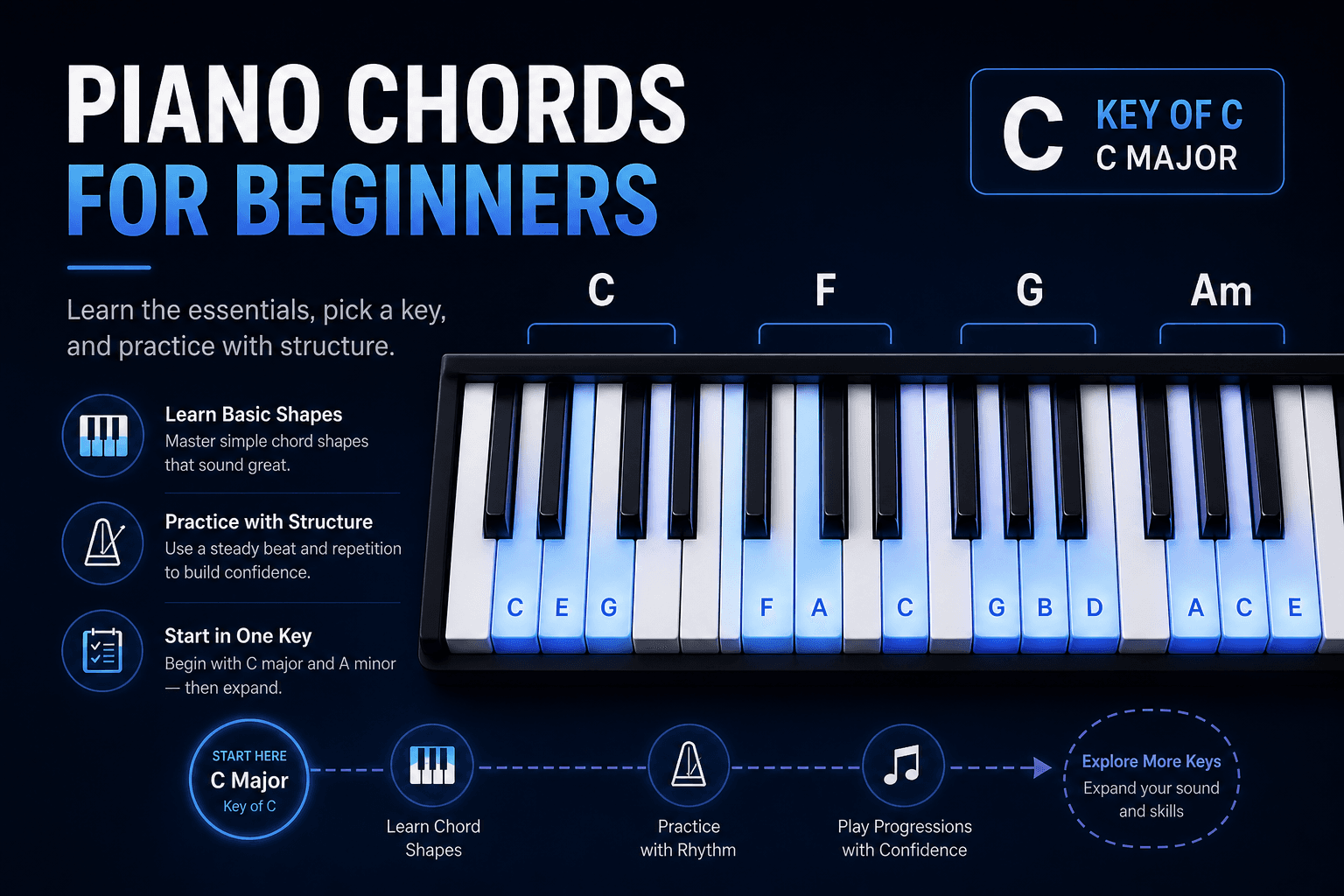
C major is C–E–G. F major is F–A–C. G major is G–B–D. A minor is A–C–E. D minor is D–F–A. E minor is E–G–B. Most beginner shapes in C use white keys only.
Practice recognizing the chord name before your fingers move. Looty Chords shows the label and keyboard diagram together so you connect symbol to shape.
Inspect any C-key chord on the interactive chord reference (C major).
Common C Major Progressions
C major chords connect into familiar progressions like I–V–vi–IV (C–G–Am–F) and I–IV–V (C–F–G). Practice each one slowly with a metronome, keeping changes on the beat even at a very slow tempo.
For the full breakdown—every common progression in C, Roman numerals, and links to each chord—see C Major Chord Progressions.
How to Practice C Chords
Use randomized drills instead of always playing C–F–G in the same order. Random prompts teach each shape independently—the skill songs actually require.
Fifteen to thirty minutes daily beats one long session per week. Slow practice with accurate changes builds speed faster than rushing with sloppy timing.
Open Practice Mode, select the key of C, and work with the metronome until changes feel steady.
When to Move to the Next Key
Move on when C major chords feel boringly easy—when you can change on tempo without pausing to find shapes. For many learners that takes a few weeks of consistent practice, but pace varies.
Good next keys are often G major (one sharp) or F major (one flat). Each adds a small new challenge while reusing the same chord relationships.
Plan the bigger journey in Piano Chords in All 12 Keys.
Use the Chord Reference and Circle of Fifths
The chord reference shows notes, intervals, and keyboard diagrams for any chord in C. Switch chord types without leaving the page.
The Circle of Fifths places C at the top of the map. Compare neighboring keys, see C’s relative minor (A minor), and study how progressions look in Roman numerals.
Explore C major on the Circle of Fifths and drill shapes on Chords in C.
Master C major, then expand
Practice the seven essential chords in C with Looty Chords, then unlock more keys when you are ready.