
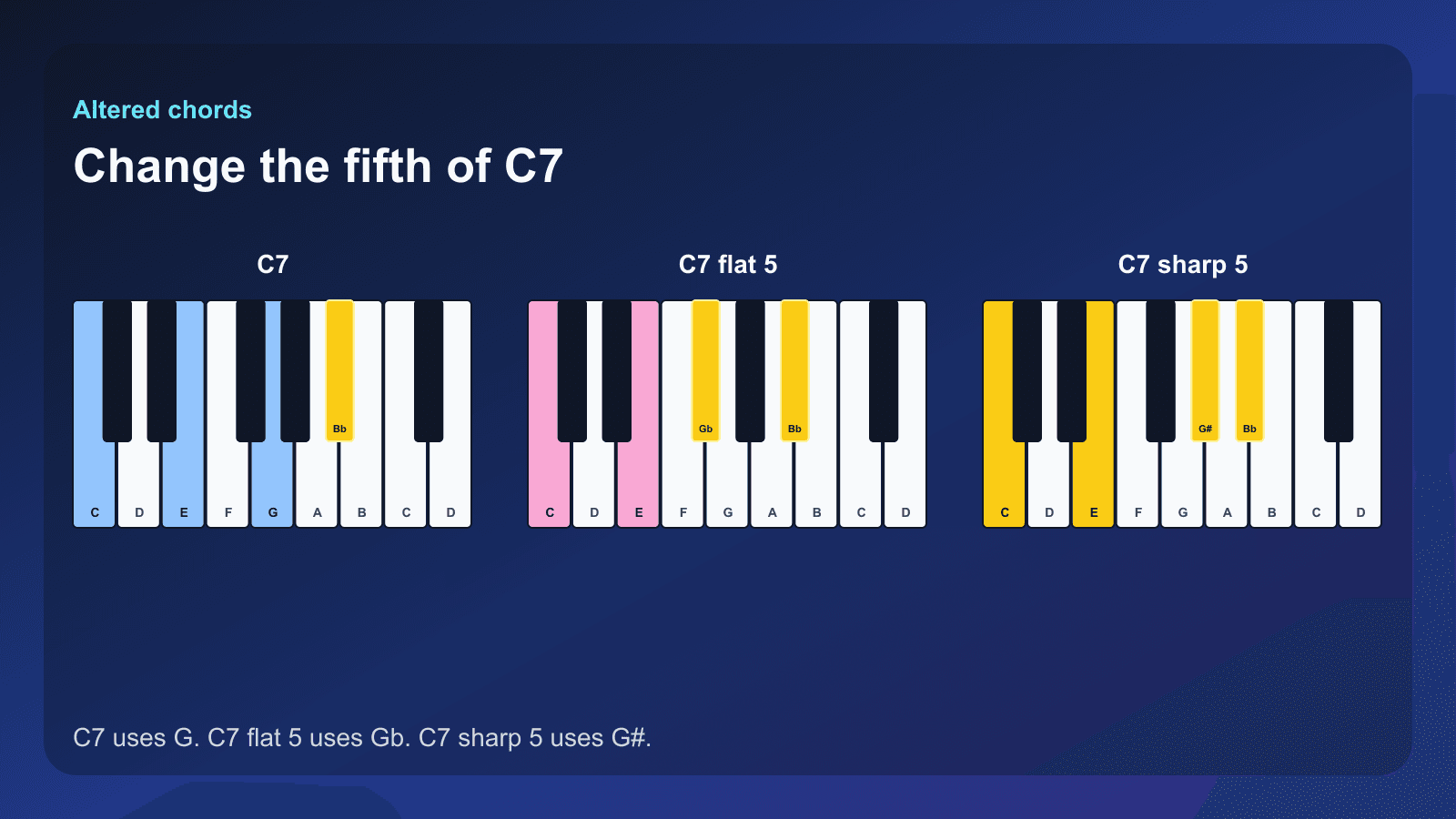
An altered chord symbol tells you which chord tone has been raised or lowered. On a dominant seventh, the fifth is the usual one. C7 is C, E, G, B-flat. C7♭5 replaces G with G-flat. C7♯5 replaces G with G-sharp. The root, third, and seventh stay.
Read the altered fifth
C 7: C – E – G – Bb
G is the unaltered fifth.
C 7b5: C – E – Gb – Bb
G-flat is the lowered fifth. C, E, and B-flat stay.
C 7#5: C – E – G# – Bb
G-sharp is the raised fifth. C, E, and B-flat stay.
What the flat and sharp change
Read the symbol from the left. C7 means a dominant seventh on C. ♭5 means the fifth is one half step lower than in that seventh chord. ♯5 means the fifth is one half step higher. The accidental belongs to the fifth, not to the root and not to the seventh.
The chord library used here spells these three chords in full. A practical piano voicing may omit the fifth or the root so the altered note is easier to reach. When that happens, the omitted note is still part of the symbol. The voicing is a smaller way to play the same chord.
Why the altered fifth pulls
G-flat and G-sharp both sit a half step away from a note in an F major triad. C7♭5 can resolve to F major when G-flat falls to F and B-flat falls to A. C7♯5 can resolve when G-sharp rises to A. The altered note is the tension. The next chord is the release.
Altered ninths, such as 7♭9 and 7♯9, are not separate types in this chord library, so this lesson does not spell them. The altered fifths above are the examples the model supports.
Continue with the altered category, C7, C7♭5, C7♯5, the seventh-chord category, Chord Explorer, Chord Finder, the symbols guide, and Piano Chord Voicings.
Start practicing piano chords with Looty Chords
Begin your free trial, compare plans, or read answers to common questions about chord practice and MIDI setup.