
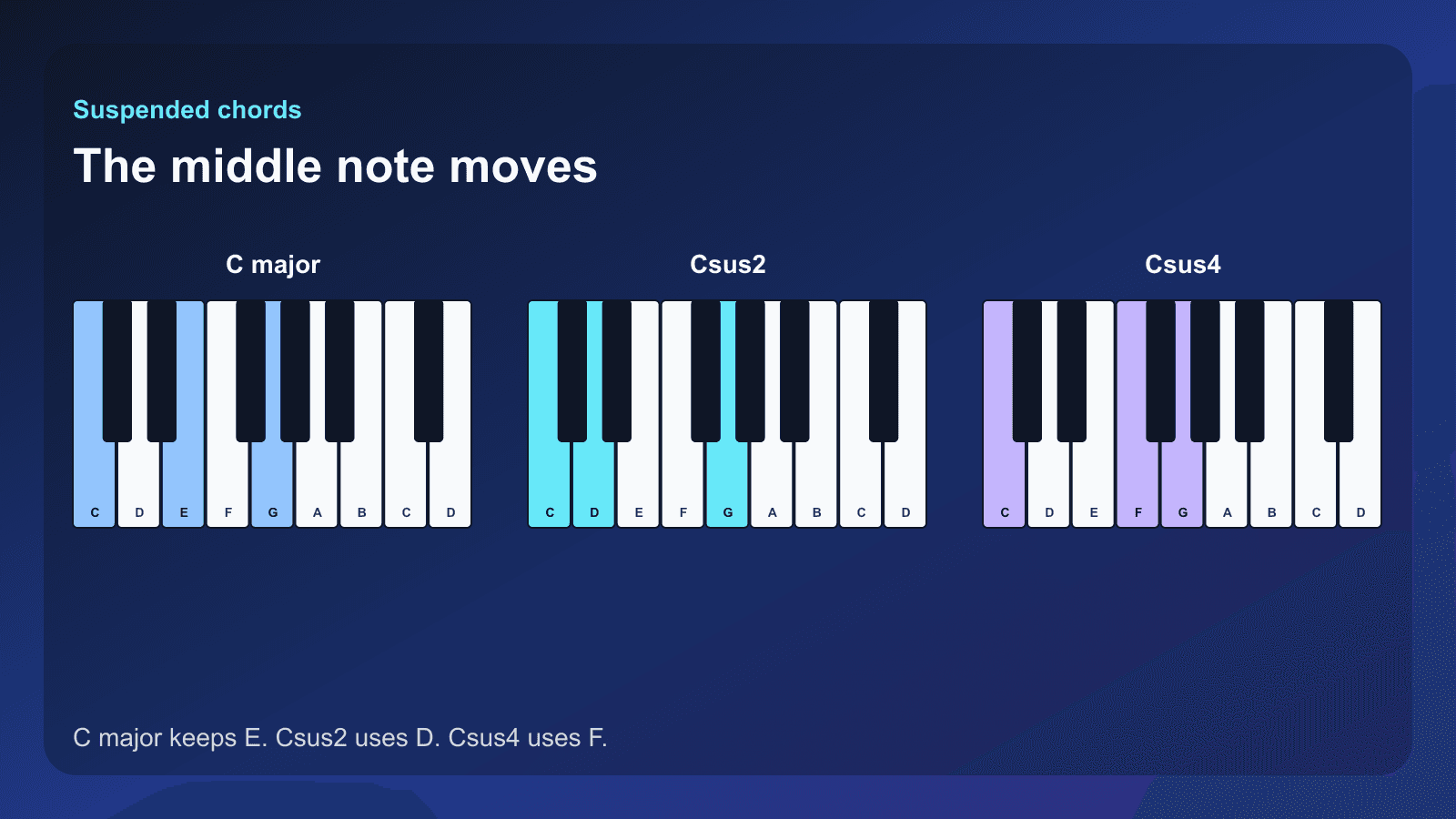
A suspended chord is a triad whose third has been replaced. The chord is not major and not minor until that middle note steps back into place. The keyboard below shows C major, Csus2, and Csus4, then a Csus4-to-C resolution you can hear.
Hear C, Csus2, and Csus4
C Major: C – E – G
E is the third.
C sus2: C – D – G
D replaces E. The third is gone.
C sus4: C – F – G
F replaces E. The third is gone.
The third is the note that changes
C major is C, E, and G. E is the third, and it is what makes the triad major. Csus2 replaces E with D: C, D, G. Csus4 replaces E with F: C, F, G. The root and the fifth stay put.
That is the whole difference between sus2 and sus4. Both omit the third. Sus2 puts the second in its place. Sus4 puts the fourth in its place.
Why it feels unfinished
Without a third, the chord does not settle as major or minor. The second or fourth wants to move. A common resolution is Csus4 to C major: F steps down to E, and the chord becomes C, E, G. Csus2 can resolve the other way, with D stepping up to E.
The same shapes can resolve to minor. If the suspended note moves to E-flat, the result is C minor: C, E-flat, G. The suspension decides the color only when it lands.
A beginner pattern
Play C, F, G together, then C, E, G. That is the Csus4-to-C resolution on the keyboard above. The Csus4 and Csus2 pages show the same notes, and the Piano Chord Symbols guide shows how sus2 and sus4 are written.
Try the same move in a progression with the Chord Progression Trainer, or check a stack of notes in Chord Finder. Chord Explorer can show either suspended type on its own keyboard.
Start practicing piano chords with Looty Chords
Begin your free trial, compare plans, or read answers to common questions about chord practice and MIDI setup.