
Voice leading is the path each note takes into the next chord. An inversion can shorten that path because a chord tone is already sitting near your hand. The song still decides whether the root, the third, or the fifth should be the bass.
Hear the positions
These notes come from the same inversion model as the chord pages.
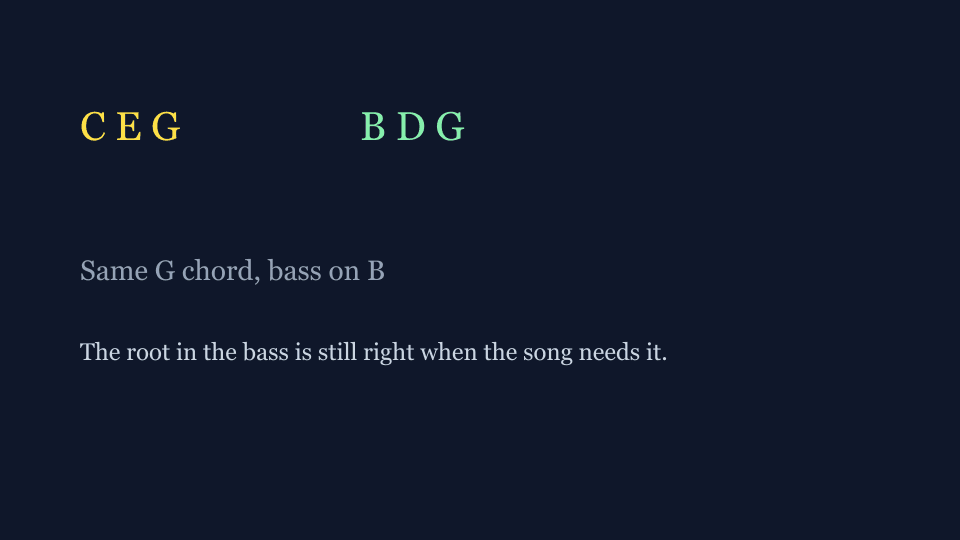
Root position
C – E – G. Lowest note: C. Written C.
Right-hand fingering: 1 – 3 – 5
First inversion
B – D – G. Lowest note: B. Written G/B.
Right-hand fingering: 1 – 2 – 5
Root-position G is G – B – D. G with B in the bass is B – D – G. The second shape sits closer to C–E–G. A song may still want the root in the bass.
Why a different bass can mean less movement
C major in root position is C–E–G. G major in root position is G–B–D, a jump up the keyboard. G major in first inversion is B–D–G. B is next to C. The same G chord is now beside the C chord instead of a stretch away.
That comparison is one context. A bass line that walks the roots wants G under the G chord. Smooth fingers and a strong root bass can disagree. Listen, then choose.
How to look for a nearby position
- Play the chord you are leaving and notice its top and bottom notes.
- On the next chord, try root position and each inversion.
- Keep the shape whose notes move the shortest distance.
- If the bass note fights the song, keep the musically right bass and accept the reach.
Practice the change slowly
Set a slow tempo and change on the downbeat. Two chords are enough: C to G/B, then back. When the landing is clean, add A minor and F. A common loop is C, G, A minor, F. Try G/B or F/C only where the bass still sounds like the song you want.
Go Practice counts you in and moves the chord on the beat. The Progression Trainer plays a progression so you can hear the changes before you copy them. The metronome is there when you only want the click.
Start practicing piano chords with Looty Chords
Begin your free trial, compare plans, or read answers to common questions about chord practice and MIDI setup.