
You can play C major and G major separately, but the moment a chart moves from one to the other on the beat, everything falls apart. Chord changes are the skill gap between knowing shapes and playing music. This guide covers how to practice transitions with better timing, smoother hand movement, and the pair-drill techniques that fix stubborn changes.
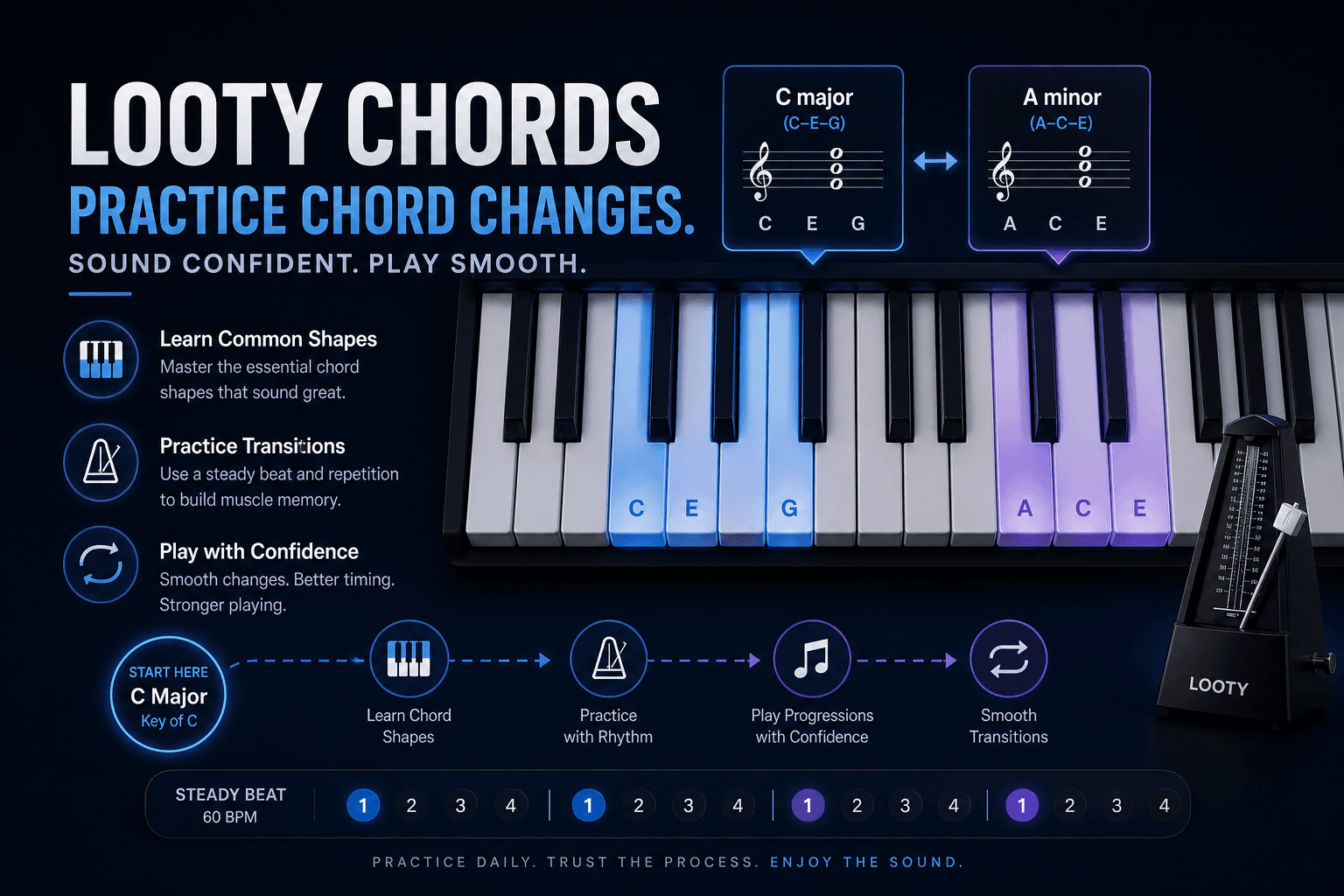
Chord Changes Are Different From Chord Shapes
Knowing a chord shape is static memory—your fingers find the keys for one symbol. A chord change is dynamic memory—the path from one shape to the next, executed on time.
Many beginners practice shapes in isolation but rarely drill the pairs that appear in songs. C to G, G to Am, and F to C each feel different. Each pair deserves focused attention.
Random chord drills in Looty Chords build general change fluency. Pair practice targets the specific transitions that still trip you up.
Practice Changes With Timing From the Start
Untimed practice lets you pause between chords. Songs do not pause. Use a metronome and commit to landing the new shape on the beat—not after it.
If you miss the beat, the tempo is too fast. Drop five BPM and rebuild clean changes before speeding up. Timing discipline during practice is what makes chart playing feel natural later.
For broader practice habits, see How to Practice Piano Chords. Open Practice Mode with the metronome enabled for every session.
Use Pair Drills for Stubborn Transitions
Identify the two chords that slow you down—maybe Dm to G or C to F. Loop only that pair for three to five minutes at a comfortable tempo.
Pair drills train the finger path between shapes. Shared notes can stay in place while only the moving fingers shift. Look for common tones between chords to minimize hand movement.
After pair practice, return to random drills to make sure the improvement holds when the next chord is unpredictable—not just in a fixed loop.
Smoother Hand Movement Between Chords
Lift fingers only as much as needed. Large hand jumps between chords waste time and invite inaccuracy. Keep curved fingers close to the keys.
Relax your wrist and shoulders. Tension slows transitions. Slow practice is the best place to notice and release tightness.
For speed goals beyond smooth movement, read How to Switch Piano Chords Faster after your changes are clean at a slow tempo.
Anticipate the Next Chord
Hesitation often means you are deciding the next shape at the moment of change. Practice seeing the next symbol one beat early and beginning to form the shape before the beat arrives.
Say the next chord name aloud during drills. That verbal cue builds anticipation until it becomes automatic—your hands move when your eyes read the symbol.
In random practice, you cannot memorize order. That forces real anticipation skills instead of sequence memory.
Practice Changes Inside Progressions
Songs move through repeating progressions, not random chords. Loop a four-chord progression to practice changes in musical context—I–V–vi–IV in your practice key is a strong starting loop.
Progression practice connects isolated pair drills to real music. The same transitions you drilled separately now appear in a sequence with rhythmic meaning.
Beginners should start with Piano Chord Progressions for Beginners. The Chord Progressions guide covers more patterns for structured practice.
Carry Change Skills Into Every Key
Transitions you master in C need to be rebuilt in G, F, and every other key. The finger paths change even when the relationships feel similar.
Use the same pair-drill approach in each new key: random drills first, then targeted loops for weak pairs, then progression finish.
Our Chords in All 12 Keys and How to Learn Piano Chords in Every Key guides explain how to expand key by key. Use the interactive Chords tool to confirm shapes in unfamiliar keys before drilling changes.
Practice chord changes with structure
Explore chords visually with the interactive Chords tool, then build speed and accuracy in Practice Mode.