
Clapping is useful because your hands are free of piano keys. You can hear whether the rhythm is even before fingering gets involved. Use the same patterns the Rhythm Trainer teaches, so the clap and the screen agree.
Rhythm Reading exercises
These titles and descriptions are the trainer’s own 4/4 reading exercises.
- Quarter NotesFour steady quarter notes in each bar. Count 1 2 3 4.
- Half NotesTwo half notes per bar. Each note lasts two beats.
- Whole NotesOne whole note per bar, held for all four beats.
- Quarter RestsPlay the notes and stay silent on the rests.
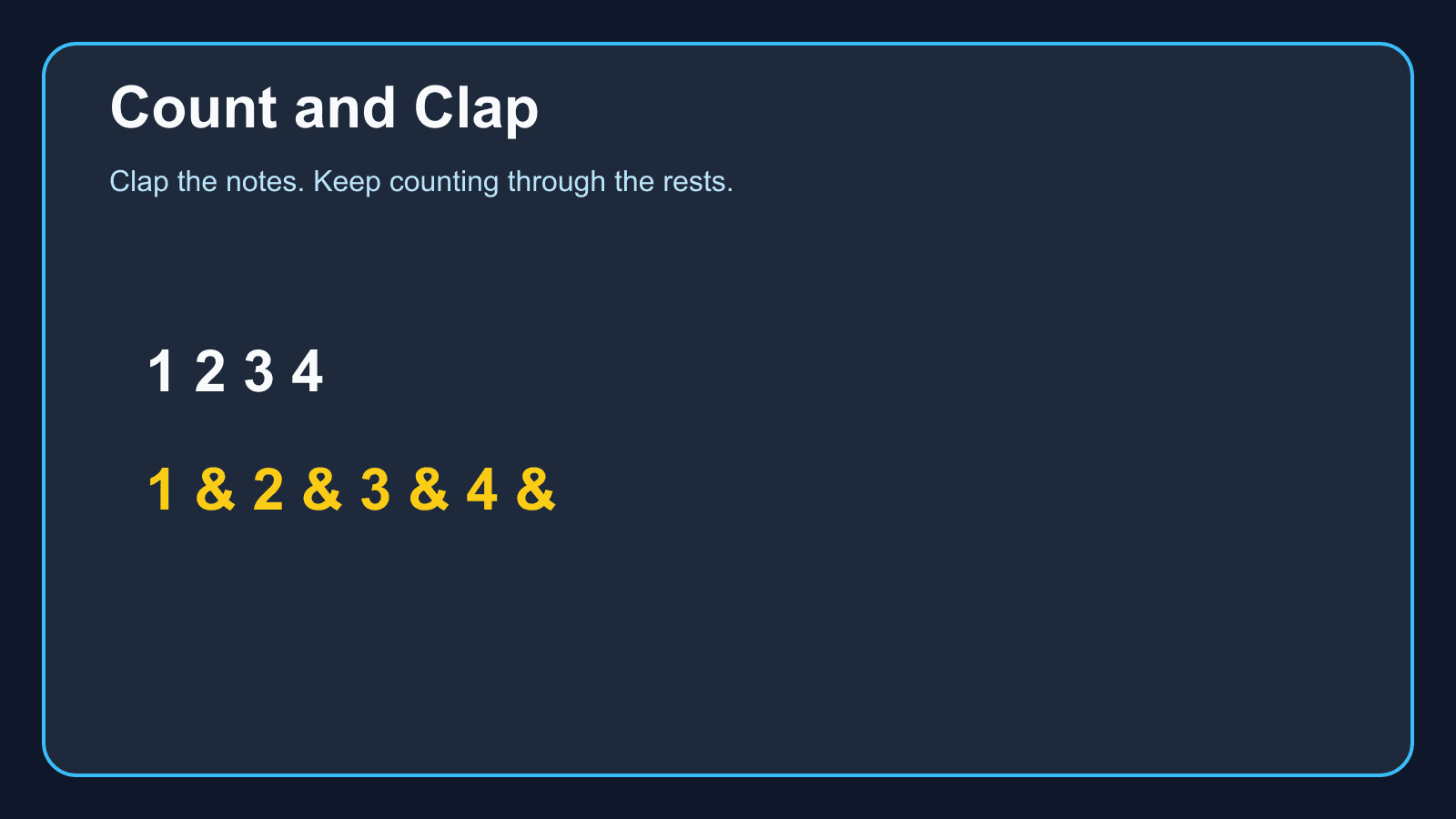
- Paired Eighth NotesEven eighth notes. Count 1 & 2 & 3 & 4 &.
- Quarters and EighthsMix a quarter note with a pair of eighths.
- Eighth RestsShort silences between eighth-note attacks.
Quarter notes: “1 2 3 4”
Count four even beats and clap on every number. That is the Quarter Notes exercise. If a clap rushes, slow the spoken count. Do not drop a number to catch up.
Half notes are “1, 3”: clap on 1 and 3, and hold through 2 and 4. A whole note is one clap on 1, held while you still say 2, 3, and 4.
Rests: say the count, skip the clap
For a bar of quarter, quarter, quarter rest, quarter, clap on 1, 2, and 4. Say 3 and keep your hands apart. The Quarter Rests exercise uses silences in that spirit: the count continues, the sound does not.
If you only clap and stop counting, the rest disappears and the next note arrives early.
Eighth notes: “1 & 2 & 3 & 4 &”
Paired eighth notes split each beat in two. Say “and” between the numbers and clap on both the number and the and. The trainer counts this as “1 & 2 & 3 & 4 &.” Keep the numbers on the same pulse you used for quarter notes.
When the clap matches the trainer in Count With Me, move the same pattern to the piano. Rhythm under chord changes is that next step.
Start practicing piano chords with Looty Chords
Begin your free trial, compare plans, or read answers to common questions about chord practice and MIDI setup.