
Chord changes feel late when your hand moves during the beat you meant to play. Give the change a counted amount of time. The rhythm is the schedule. The chord is what you play when that schedule says to play.
A counted change
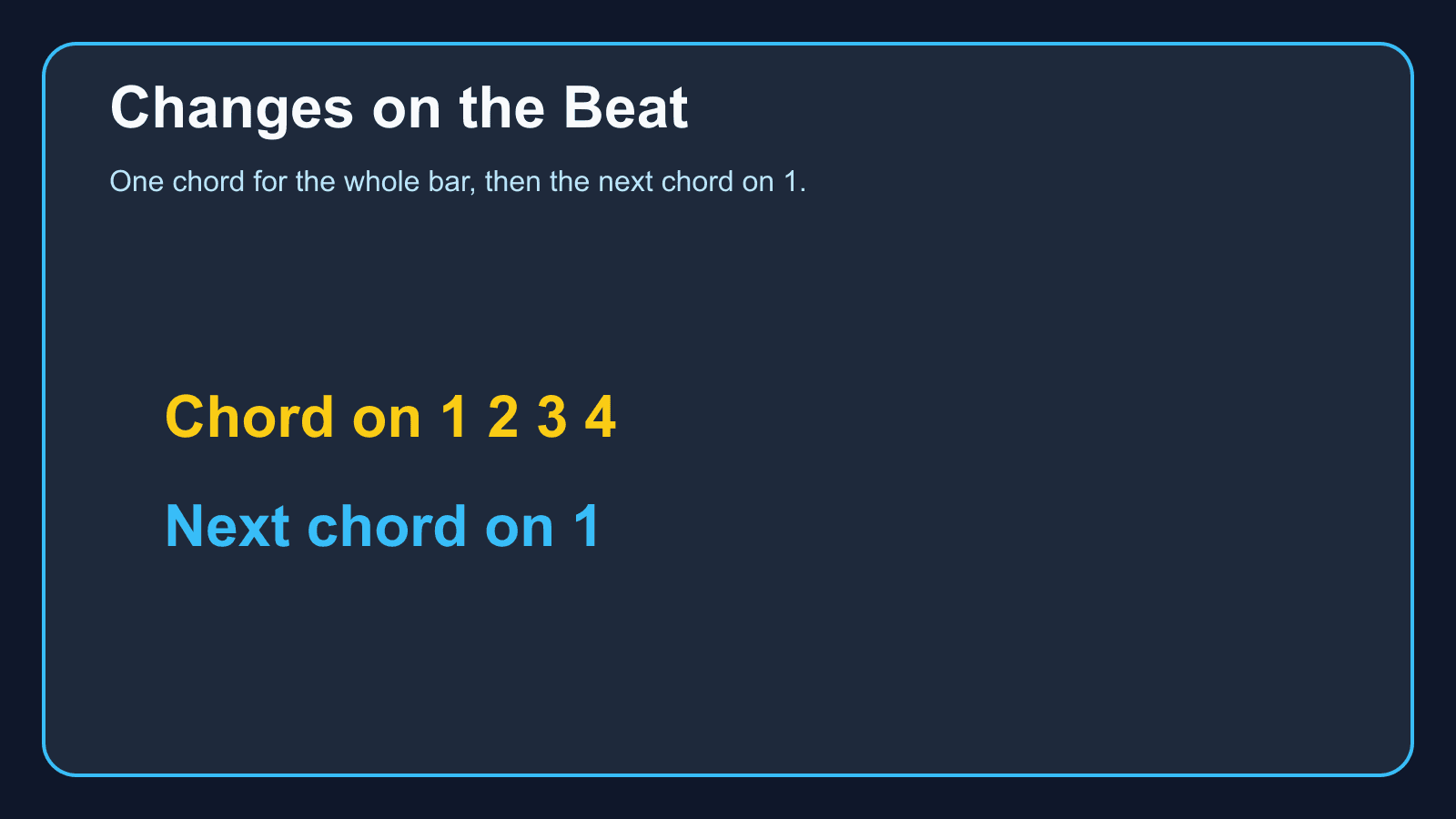
Play the first chord on beat 1 and hold it through beat 4. Play the second chord on the next beat 1.
- 1
- 2
- 3
- 4
One chord per bar of quarter notes
Pick two chords you already know, such as C and G in root position. Count “1 2 3 4.” Play C on 1 and hold it through 4. Play G on the next 1. You are not practicing a new rhythm. You are placing a chord on a beat you can already clap.
If the second chord arrives after 1, you changed too late. Slow the count. Do not shrink the pattern to hide the late change.
Then two chords in a bar
When one chord per bar is clean, play C on 1 and G on 3, holding each for two beats. That is the half-note schedule from the Rhythm Trainer, used as a chord drill. The pitches are yours. The timing is the trainer’s half-note length: two beats each.
Go Practice already moves chords on the beat after a count-in. Read How to Practice Chord Changes for the hand movement, and keep this page for the count.
What this drill does not claim
Landing on time does not by itself make the voicing smooth. An inversion may still be a shorter reach. This drill only makes the moment of the change predictable.
Use the Rhythm Trainer if you want to see the same quarter-note and half-note lengths written out. Use the metronome when you want the click without the notation.
Start practicing piano chords with Looty Chords
Begin your free trial, compare plans, or read answers to common questions about chord practice and MIDI setup.