
Every larger interval on this site is a count of half steps. Learn the two smallest moves first, on the keys you can see, before you memorize a list of interval names.
Check the smallest moves
- E to FEF
- B to CBC
- C to DCD
A half step is the next key
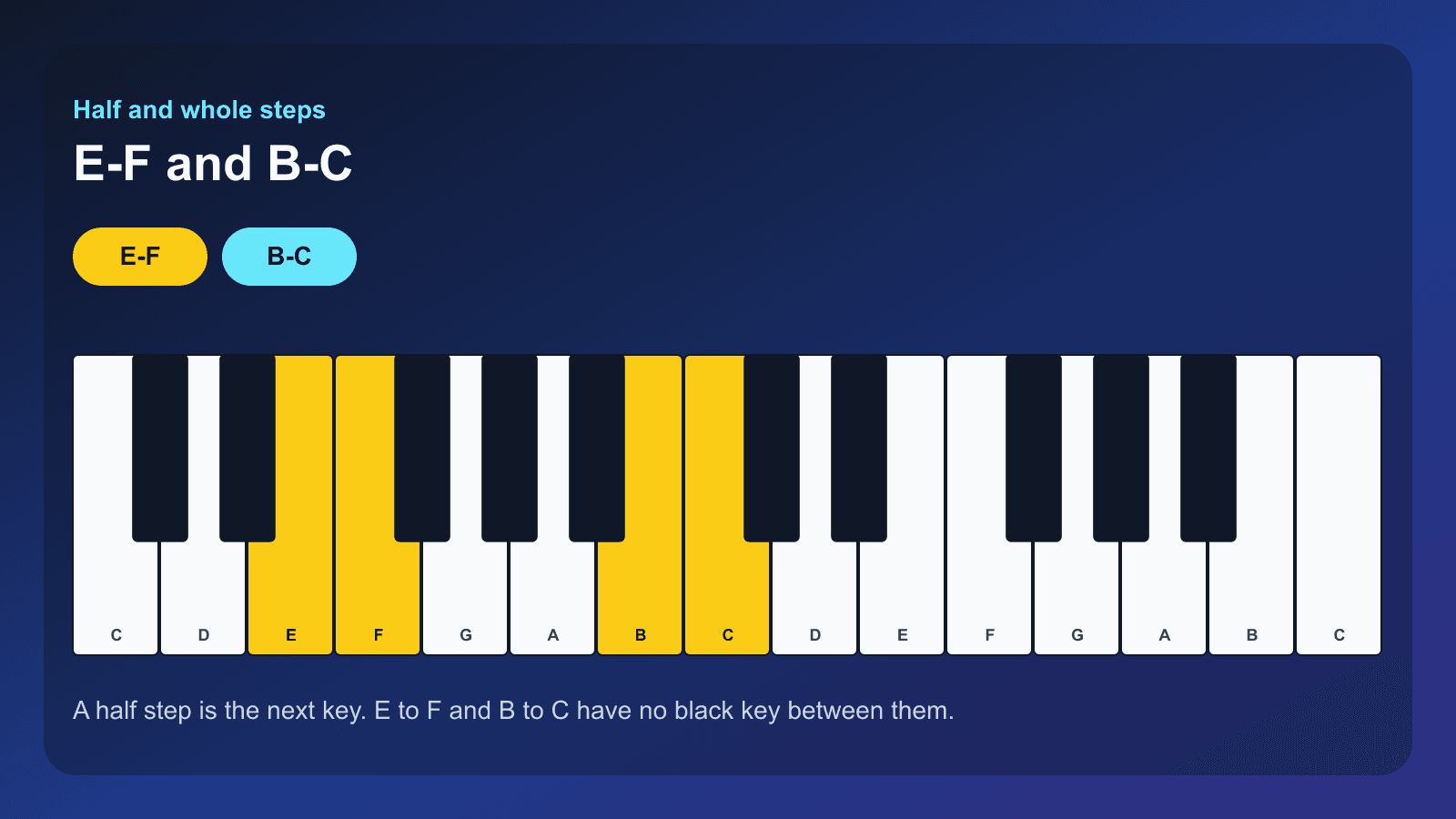
From any key, the very next key up or down is a half step. That next key may be black. E to F is a half step even though both keys are white, because no black key sits between them. B to C is the other white-key half step.
C to C♯ is also a half step. The color of the key is not the rule. The rule is that you did not skip a key.
A whole step skips one key
C to D skips C♯, so it is a whole step: two half steps. E to F♯ is a whole step as well. E to F is not, because you did not skip anything.
The demo highlights E–F and B–C. Play each pair and count one move, not two.
Scales are patterns of these two moves
A major scale is whole, whole, half, whole, whole, whole, half. A natural minor scale is whole, half, whole, whole, half, whole, whole. You do not need a different rule for each key. You start on the tonic and apply the same pattern.
Major scales and natural minor scales show the pattern with spelled notes from the scale engine.
Start practicing piano chords with Looty Chords
Begin your free trial, compare plans, or read answers to common questions about chord practice and MIDI setup.