
A good key is the one that fits the music and your current reading. The circle and the signature shortcuts help you compare options. They do not override a chord chart that already names the key.
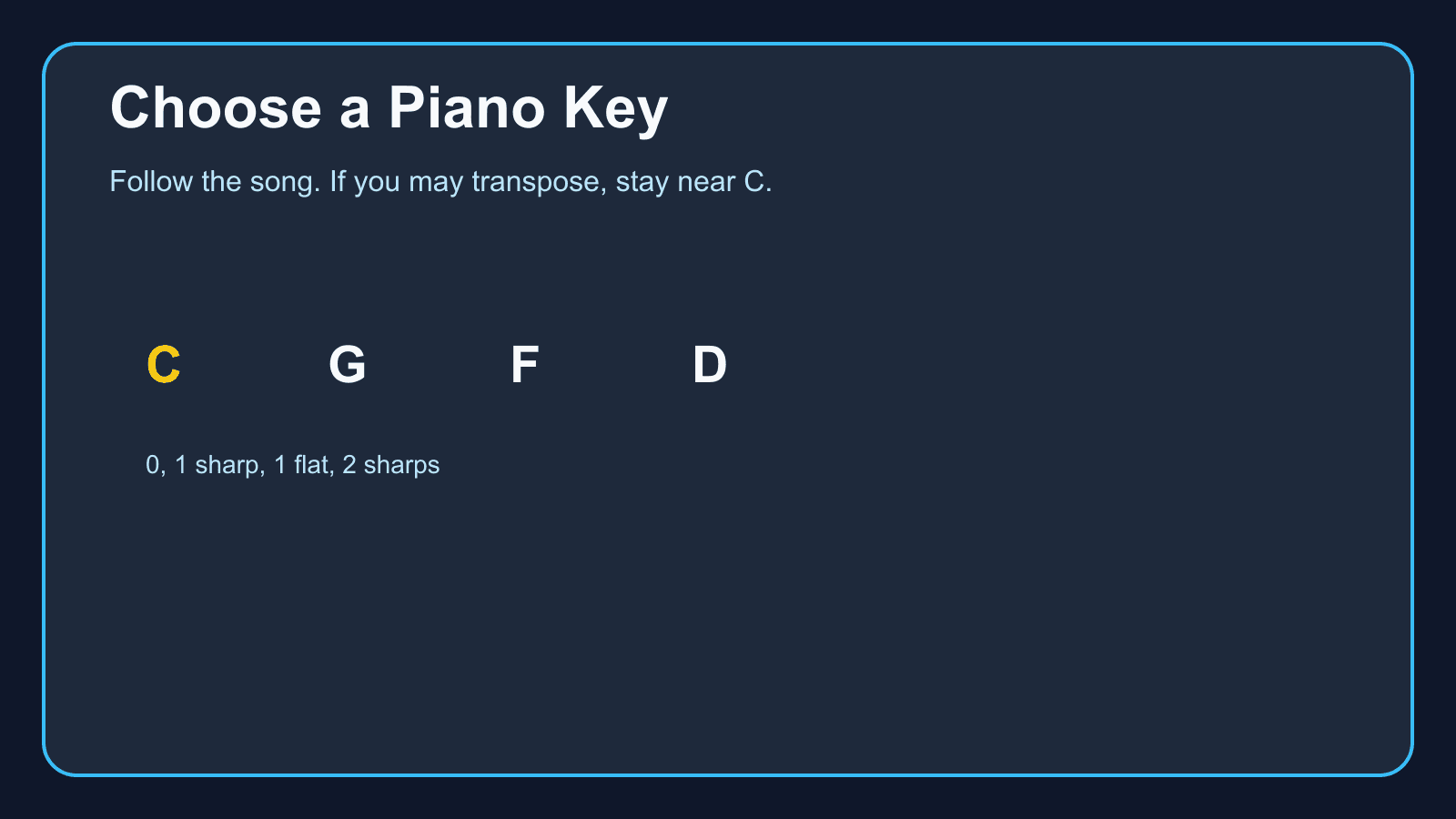
Four keys to compare
- CNo sharps or flats
- G1 sharp
- F1 flat
- D2 sharps
Follow the song when the key is already chosen
If a chart says the song is in G, practice in G. Transposing it to C changes the melody’s pitch and the chord names. Do that only when you mean to.
The chords of that key are on Learn Piano Chords by Key and on the circle tool.
Use signature size when you may choose
For your own exercises, C, G, F, and D keep the signature to two accidentals or fewer. That is a reading choice, not a musical ranking. A piece in E♭ is not worse. It is a piece with three flats.
If you are comparing those four, using the circle to choose a key shows them as neighbors of C rather than as a new theory.
Then check your hands
After the signature looks readable, play the tonic chord and the scale once. If the melody sits at the edge of your voice or your hands, a neighboring key may fit better. Move one step, not across the circle, and try again.
Go Practice can drill the chords of the key you keep. The metronome is for the tempo, not for the key choice.
Start practicing piano chords with Looty Chords
Begin your free trial, compare plans, or read answers to common questions about chord practice and MIDI setup.