
An added-tone chord keeps a complete triad and adds one extra color note. Cadd9 is C major plus D: C, E, G, D. The third stays. Nothing is suspended, and no seventh is implied.
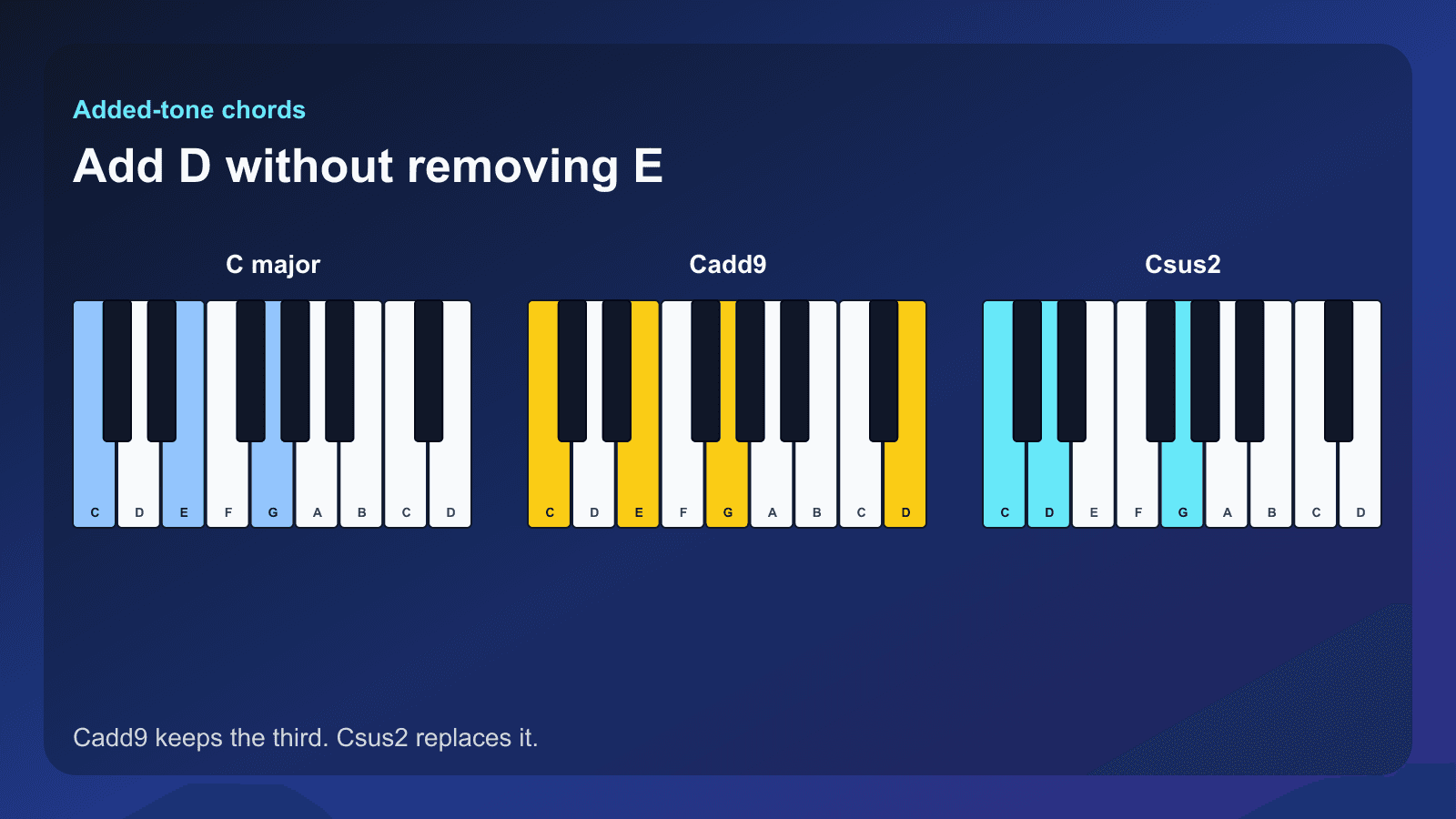
Cadd9 beside sus2 and C9
C Major: C – E – G
The plain triad.
C add9: C – E – G – D
D is added. E, the third, stays. There is no seventh.
C sus2: C – D – G
D replaces E. This is a suspension, not an added tone.
C 9: C – E – G – Bb – D
The full C9 spelling includes B-flat, the seventh.
A practical C9 voicing from the chord library uses C – E – Bb – D. The full spelling above still includes every chord tone.
Open Cadd9 in Chord Exploreradd9 is not sus2
Csus2 is C, D, G. The third is gone, and D stands in for it. Cadd9 is C, E, G, D. E is still there, and D is an extra note. If you can hear the third, you are not playing a suspension.
C9 is a different chord again. The full spelling is C, E, G, B-flat, D. It has the third, the ninth, and a flat seventh. Cadd9 stops at the triad plus D. Do not add B-flat unless the symbol says 9.
Full spelling and a practical voicing
The notes above are the full spelling from the chord reference. A pianist sometimes leaves out a tone, often the fifth, so the hand can reach the added note. That reduced shape is a voicing of the same chord. It is not a new chord and it is not a fingering.
This page does not show numbered inversion controls for added-tone chords. Compare the shapes in the demo, then open the added-tone category, Cadd9, the suspended category, the extended category, Piano Chord Voicings, and the symbols guide. Chord Finder and Chord Explorer use the same reference.
Start practicing piano chords with Looty Chords
Begin your free trial, compare plans, or read answers to common questions about chord practice and MIDI setup.