
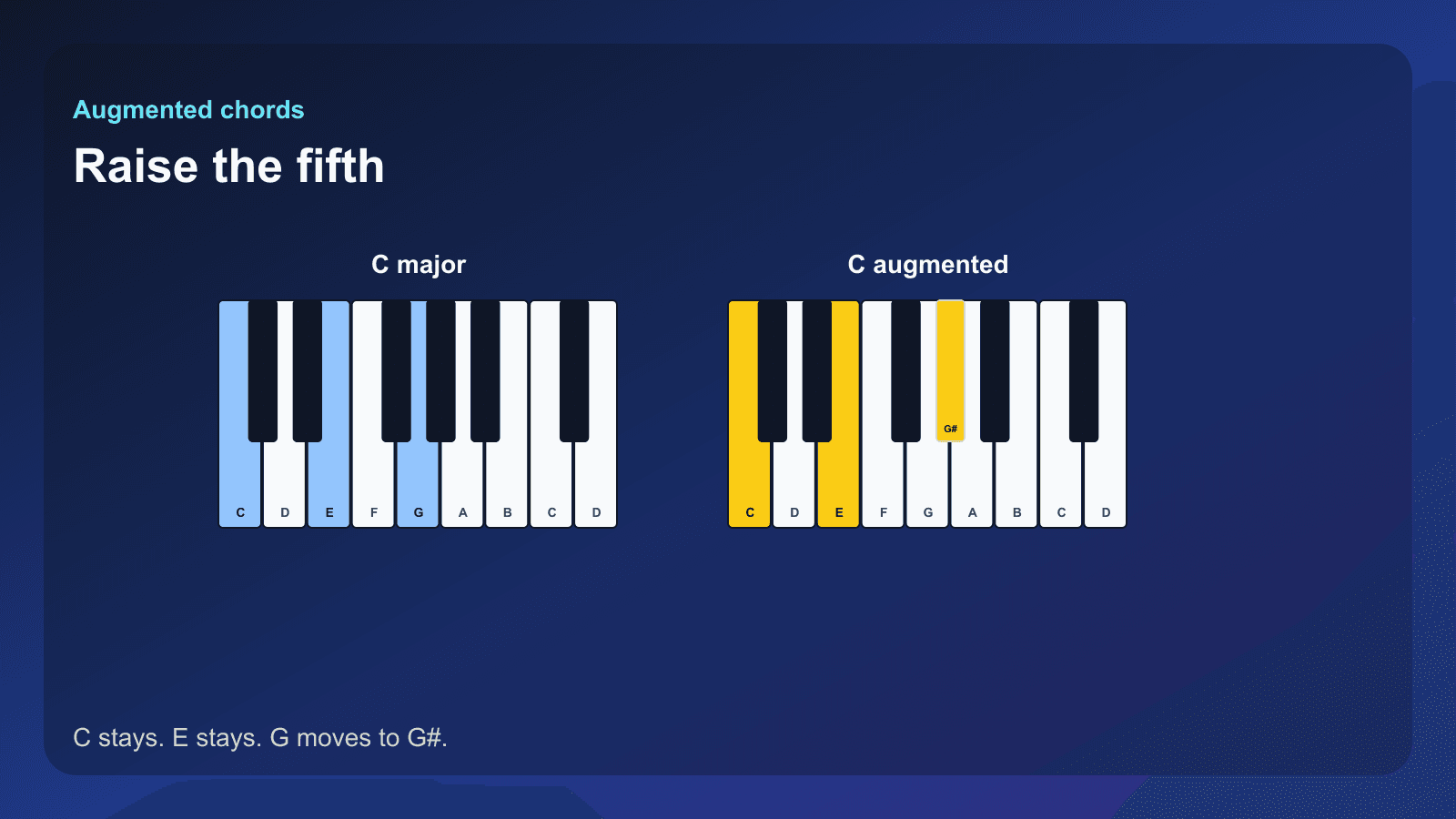
An augmented chord starts as a major triad and raises the fifth by one half step. C major is C, E, G. C augmented is C, E, G-sharp. The third stays major. Only the top note moves. That raised fifth is what the keyboard highlights.
Hear the raised fifth
C Major: C – E – G
G is the perfect fifth.
C aug: C – E – G#
G# is the raised fifth. C and E stay.
One note makes it augmented
Compare the two chords on the keyboard. C and E do not move. G becomes G-sharp. The distance from C up to G-sharp is an augmented fifth, which is why the chord has that name.
The raised fifth does not rest the way a perfect fifth does. In a progression it often steps up again, or the whole chord moves to a triad that contains the note it was leaning toward. One clear example is C augmented resolving to F major: C stays, E moves to F, and G-sharp moves to A.
The stack repeats every major third
C, E, and G-sharp are each a major third apart. Stack another major third on G-sharp and you land on C again. That even spacing is the symmetry of an augmented triad. Any of the three notes can be heard as a starting point, which is why the chord can be renamed by a different root in another context.
The chord pages do not offer numbered inversion links for augmented triads. This lesson does not pretend they do. Hear the root-position spelling here, then open C augmented, the augmented category, Chord Explorer, Chord Finder, and the symbols guide. The chord-progression lesson is the place to try the resolution inside a longer phrase.
Start practicing piano chords with Looty Chords
Begin your free trial, compare plans, or read answers to common questions about chord practice and MIDI setup.