
Playing the scale means you can name each note and land on the octave without adding a raised seventh. Speed comes after the spelling is right. This page does not print finger numbers, because a guessed fingering would be worse than none.
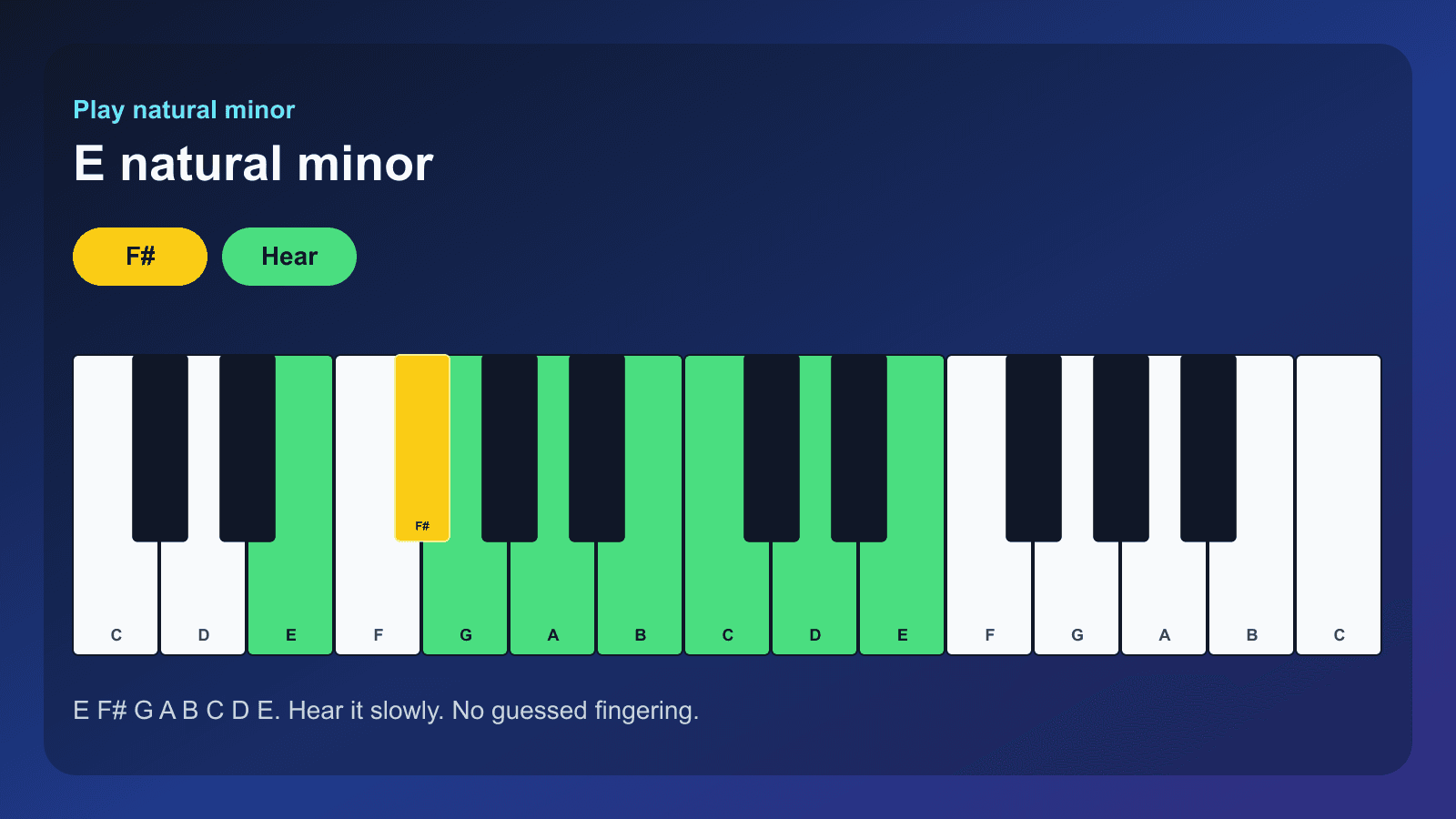
Natural minor spelling
Natural minor only. The selector does not raise the seventh degree.
A B C D E F G A
Use the selector, not a second chart
The keys are the natural minor keys the inversion tool already supports. The note names come from keyScale. A sharp or flat appears only when that spelling needs it. D♯ minor is the circle’s spelling for that minor key, not E♭ minor.
Hear Scale plays the eight notes once. Stop ends the sound. Leaving the page ends it too.
A slow way to practice one key
Pick A minor. Say the notes while you hear them: A, B, C, D, E, F, G, A. Then play only the two half steps, B–C and E–F, and name them as half steps. Then play the whole scale again.
If you raise G to G♯, you have left natural minor. That raised seventh belongs to harmonic minor. Stop and return to G natural before you call the scale finished.
Why there is no fingering diagram
Verified right-hand fingering exists for some chords. It is not published here as a scale fingering, and this lesson will not invent 1–2–3 patterns for twelve minor scales.
When the notes are secure, the seven triads are the next thing to play. The metronome can mark a slow pulse. It does not choose the fingers.
Start practicing piano chords with Looty Chords
Begin your free trial, compare plans, or read answers to common questions about chord practice and MIDI setup.