
Build a triad on each note of the natural minor scale and you get seven chords. In A natural minor the inversion model names them A minor, B diminished, C major, D minor, E minor, F major, and G major. Degree 5 is E minor, not E major.
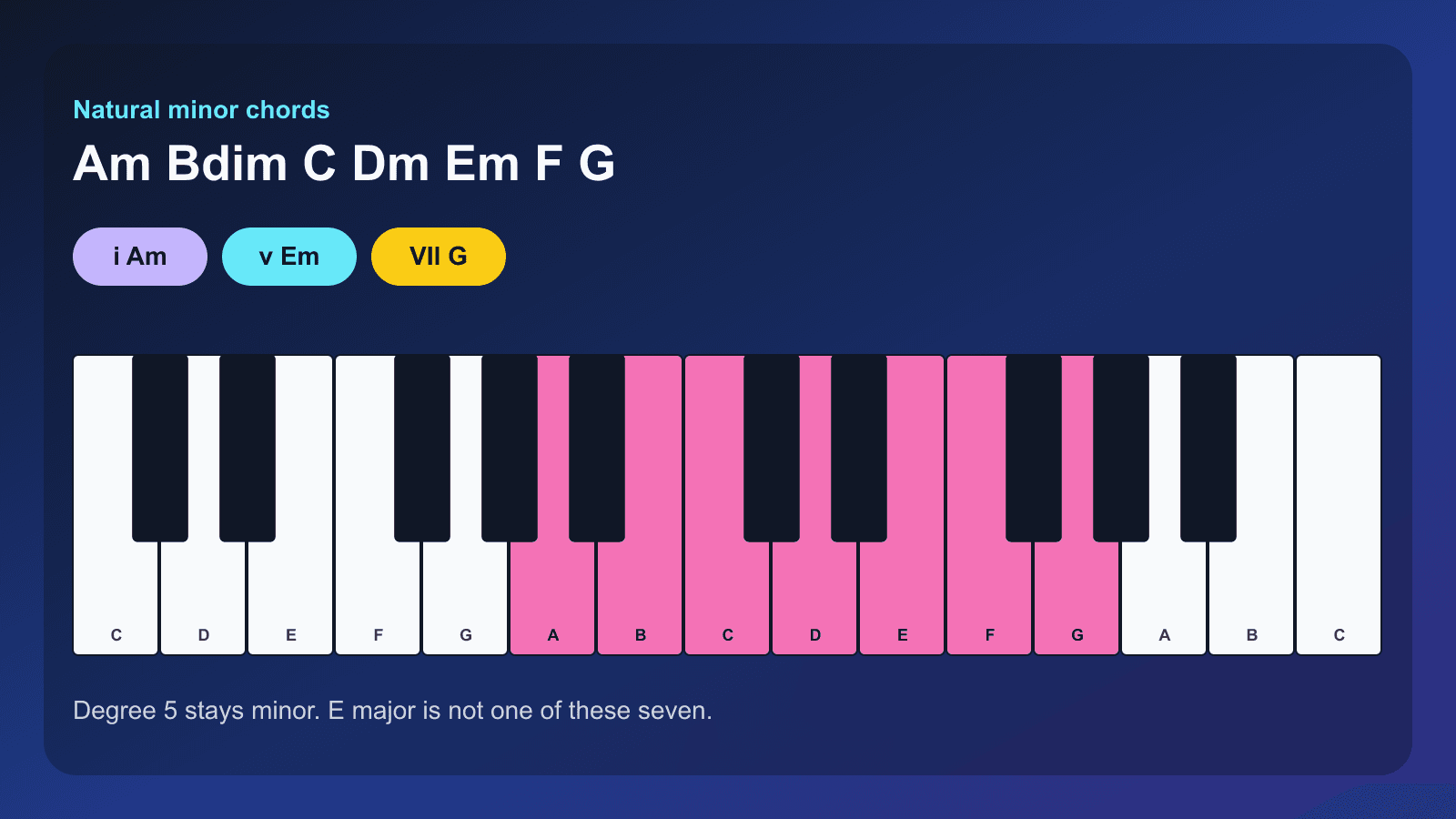
A natural minor
- iAm
- ii°B°
- IIIC
- ivDm
- vEm
- VIF
- VIIG
The natural minor numerals
The qualities are i, ii°, III, iv, v, VI, VII. Minor chords sit on degrees 1, 4, and 5. Major chords sit on degrees 3, 6, and 7. Degree 2 is diminished. The demo reads this row from the same model as the Chord Inversions tool.
Change the key in the demo and the numerals stay. The note names follow that key’s natural minor scale.
A natural minor, written out
The symbols on the demo are the model’s own: Am, B°, C, Dm, Em, F, and G. C is the relative major, degree 3. G is the major chord on the lowered seventh, degree 7. Em is the natural dominant. If a chart writes E or E7 in the key of A minor, that chord borrows the raised seventh. It is not one of these seven.
Progressions can use the borrowed dominant on purpose. This page does not relabel Em as E just because many songs do.
The same chords, moved to another bass note
Chord Inversions opens A natural minor and shows each triad in root position, first inversion, and second inversion. The quality does not change when the bass note changes. Am in first inversion is still A minor.
Major-key degrees are the parallel explanation for major. Do not mix the two numeral rows.
Start practicing piano chords with Looty Chords
Begin your free trial, compare plans, or read answers to common questions about chord practice and MIDI setup.