
Piano chords are not random clusters of keys. Each one is built from a root note and a specific pattern of intervals—the distances between notes. Once you understand that pattern, chord names start to make sense, transposing gets easier, and practice becomes more intentional. This guide walks through how chords work from the ground up.
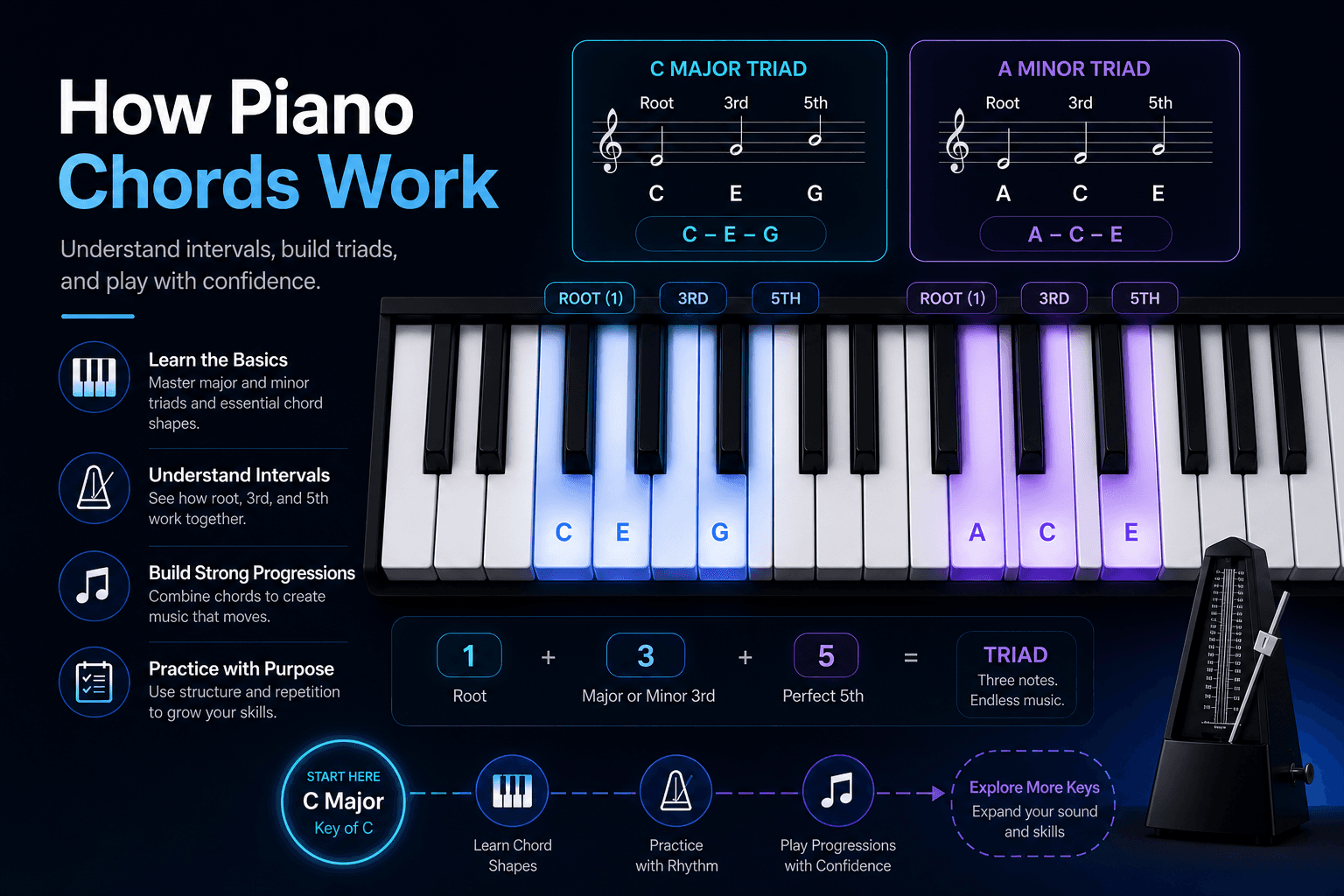
The Root Note: Where Every Chord Begins
The root is the starting note and the foundation of the chord. In C major, C is the root. In F#m7, F# is the root. The chord is named after this note, and every other tone is measured from it.
On piano, moving the root up or down the keyboard moves the entire chord. A C major triad uses C, E, and G. Move the root to G and you get G major: G, B, and D. The relationship between the notes stays the same; only the starting position changes.
Looty Chords lets you practice chords in any of the twelve root keys. The Chords in All 12 Keys guide explains why learning every key matters and how to approach them one at a time.
For a closer look at how root keys and chord types combine to change which notes you play, see Learn Piano Chords by Key.
Intervals: The Distances That Define Sound
Intervals describe how far each note sits from the root. The root is 1. A major third is 3. A minor third is b3 (flattened third). The fifth is 5. Seventh chords add 7 or b7 depending on the type.
Those numbers are not abstract—they map directly to keys on the piano. Count up from the root: for C major, C is 1, E is 3 (a major third up), and G is 5 (a perfect fifth up). Change E to Eb and C major becomes C minor.
The interactive Chords tool shows interval badges on highlighted keys so you can see how each note relates to the root. That visual link helps theory click faster than memorizing formulas alone.
Triads: The Three-Note Foundation
Most chords start as triads—three notes built from the root, a third, and a fifth. Major triads use a major third and perfect fifth (1–3–5). Minor triads lower the third (1–b3–5). Diminished triads lower both the third and fifth.
Triads are the backbone of countless songs. Even when a chord has more than three notes, it often extends a triad by adding a seventh, ninth, or other tone on top.
Learning triads in one key gives you a mental map. When you see Am on a chart, you know it is a minor triad on A. When you see F, you know it is a major triad on F. The shape follows the formula.
Chord Tones and What Each Note Does
The root anchors the chord and defines its name. The third sets the mood—major thirds sound bright, minor thirds sound darker. The fifth adds stability without changing the major/minor quality as dramatically.
Added tones like the seventh create tension or color. A dominant 7th (b7) wants to resolve. A major 7th sounds lush and jazzy. Suspended chords replace the third with a 2nd or 4th for an open, unresolved feel.
The Seventh Chords guide goes deeper on these four-note shapes. Master triads first, then sevenths become a natural next step.
How Chords Connect to Keys
A key is a family of chords built around one tonal center. In the key of C, C major is home (the I chord). G major (V) and F major (IV) are strong supporting chords. A minor (vi) and D minor (ii) add contrast.
Those Roman numerals describe function, not fixed names. In G major, the I chord is G major—not C. The relationships repeat in every key; only the note names change.
That is why learning chords in all 12 keys matters. You are learning the same relationships in twelve positions, not twelve unrelated sets of shapes.
How Chords Work in Progressions
Songs move through chord progressions—sequences that repeat through verses and choruses. A I–V–vi–IV progression in C plays C, G, Am, and F in order. The same pattern works in any key with different chord names.
Progressions matter because your hands learn transitions, not just static shapes. C to G feels different from G to Am. Practicing those pairs in time is what makes you ready for real music.
If you are new to chords entirely, start with What Are Piano Chords? for a beginner-friendly overview. Then use Practice Mode to drill changes at a comfortable tempo.
Practice the Patterns, Not Just the Names
Understanding how chords work is step one. Playing them smoothly in time is step two. Randomized practice prevents you from memorizing order instead of truly knowing each shape.
Looty Chords presents chords in random sequences with a metronome so you build reflexes for real songs. Start in one key, master the seven essential chord types there, and expand when changes feel automatic.
Use the interactive Chords tool to confirm a new shape, then head to Practice Mode to drill it. Even fifteen minutes a day builds steady progress.
Put chord theory into practice
Explore any root and chord type on the interactive keyboard, then practice changes with timing to make the patterns stick.