
Many new piano players spend months on notation before they play anything that sounds like a song. Chords offer a different path: learn a handful of shapes, connect them in time, and you are already making music. Looty Chords is built around that idea—chord-first practice that gets you playing faster and understanding more along the way.
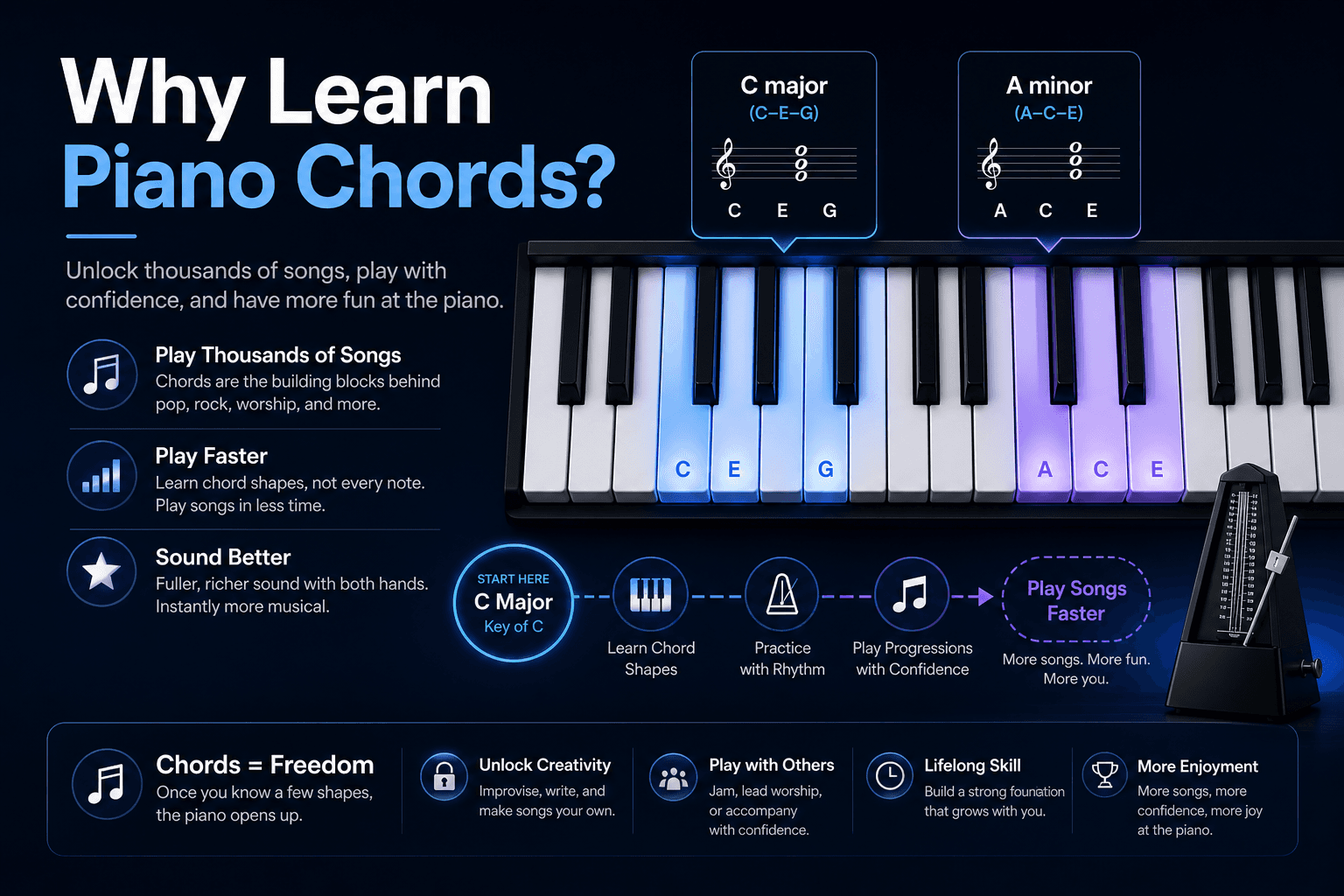
Why Piano Chords Matter
A chord is a group of notes played together. In popular music, gospel, jazz, and countless other styles, chords are the backbone of accompaniment. When you learn chords, you learn the language most songs are written in.
Chords also connect directly to what you hear. A major chord sounds bright; a minor chord sounds darker. A seventh chord adds tension. Those sounds become recognizable patterns instead of isolated notes on a staff.
For piano players especially, chords train both hands to work as a unit. Your left hand holds harmony while your right hand can add melody, fills, or rhythm. That coordination is one of the biggest leaps from beginner to confident player—and chord practice is how you build it.
Chords Help You Play Songs Faster
Most songs you want to play are built from a small set of chord shapes repeated in a pattern. Learn those shapes in one key and you can already accompany dozens of tunes. You do not need to read every note on the page to sound musical.
Chord charts—symbols like C, Am, G, and F written above lyrics—are everywhere. Once you recognize the shapes on the keyboard, you can follow along with real music almost immediately. That is a much shorter path than mastering full notation first.
Looty Chords helps you build that speed with randomized chord prompts and a metronome. You practice the exact skill songs demand: landing the right shape on the beat, every time. When you are ready, head to Practice Mode to drill changes at your own tempo.
Chords Teach You How Keys Work
A key is a family of chords built around one tonal center. In the key of C, C major feels like home. G major and F major support it. A minor and D minor add color. Learning chords in a key teaches you how those relationships sound and feel.
When you move to a new key—say, G or E flat—the chord names change but the relationships stay the same. That is why learning chords in all twelve keys matters: you are not memorizing a random collection of shapes, you are learning the same patterns in different positions.
Our Chords in All 12 Keys guide walks through a practical plan for learning every key one at a time. The interactive Chords tool lets you explore any root and chord type on a visual keyboard before you practice.
Chords Make Progressions Easier to Understand
Songs rarely stay on one chord. They move through progressions—sequences like I–V–vi–IV that repeat through verses and choruses. Once you know individual chords, progressions show you how they connect in real music.
Practicing progressions trains transitions, not just static shapes. Moving from C to G feels different from G to Am. Those pairs appear in hundreds of songs. Drilling them in time is what makes you performance-ready.
Read more in our Chord Progressions guide. When you are comfortable with basic triads, seventh chords add the color you hear in jazz, R&B, and modern pop—see our Seventh Chords guide for how those shapes work.
Chords Improve Practice Structure
Without a clear focus, practice can feel scattered. Chord practice gives you a concrete goal: play this shape, then the next one, on tempo. Randomized prompts prevent you from memorizing order instead of truly knowing each chord.
Short daily sessions beat occasional marathons. Fifteen to thirty minutes of timed chord changes builds muscle memory steadily. A metronome keeps you honest—slow and accurate beats fast and sloppy every time.
Looty Chords structures practice around seven essential chord types per key, with optional MIDI keyboard support so you train on real keys. You always know what to work on next, which makes it easier to show up and make progress.
Start Learning Chords in Every Key
You do not need all twelve keys on day one. Start in one familiar key—many beginners choose C—and master the essential shapes there. When changes feel automatic, add the next key.
Each key you learn makes more songs easier to approach. A chart in B flat uses different finger positions than the same song in C, but the chord relationships are the same. Sequential mastery across keys is how you become versatile.
Use the interactive Chords tool to explore shapes visually, then Practice Mode to drill them with timing. Our Chords in All 12 Keys guide explains the full roadmap. Looty Chords tracks your progress key by key so you always know where you stand.
Start learning piano chords today
Explore chord shapes on the interactive reference, then move into timed practice to build the speed and confidence you need for real songs.