
Struggling to move between chords smoothly? This guide explains how muscle memory works for piano players and how Looty Chords trains your hands to find every chord on time—without reading notation note by note.
What Is Piano Chord Muscle Memory?
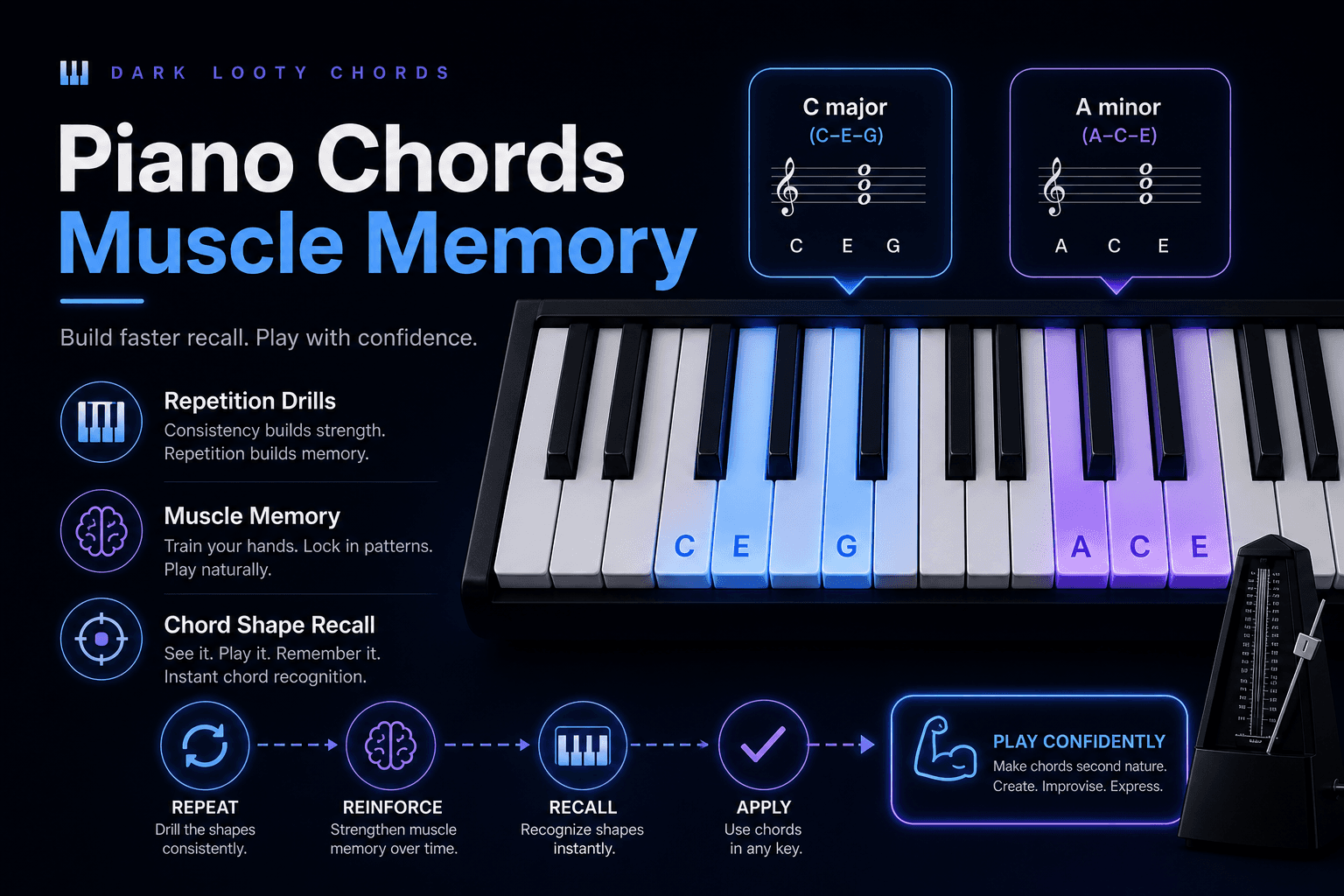
Piano chord muscle memory is the ability to form the right chord shape and move to the next chord without stopping to think. Your fingers recognize the pattern physically—not just visually on a chart.
That matters because songs move quickly. If you hunt for each chord, the music passes you by. Muscle memory lets you keep tempo, follow a singer, and enjoy playing instead of surviving each measure.
Looty Chords is built around this idea: repeated, timed, randomized chord practice until changes feel automatic.
For broader memorization techniques beyond repetition alone—patterns, visual recognition, and timing—see How to Memorize Piano Chords.
Why Repetition Builds Lasting Chord Memory
Your brain and hands learn through consistent reps. Seeing a C major chord once does not store it. Playing it dozens of times across short sessions does.
Looty Chords encourages focused daily practice—often 15 to 30 minutes—so each chord shape gets enough repetitions to stick. Short, regular sessions beat rare marathon practices for motor learning.
The goal is not mindless drilling. It is deliberate repetition with feedback: did you land the shape cleanly, on time, and without hesitation? That loop is what turns knowledge into reflex.
Random Chord Practice vs. Predictable Patterns
Practicing chords in the same order every time trains your sequence memory, not each individual chord. You remember what comes after G major because it always follows C major—not because your hand truly knows G major in isolation.
Looty Chords shuffles chords randomly within your chosen key. Your fingers must build each shape on demand, the same way a real song asks for unexpected changes.
Random practice is harder at first—and more effective. It is the fastest path to chord muscle memory that holds up when you play actual music.
Timing and the Metronome
Muscle memory for chords includes when to change, not only which shape to play. A chord played late breaks the groove as much as a wrong note.
Looty Chords pairs each practice session with a metronome so you learn to land chords on the beat. Over time, your changes align with tempo naturally—you feel the pulse instead of counting every switch.
Timing practice also exposes weak chords. If one change always lags, you know exactly where to spend your next reps.
MIDI Keyboard Training for Real Muscle Memory
Muscle memory should develop on the instrument you play. Looty Chords supports USB MIDI keyboards so you practice on your piano or digital keyboard, not only on a screen.
Physical key resistance, key width, and your seated posture all affect how reflexes form. MIDI practice connects on-screen chord prompts to real finger movement on real keys.
If your keyboard appears as a MIDI device in Chrome, you can plug in and practice chords, inversions, and progressions in real time while Looty Chords guides the session.
How Looty Chords Trains Chord Muscle Memory
Together, repetition, random sequences, metronome timing, and optional MIDI input form a complete muscle-memory system:
- Pick a key and practice the seven essential chords for that key.
- Follow randomized prompts so every chord shape is learned independently.
- Stay in time with the built-in metronome.
- Track sessions and build consistency across days and weeks.
- Move to new keys only after the current key feels automatic.
Most learners notice smoother chord changes within two to three weeks of steady practice in one key. From there, you can expand to all twelve keys and play songs in any key you choose.
Build chord muscle memory through practice
Confirm chord shapes on the interactive keyboard, then drill randomized changes in Practice Mode until they feel automatic.