
Players often ask how to memorize piano chords when charts feel overwhelming. The answer is not reading more diagrams—it is practicing the right way until your hands remember shapes on their own. Memorization combines visual recognition, pattern understanding, and motor repetition in a consistent routine.
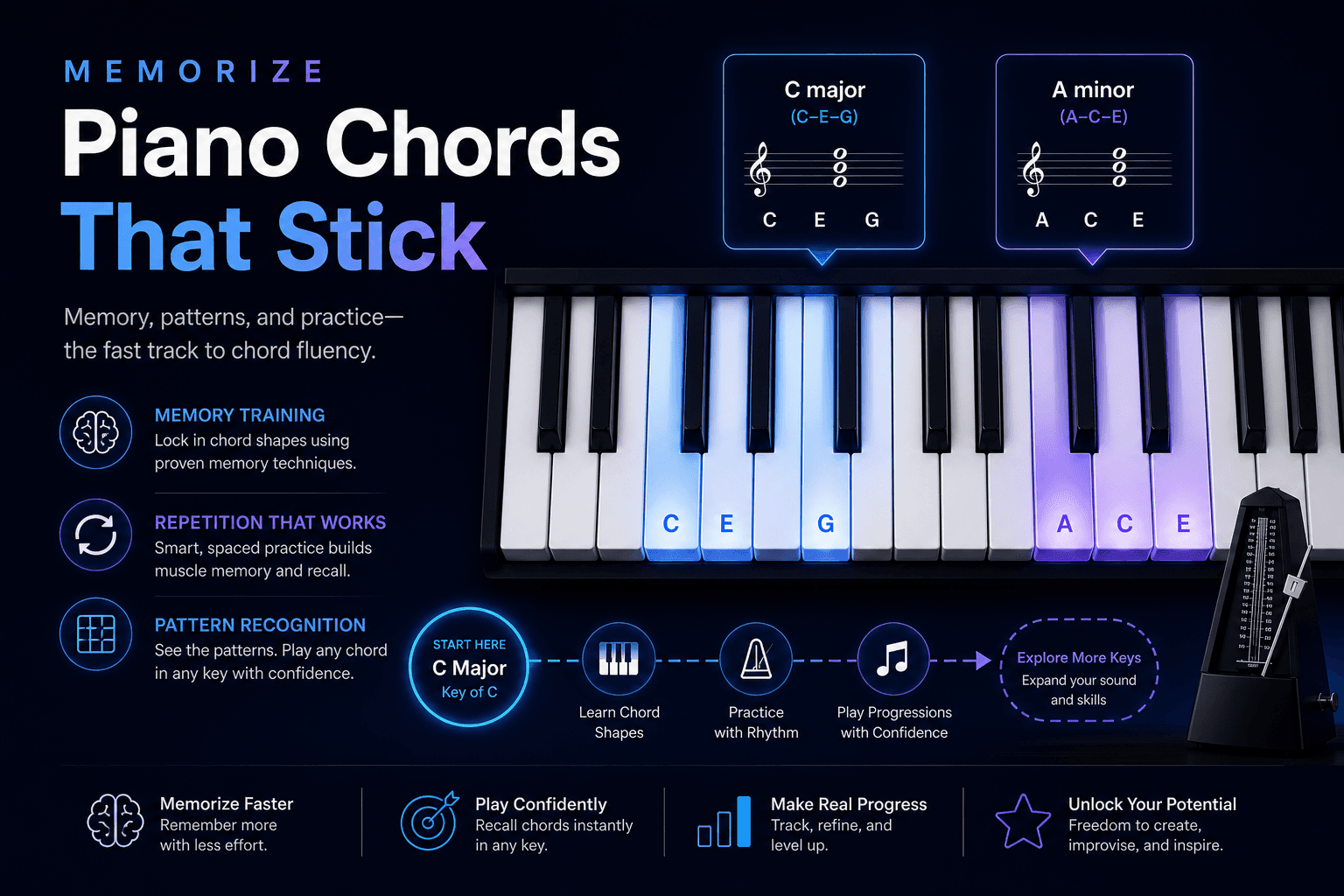
Memorization vs. Reading Charts
Reading a chord chart while you play is valid, but it is not the same as memorization. Memorized chords live in motor memory—you form the shape without translating symbols in real time.
Looty Chords trains that motor layer by showing a chord, hearing the beat, and requiring you to play before the next prompt appears.
You still see names and diagrams during practice; over time you need less mental translation because your fingers already know the shape.
For a deeper look at how that motor-memory training works session to session, see Piano Chord Muscle Memory Training.
Use Patterns and Keys to Reduce What You Memorize
Chords follow formulas. A major triad is always root, major third, fifth. A minor triad lowers the third. Once you know the pattern, you are not memorizing eighty-four unrelated shapes—you are applying the same formula in different positions.
Learning one key deeply teaches the relationships. When you move to the next key, the chord types stay the same; only the root positions change.
Our Chords in All 12 Keys guide explains how to work through keys systematically. Start with Piano Chords for Beginners if the basics are still new.
Build Visual Recognition Before Speed
See the chord name, picture the shape, then play it. That sequence—symbol to visual to fingers—becomes faster with repetition until the middle step disappears.
Use the interactive Chords tool to strengthen visual recognition. Highlighted keys and interval labels connect the symbol on the page to the shape on the keyboard.
Say chord names aloud during practice. Connecting the spoken name to the hand shape reinforces memory from multiple angles—not just muscle alone.
Repetition Habits That Build Lasting Memory
- Practice daily in short sessions instead of weekly marathons.
- Randomize chord order so each shape is learned independently.
- Use a metronome every session—even at slow tempos.
- Stay in one key until changes feel automatic before adding keys.
- Review weak chords by noticing which prompts slow you down.
A structured Piano Chord Practice Routine keeps repetition focused instead of scattered.
Why Timed Practice Locks Memory In
Untimed practice lets you pause and think. Songs do not wait. Timed drills with a metronome force your brain to retrieve shapes under mild pressure—the same condition you will face when playing real music.
Start slow enough to succeed. Memory forms more reliably when repetitions are clean than when they are rushed and sloppy.
Open Practice Mode for randomized timed drills. For a quick daily plan, try the 15-Minute Piano Chord Practice Routine.
Memorize Transitions, Not Just Static Shapes
Knowing a chord in isolation is different from moving to it from another chord. Songs require transitions—C to G, G to Am, Am to F. Pair practice cements the paths between shapes.
When a transition trips you, loop that pair slowly until it feels automatic. That targeted repetition builds memory where it matters most.
See How to Practice Chord Changes and How to Switch Piano Chords Faster for transition-focused techniques.
What Progress Usually Looks Like
Within the first week you may still think about finger placement for every chord—that is normal.
By two to three weeks of consistent practice in one key, many Looty Chords users report smoother changes and less conscious effort.
Memorizing all twelve keys is a longer journey, but the process repeats: one key, random drills, timing, then the next key.
When progressions appear in your music, the Chord Progressions guide helps you memorize changes in realistic song-like sequences.
Memorize chords through structured practice
Explore chords visually with the interactive Chords tool, then build speed and accuracy in Practice Mode.