
Knowing chord names is only half the skill. The other half is playing them cleanly, on time, and without hesitation. Whether you are a beginner learning your first key or expanding into new tonal centers, how you practice matters as much as what you practice. This guide covers the habits that turn chord knowledge into real playing ability.
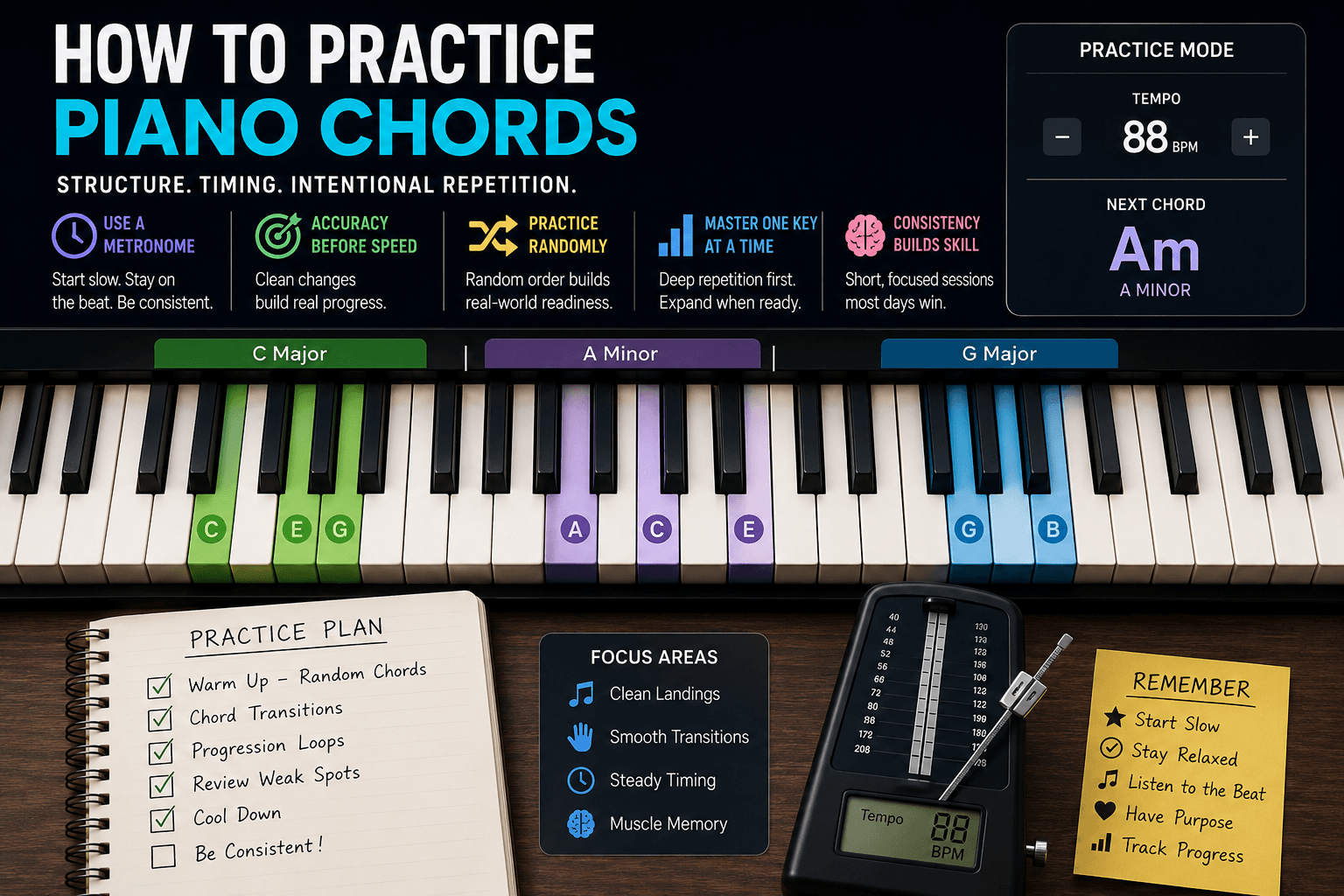
Structure Beats Raw Volume
Thirty unfocused minutes rarely beats fifteen focused ones. Chord practice works best when you have a clear goal for each session: drill random shapes, work on transitions, or loop a progression at a steady tempo.
Looty Chords removes guesswork by prompting chords in random order with a built-in metronome. You are not deciding what to play next—you are responding to the prompt and landing the shape on the beat.
If you are new to chords, start with Piano Chords for Beginners for a foundation before diving into practice technique.
Practice With a Metronome Every Session
Timing is not optional in real music. Songs move at a steady tempo, and chord changes must land on the beat—not sometime after it. A metronome trains that habit from day one.
Start slower than you think you need. If you miss beats or fumble finger placement, the tempo is too fast. Drop five to ten BPM, rebuild clean changes, then creep back up.
The metronome also reveals which chords slow you down. Those are the shapes worth extra attention—not the ones you already play effortlessly.
Accuracy Before Speed
Fast sloppy changes create bad habits that are hard to undo. Every practice session should prioritize clean landings: all notes sounding, correct fingers on correct keys, change completed before the next beat.
Speed comes naturally when accuracy is solid. Players who rush early often plateau because their hands learned imprecise paths. Slow practice with full attention builds precise motor memory.
For dedicated transition work, see How to Practice Chord Changes and How to Switch Piano Chords Faster.
Use Random Repetition, Not Fixed Order
Drilling chords alphabetically—C, then D, then E—teaches sequence memory. Songs do not play chords in alphabetical order. Random prompts force each shape to stand on its own.
Looty Chords randomizes chord order in every session so you cannot predict the next prompt. That mirrors real playing, where any chord symbol can appear at any moment.
Repetition still matters—just not in a predictable pattern. The same chord will appear multiple times across a session, giving your fingers enough reps without letting order do the work for you.
Master One Key Before Adding Another
Spreading practice across twelve keys at once dilutes progress. Your hands need deep repetition in one tonal center before shapes transfer reliably to the next.
In each key, Looty Chords covers seven essential chord types—the shapes that appear most often in popular music. Finish those in one key before unlocking the next.
Our Chords in All 12 Keys guide explains the full roadmap for expanding key by key.
Combine Visual Reference With Active Playing
Looking at chord diagrams helps you learn a shape. Playing it on the keys is what builds memory. The best practice combines both: confirm the shape visually, then play it without staring at your hands.
Use the interactive Chords tool to explore unfamiliar shapes before drilling them. Note names, intervals, and highlighted keys make theory concrete.
Over time, you will need the diagram less. Your fingers will form the shape before your brain finishes reading the symbol—that is the goal of structured repetition.
Build Daily Habits That Stick
Consistency beats intensity. Fifteen minutes most days of the week outperforms two-hour sessions once a week. Chord memory is motor learning—it needs regular reinforcement.
Pick a fixed time if that helps: morning before work, lunch break, or evening after dinner. Link practice to an existing habit so it becomes automatic.
Open Practice Mode and set a tempo you can hold cleanly. When progressions appear in your music, the Chord Progressions guide shows how to practice realistic song-like movement.
Put structured practice to work
Explore chords visually with the interactive Chords tool, then build speed and accuracy in Practice Mode.