
Once you know a few individual chord shapes, the next step is learning how they connect in songs. A piano chord progression is a repeating sequence of chords—the harmonic backbone of verses, choruses, and bridges. Beginners who practice progressions early play music that sounds complete instead of isolated chords with gaps between them.
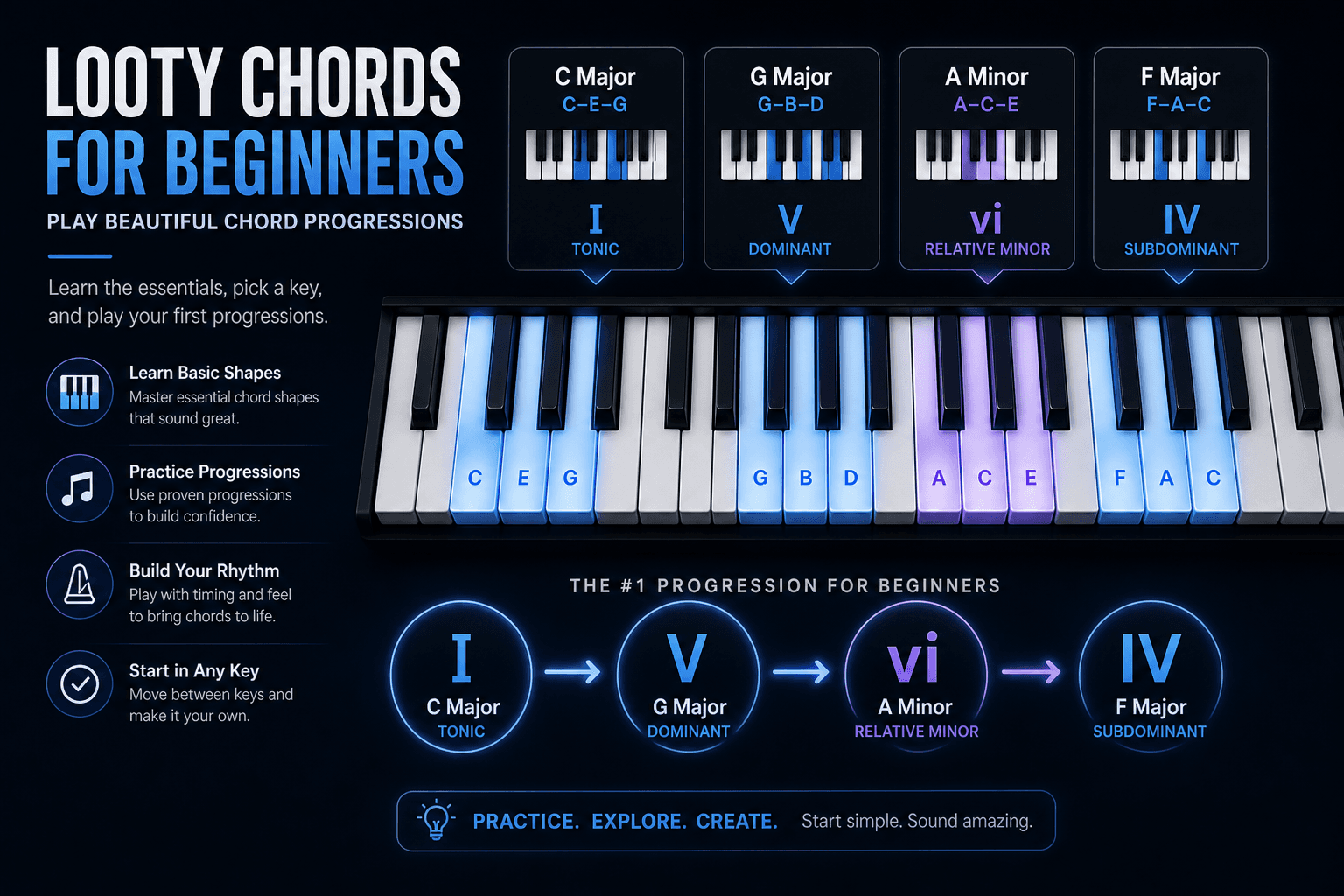
What Is a Chord Progression?
A chord progression is an ordered list of chords that loops through a section of music. In the key of C, a common four-chord progression might play C major, G major, A minor, and F major in sequence—then repeat.
Progressions are often described with Roman numerals: I, IV, V, vi. Those numbers tell you the chord's role in the key, not just its name. The same pattern works in any key with different chord names.
Hundreds of popular songs share a small set of familiar progressions. Learning those patterns once unlocks a large catalog of music you can accompany.
Common Progressions Beginners Should Know
The I–V–vi–IV progression appears in countless pop songs. In C, that is C–G–Am–F. In G, it is G–D–Em–C. The pattern feels the same even when the chord names change.
The I–IV–V progression is another staple—C–F–G in the key of C. It is simpler and appears in folk, gospel, and early rock.
The ii–V–I progression is central to jazz but worth knowing early: in C, that is Dm–G–C. It trains your ear for chords that pull toward home.
You do not need to memorize every progression at once. Start with one loop in your practice key and play it until changes feel smooth.
How Chords Move Through a Song
Songs usually stay on each chord for one to four beats before moving to the next. Your job as an accompanist is to land the new shape on time—not early, not late.
Verses and choruses often share the same progression with different lyrics. Bridges sometimes introduce a new sequence for contrast before returning to the main loop.
Listening while following a chord chart trains your ear. Play along with a recording at slow tempo and notice when the harmony shifts—that timing sense is as important as finger placement.
Practice Progressions With Better Timing
Start slower than the song's actual tempo. Loop the same four chords until every change lands on the beat. Speed comes after accuracy, not before.
Use a metronome for every progression session. Count beats per chord aloud if that helps—"one, two, three, four, change"—until the rhythm feels internal.
For general practice habits, see How to Practice Piano Chords. For stubborn transitions within a progression, read How to Practice Chord Changes.
When to Move From Single Chords to Progressions
Master individual chord shapes in one key first. If you still pause to find each note, adding progression speed will frustrate you. Random single-chord drills build that foundation.
When you can land most shapes in your key without staring at the keyboard, add a simple four-chord loop. That is the moment progressions become productive—not before.
Looty Chords supports progression practice after you are comfortable with essential chords in a key. The full Chord Progressions guide covers more patterns and practice strategies.
Progressions in Different Keys
The same progression uses different chord names in each key. I–V–vi–IV in G is G–D–Em–C. The finger positions change, but the relationships and the feel of the loop stay the same.
Learn a progression in one comfortable key before transposing. Once the pattern is in your hands, moving it to a new key is mostly about learning new shapes—not relearning the concept.
Our Chords in All 12 Keys guide and How to Learn Piano Chords in Every Key explain how to expand without feeling overwhelmed.
Put Progressions Into Daily Practice
End each practice session with one musical loop—a progression played through at a tempo that feels good. It connects isolated drills to real music and builds confidence.
Use the interactive Chords tool to confirm any unfamiliar shape in the progression, then open Practice Mode to drill changes with timing.
For the bigger picture on playing real music, read How Piano Chords Help You Play Songs.
Practice beginner progressions today
Explore chords visually with the interactive Chords tool, then build speed and accuracy in Practice Mode.