
The circle of fifths is a map of keys, not a list of songs. It puts the 12 major keys in one order so you can see which keys sit next to each other and which minor key shares a signature with each major key.
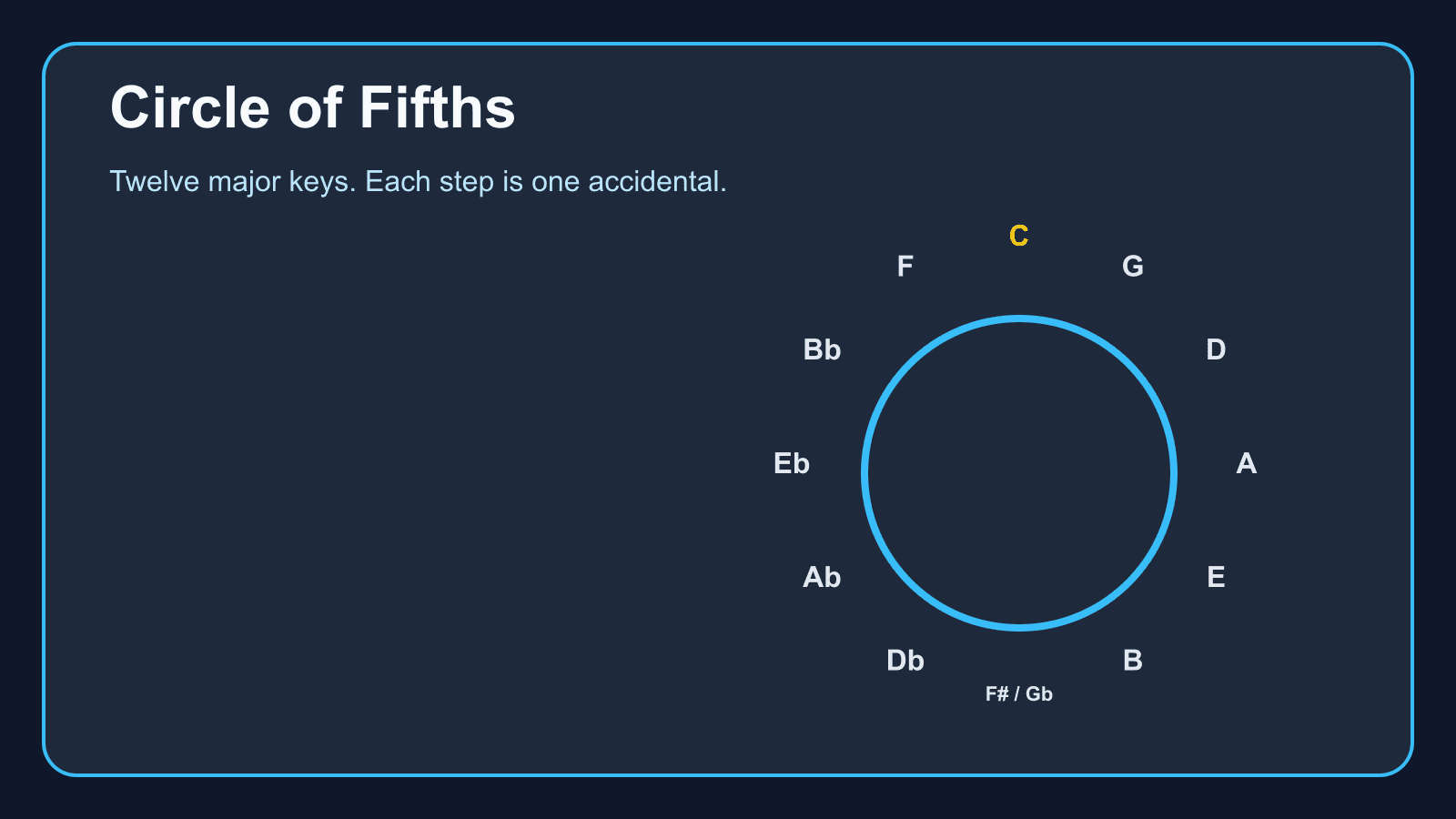
The 12 major keys
Select a key. The signature count comes from that key’s place on the circle.
C: No sharps or flats.
The order around the circle
Clockwise from C the major keys are G, D, A, E, B, then F♯ / G♭, then D♭, A♭, E♭, B♭, and F, back to C. Each clockwise step is up a perfect fifth. Each step the other way is up a perfect fourth, which is the same as down a fifth.
C sits at the top because its major scale uses no sharps or flats. One step clockwise, G has one sharp. One step the other way, F has one flat. The opposite side of the circle is F♯ / G♭, which can be written with six sharps or six flats.
Each major key has a relative minor
The relative minor uses the same key signature as its major partner. C major pairs with A minor. G major pairs with E minor. F major pairs with D minor. On the Looty Chords circle, that minor name is shown with the major key.
Related keys explains how to find the neighbors and the relative minor without memorizing a second chart.
What the circle is for
Players use it to pick a nearby key, to see how many sharps or flats a key uses, and to find chords that belong together. It does not tell you which inversion to play, and it does not replace listening.
The wheel on this page is the same circle as the Circle of Fifths tool. Open the tool when you want the chords of the key you select.
Start practicing piano chords with Looty Chords
Begin your free trial, compare plans, or read answers to common questions about chord practice and MIDI setup.