
Once you can find a key on the circle, the next skill is naming the keys that sit closest to it. Those are the keys composers and songwriters move toward when they want a change that still sounds connected.
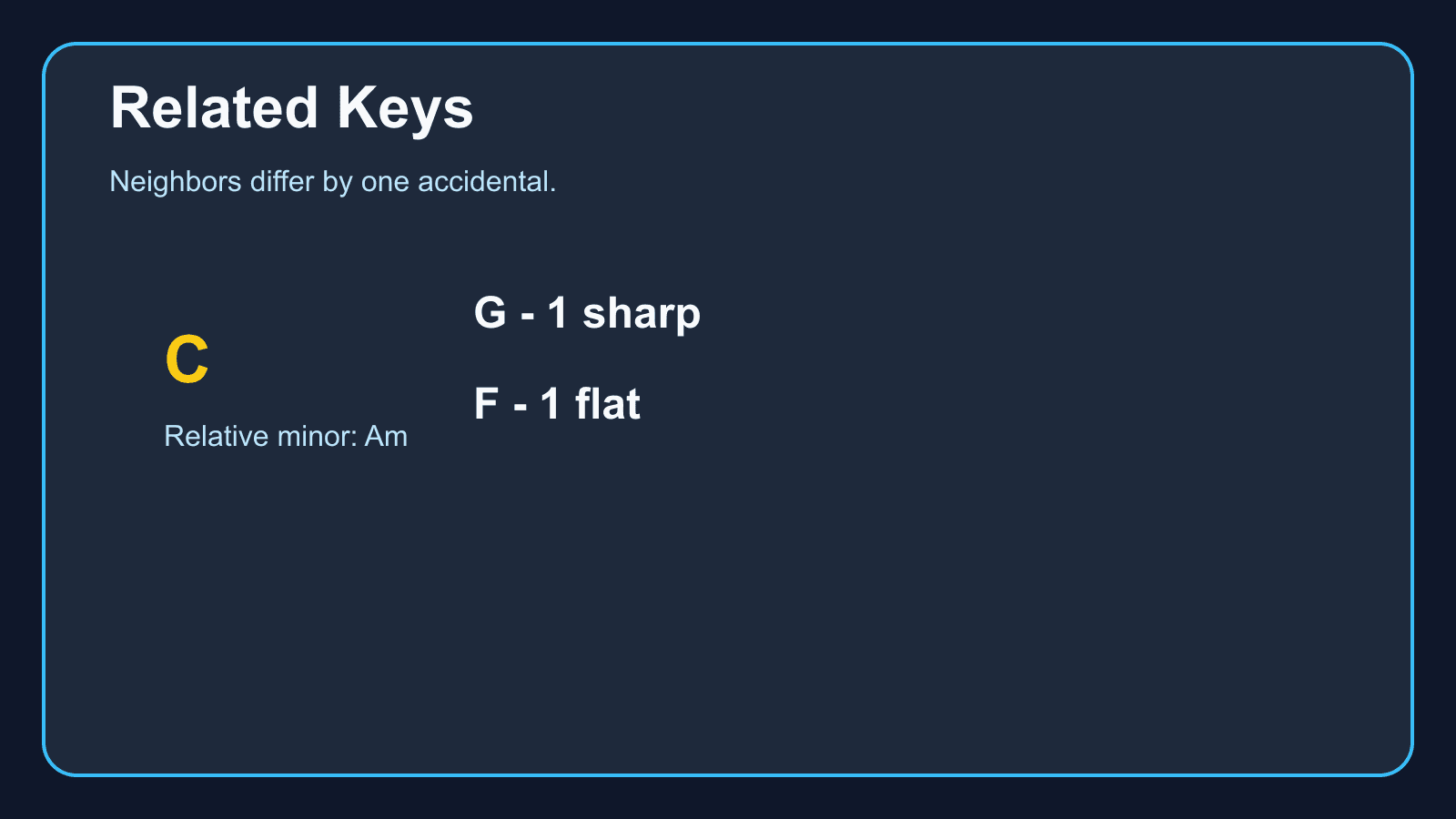
Neighbors of the key you select
The keys one step away are the neighboring major keys. The signature changes by one accidental.
C: No sharps or flats.
The two neighboring major keys
For any major key, look one step clockwise and one step counter-clockwise. From C, those neighbors are G and F. From G, they are D and C. Each neighbor’s signature differs by one accidental.
A neighbor is not the same key. G major and C major share many notes, and G major’s signature adds F♯. The circle shows that difference as a single step.
The relative minor
The relative minor is the minor key with the same signature, not the minor key a step away on the major circle. C major’s relative minor is A minor. G major’s is E minor. F major’s is D minor. Both keys use the same sharps or flats. Their home notes are different.
Moving to the relative minor changes the mood more than it changes the signature. You are not adding an accidental. You are treating a different note as home.
Check the relationship on the tool
Select a major key on the Circle of Fifths. Name the key on each side, then name the relative minor printed with it. If you can do that for C, G, and F, you can do it for the rest of the circle by the same rule.
Key-signature reading is a separate lesson: What Is a Key Signature?
Start practicing piano chords with Looty Chords
Begin your free trial, compare plans, or read answers to common questions about chord practice and MIDI setup.