
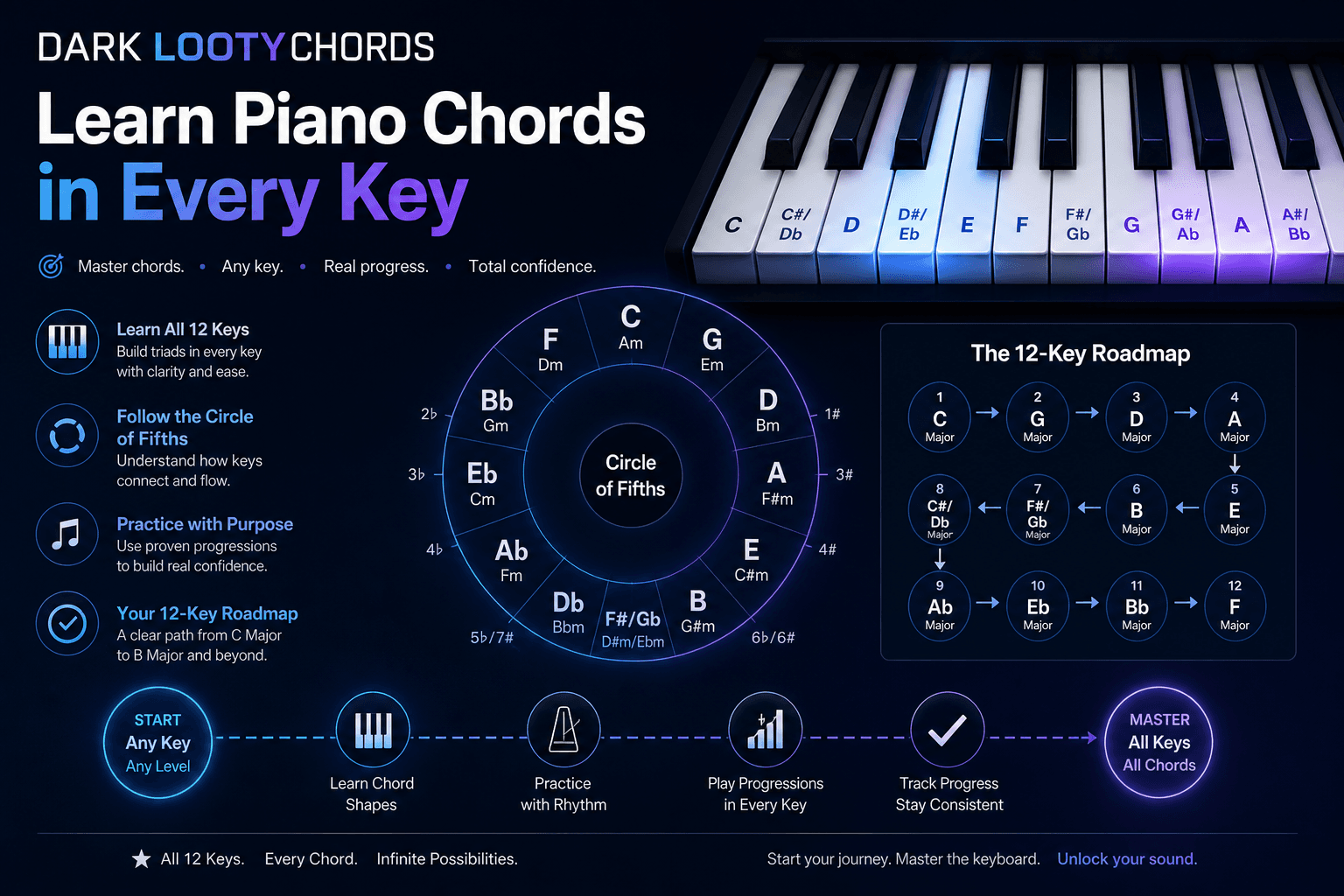
Learning piano chords in every key is one of the most valuable skills you can build. It means you can play any song in any tonal center—not just the one or two keys that feel comfortable. The challenge is scope: twelve keys times seven essential chord types is a lot of ground. The solution is not to learn everything at once—it is to follow a roadmap that keeps progress steady and manageable.
Why Every Key Matters
Songs are written in different keys. A chart in E flat uses different shapes than the same song in C. If you only know one key, you are limited to music written in that tonal center—or dependent on transposing charts for you.
Learning all twelve keys also deepens your understanding of how music works. The relationships between chords stay the same; only the note names and finger positions change. That pattern recognition makes each new key faster than the last.
Looty Chords organizes practice around all twelve keys so you can expand systematically—not randomly—when you are ready.
The One-Key-at-a-Time Rule
The single most important principle: finish one key before starting the next. Spreading attention across multiple keys dilutes muscle memory. Your fingers need deep repetition in one tonal center before shapes transfer reliably.
In each key, practice seven essential chord types—the shapes that appear most often in popular music. When those changes feel automatic, unlock the next key and repeat the same process.
Most learners spend two to three weeks of consistent practice to feel solid in a single key, though pace varies. There is no prize for rushing.
A Practical Roadmap
Start in a comfortable key—C major is common for beginners because many songs use white-key chords. Master all seven essential shapes with randomized drills and metronome timing.
Move to a related key next. G major or F major share many shapes with C and feel like a natural second step. Gradually add keys with more black notes as your confidence grows.
Track which keys you have completed. Looty Chords lets you focus on one key at a time so progress stays visible—you always know where you stand.
The Chords in All 12 Keys guide covers the same roadmap with more detail on what "all twelve keys" means in practice.
How to Avoid Feeling Overwhelmed
Do not think about all twelve keys at once. Think about this week's key. One tonal center, seven chord types, daily short sessions—that is the entire scope until it feels easy.
Random practice within each key prevents order memory from doing the work. Looty Chords randomizes prompts so every shape must stand alone before you move on.
Celebrate finishing a key. Each completed tonal center unlocks more songs and proves the process works. Momentum comes from small wins, not from imagining the full eighty-four-chord finish line.
Structure Practice for Every Key
Use the same routine in every key: warm up slowly, drill random chords with a metronome, focus on weak transitions, finish with a progression loop. Consistency across keys makes each new one familiar—not foreign.
See How to Practice Piano Chords for timing and accuracy habits. Use Practice Mode to drill each new key with the same structured approach.
When transitions lag in a new key, pair practice helps: loop only the two chords that slow you down before returning to full random drills.
Think Patterns, Not Just Positions
Each key uses the same chord relationships. The I chord is major. The ii chord is minor. The V chord is major. Learning that pattern in C means you already understand G—you just need to learn where G, Am, Bm, and the rest live on the keyboard.
Interval thinking accelerates new keys. A major triad is always root, major third, fifth. Build that formula on any root and you are not starting from zero.
Use the interactive Chords tool to compare the same chord type across different roots. Seeing C Major next to G Major reinforces that the formula repeats.
Connect Keys to Real Songs
Pick a song in your current practice key and play along with a chord chart. That application cements memory faster than drills alone—you hear why each shape matters in context.
When you finish a key, find a song written in the next key you plan to learn. Having a musical goal for each tonal center keeps motivation high.
Read How Piano Chords Help You Play Songs for how chords connect to chord charts and accompaniment. For progression practice in each key, see the Chord Progressions guide.
Start learning chords key by key
Explore chords visually with the interactive Chords tool, then build speed and accuracy in Practice Mode.