Most people learn piano because they want to play songs—not because they want to spend years on exercises that never sound musical. Piano chords bridge that gap. They let you accompany melodies, follow chord charts, and participate in real music long before you master traditional notation. Here is how chords turn practice into playable songs.
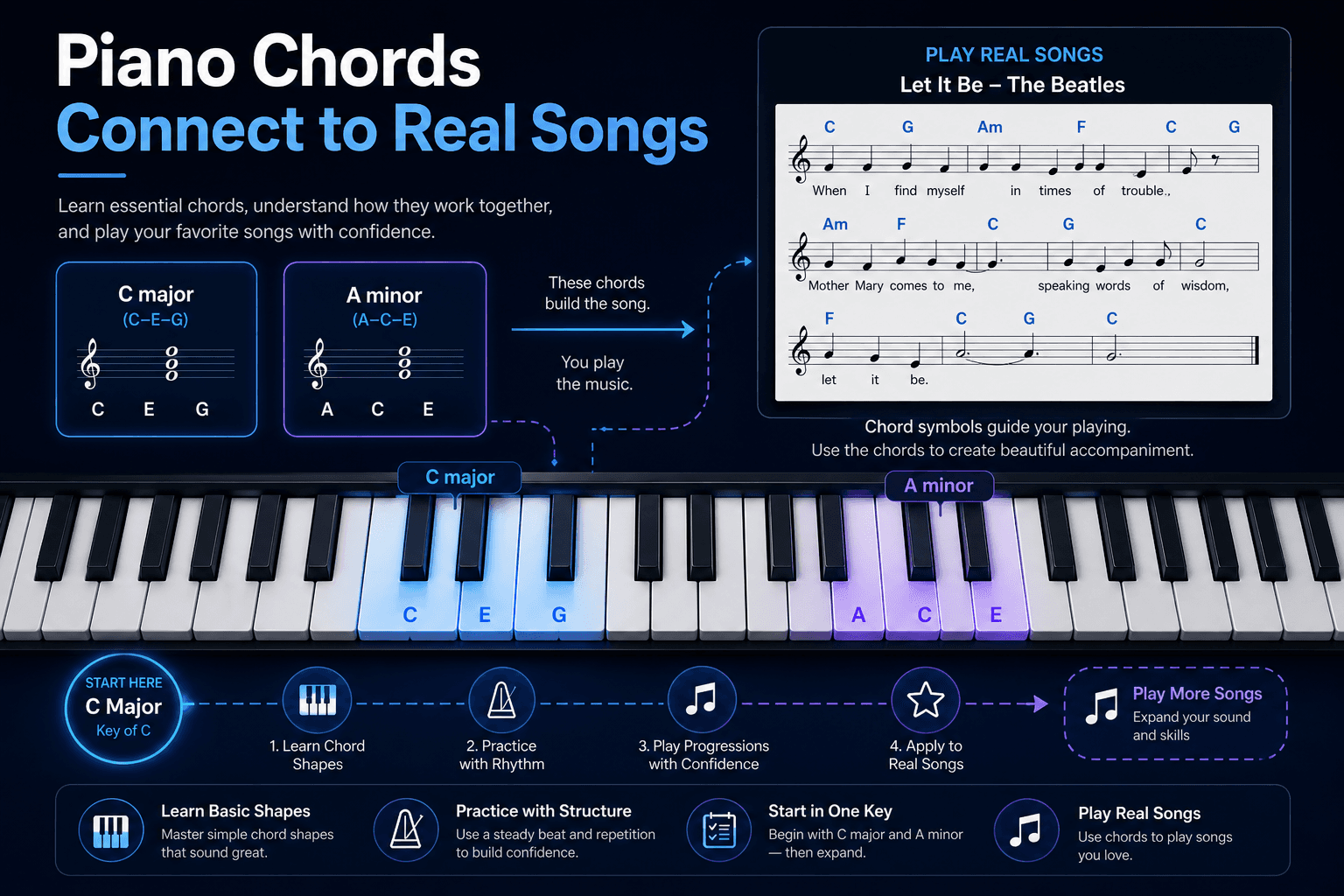
Why Songs Are Built on Chords
Popular music, gospel, rock, country, and countless other styles use chords as harmonic foundation. The melody might be what you hum, but chords are what fill out the sound and give the song its emotional color.
Most songs repeat a small set of chord progressions through verses and choruses. Learn those shapes in the song's key and you can hold down the harmony while someone sings—or play both hands when you are ready.
Chord-first learning means you are always close to something musical. Every practice session connects to songs you know instead of abstract drills with no clear payoff.
Follow Chord Charts and Lead Sheets
A chord chart shows chord symbols above lyrics or a simple melody line—C, Am, F, G7, and so on. You do not need to read every note on a staff to follow along. Learn the shapes and play each symbol when the chart changes.
Lead sheets add a melody line on top of chord symbols. Your left hand plays chords; your right hand can pick up the melody. That is how countless gigging musicians operate.
The skill chord charts demand is timely changes—landing the right shape on the right beat. That is exactly what Looty Chords trains with randomized prompts and metronome practice.
Understand Progressions in Real Music
When you recognize that a verse uses I–V–vi–IV, you are not memorizing four random chords—you are recognizing a pattern you have practiced. That pattern appears in hundreds of songs across decades of music.
Progression awareness also helps you learn new songs faster. Once you identify the loop, you only need to confirm the key and play the matching shapes.
Beginners should start with Piano Chord Progressions for Beginners. The full Chord Progressions guide covers more patterns used in practice.
Accompany Singers and Other Musicians
Chords let you support a vocalist, a worship team, or a jam session. Your job is to hold steady harmony and keep tempo—skills that chord practice builds directly.
Accompaniment does not require flashy technique. It requires knowing shapes, changing on time, and listening to the music around you. Simple, clean chords played confidently sound better than complex voicings played hesitantly.
A MIDI keyboard with Looty Chords maps practice directly to how you will play in a group—real keys, real timing, real chord symbols on screen.
A Faster Path Than Notation-First Learning
Traditional piano education often spends months on notation, scales, and exercises before a student plays a recognizable song. Chord-first learning reverses that order: play something musical early, add theory and notation as you grow.
That does not mean notation is worthless—it means chords give you a parallel path that keeps motivation high while you build broader skills.
For motivation on why chords matter, see Why Learn Piano Chords?.
Practice Habits That Transfer to Songs
Random chord drills build shape memory for any symbol a chart might throw at you. Metronome practice builds the timing charts demand. Progression loops build the flow real songs use.
Structure your sessions with How to Practice Piano Chords. When changes lag, use How to Switch Piano Chords Faster and How to Practice Chord Changes to target weak transitions.
Open Practice Mode daily—even fifteen minutes—and songs start feeling reachable within weeks, not years.
More Keys Means More Songs
Every key you learn unlocks songs written in that tonal center. A chart in B flat is approachable once you know B flat chords—not only when you stay in C.
Work through keys one at a time so the catalog grows steadily without overwhelm.
Follow the roadmap in How to Learn Piano Chords in Every Key and Chords in All 12 Keys. Use the interactive Chords tool to preview shapes in any key before you play along with a chart.
Start playing songs with chords
Explore chords visually with the interactive Chords tool, then build speed and accuracy in Practice Mode.