
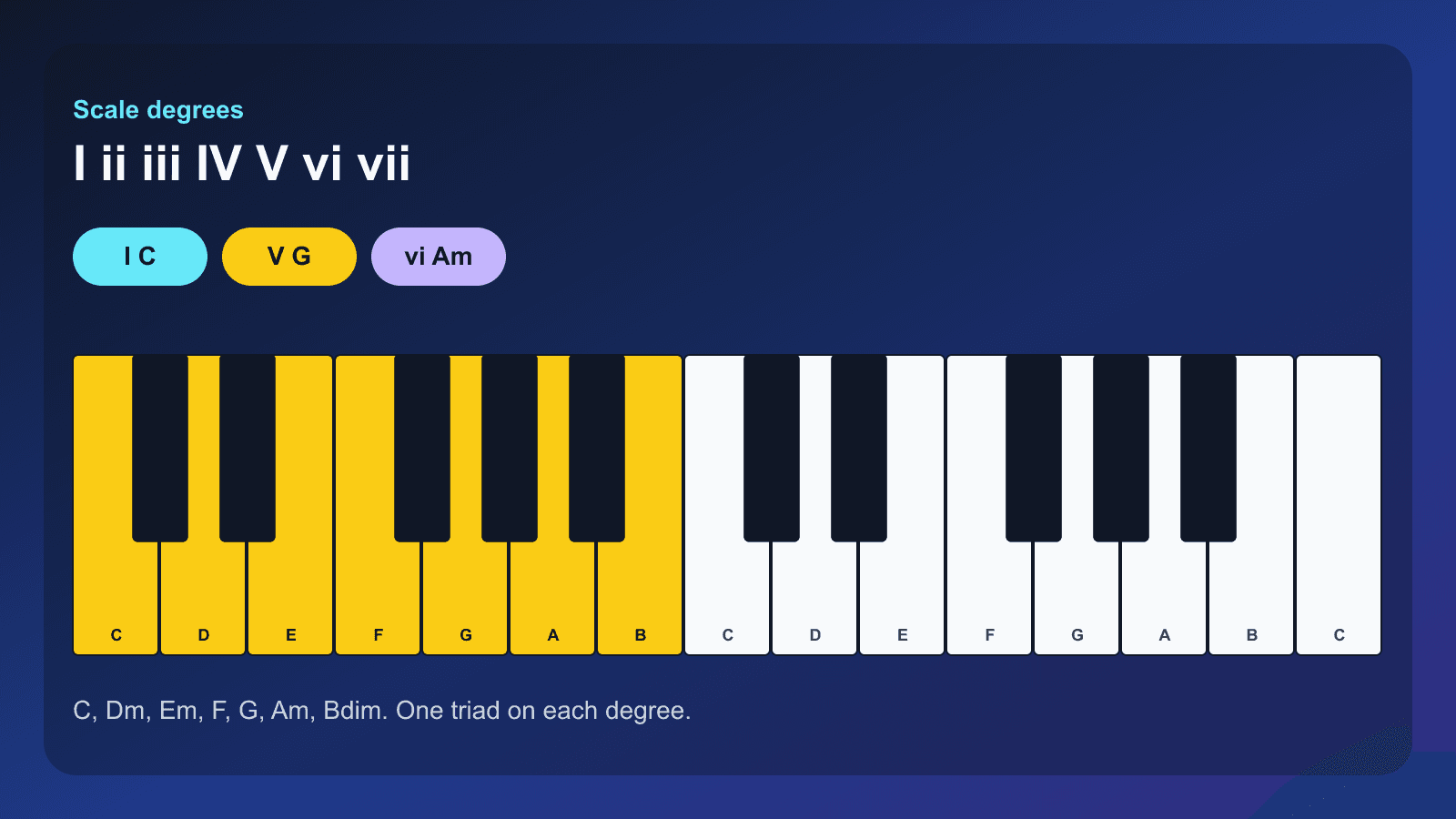
Scale degree 1 is the tonic. Degrees 2 through 7 are the other notes of the scale, in order. A triad on a degree uses that note, then every other scale note, twice. The qualities follow the scale. They are not a separate invention.
C Major
- IC
- iiDm
- iiiEm
- IVF
- VG
- viAm
- vii°Bdim
Degrees 1 through 7
In C major the degrees are C, D, E, F, G, A, and B. Roman numerals mark the triad built on each one. Uppercase is major. Lowercase is minor. A small circle marks diminished.
The pattern in every major key is I, ii, iii, IV, V, vi, vii°. The demo lists C major’s seven triads from the inversion model. Change the key and the numerals stay; the note names follow the scale.
C major’s seven triads
They are C, D minor, E minor, F, G, A minor, and B diminished. G is the dominant, degree 5. A minor is the relative minor, degree 6. B diminished is degree 7. None of these is an inversion yet. Each is the root-position triad on that degree.
A progression such as I–V–vi–IV is four of these chords in an order. The progression trainer practices orders. This page only names the seven available chords.
Three tools that use the same chords
Chord Inversions shows each of these triads in root position, first inversion, and second inversion. The circle shows the key those chords belong to. The progression trainer plays common orders of them.
Natural minor uses a different quality pattern. It is the next group of lessons, not a synonym for this one.
Start practicing piano chords with Looty Chords
Begin your free trial, compare plans, or read answers to common questions about chord practice and MIDI setup.