
Major piano chords are usually the first chord quality beginners learn. They sound open, stable, and resolved—the tonal home most songs return to. Understanding how major chords are built and where they appear in music helps you practice with purpose and play from chord charts with confidence.
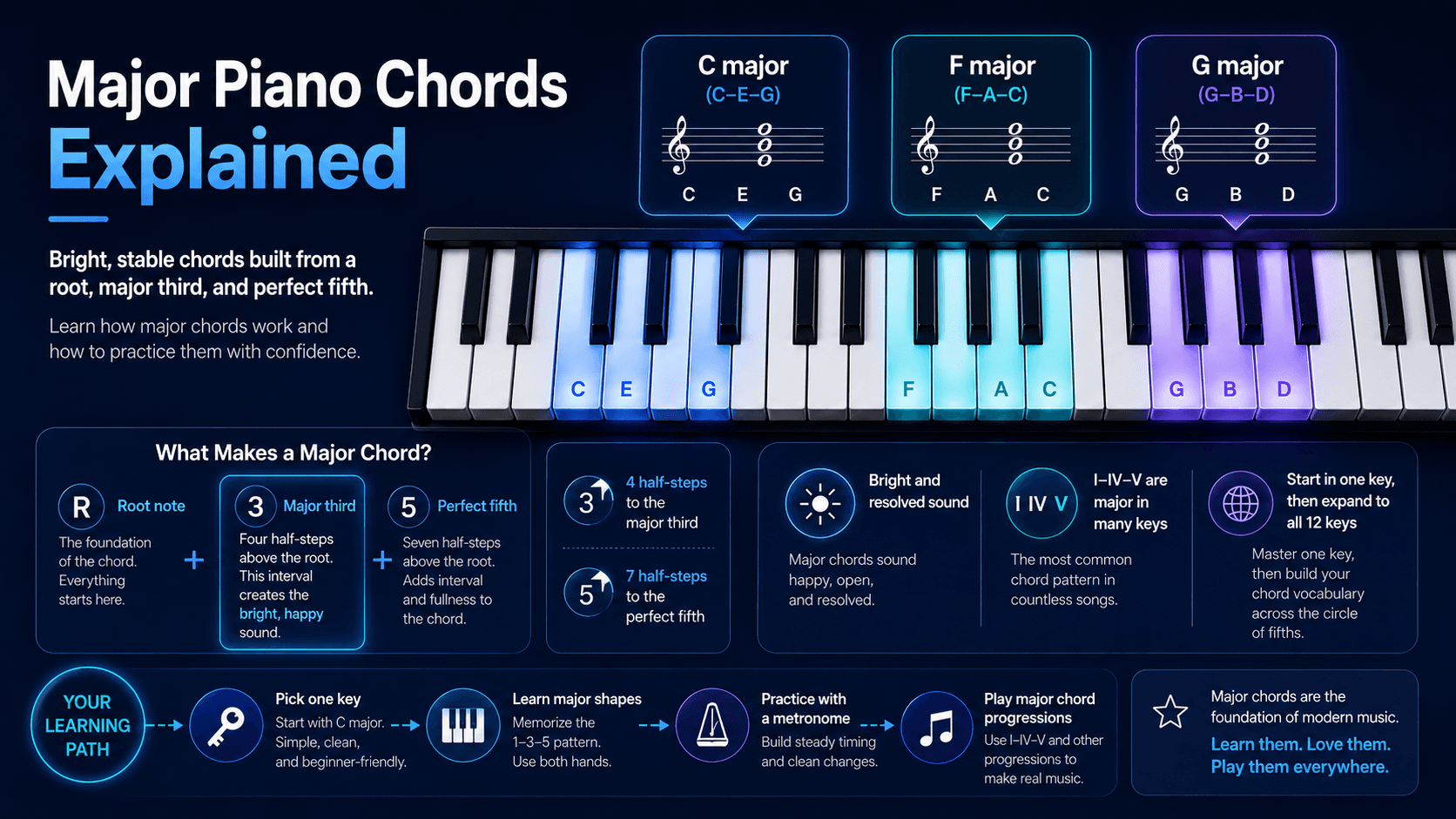
What Makes a Chord Major?
A major chord combines a root note, a major third, and a perfect fifth. On piano, you play three keys that match that pattern starting from the chord name—C major uses C, E, and G; G major uses G, B, and D.
The major third is what gives the chord its bright character. It sits four half-steps above the root. The perfect fifth sits seven half-steps above the root and adds stability without changing the major quality.
See any major chord on the keyboard with the interactive Chords tool. Pick a root and select Major—the highlighted keys and interval labels show exactly how the formula maps to piano keys.
Why Major Chords Sound Bright and Stable
The major third creates a consonant, open sound that feels resolved. That is why the I chord in most keys is major—it sounds like home. Songs often start and end on major chords for that sense of arrival.
Major chords anchor upbeat sections, choruses, and hymns. When a progression moves to a major chord after tension, it feels like a release. Your ear learns to expect that brightness in certain harmonic positions.
Not every major chord plays the same role. C major as the I chord in the key of C feels like home. F major as the IV chord feels like a gentle lift. Context within the key shapes how you hear each major shape.
Major Chords in Every Key
Every key has a set of major chords built on different scale degrees. In C major, the I, IV, and V chords—C, F, and G—are all major triads. In G major, the I, IV, and V chords are G, C, and D major.
The finger positions change with each root, but the major formula stays the same. Learning major chords in one key trains your ear and hands; learning them in all twelve keys makes you versatile.
The Chords in All 12 Keys guide explains how to work through each tonal center systematically. Looty Chords includes major chords in every key you practice.
Where Major Chords Appear in Songs
Pop progressions like I–V–vi–IV lean heavily on major chords. The I and V chords are major in most keys; the vi is minor but sits between major changes that drive the song forward.
Gospel, rock, country, and folk all rely on major triads as harmonic anchors. When you see C, G, F, or D on a chord chart, you are usually looking at major shapes.
If you are new to chords, start with What Are Piano Chords? and Piano Chords for Beginners for a broader foundation before drilling major shapes.
Major vs. Minor: Hearing the Difference
Major and minor chords share the same root and fifth—the third is what changes. C major uses C, E, G. C minor uses C, Eb, G. One note shifts the entire mood from bright to dark.
Training your ear to hear major vs. minor helps you learn faster. When Looty Chords prompts a chord, listen before you look—does it sound resolved and bright, or darker and more introspective?
The Minor Piano Chords Explained guide covers the darker side of triads. Practice both qualities in the same key so your fingers feel the small finger adjustments between them.
How to Practice Major Chords Effectively
Learn all major-family shapes in one key before switching keys. Looty Chords randomizes chord prompts so you cannot rely on alphabetical order—each major shape must stand on its own.
Keep the metronome on. Major chords still need on-time changes. Slow practice with clean landings beats fast sloppy ones every time.
Connect a MIDI keyboard when possible. Practicing on real keys builds touch and spatial memory that a screen alone cannot fully replicate.
Open Practice Mode to drill major chords with timing. When sevenths appear in your music, the Seventh Chords guide covers major 7th and dominant 7th shapes built on major triads.
Prefer a shorter, drill-only walkthrough? Major Piano Chords in Practice skips the theory and focuses purely on shapes, timing, and key-by-key progress.
Practice major chords with structure
Explore major chord shapes on the interactive keyboard, then drill changes in Practice Mode to build speed and confidence.