
Minor piano chords are the darker counterpart to major chords. They appear in ballads, emotional choruses, film scores, and countless progressions where the music needs introspection or tension. Learning minor chords alongside major chords gives you the full harmonic palette beginners need for real songs.
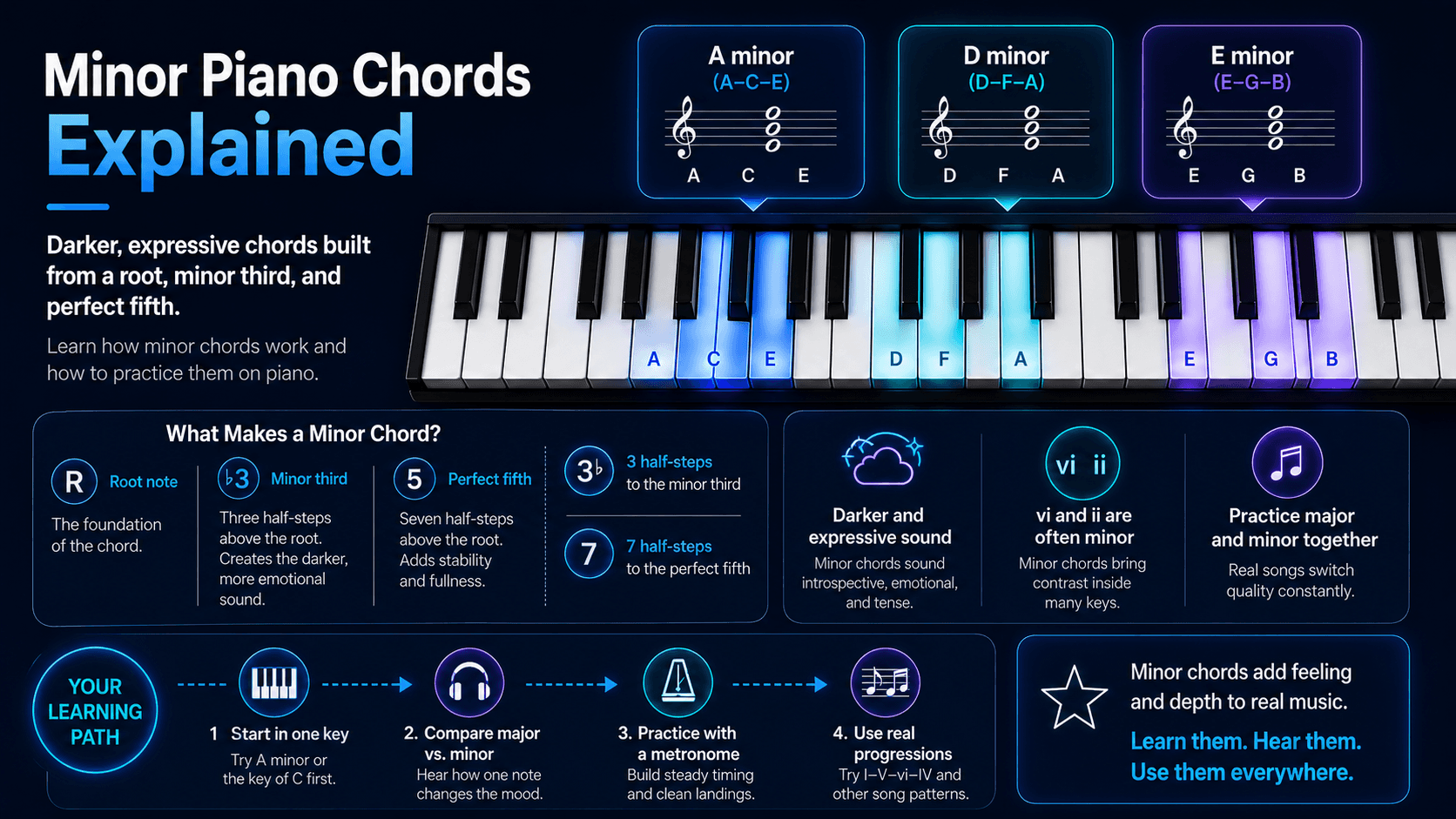
What Makes a Chord Minor?
A minor chord combines a root note, a minor third, and a perfect fifth. The minor third sits three half-steps above the root—one half-step lower than the major third. That small shift creates the darker, more somber sound.
A minor uses A, C, and E. Compare that to A major (A, C#, E)—only the middle note changes. On piano, minor chords often feel like a small adjustment from their major neighbors in the same key.
Use the interactive Chords tool to compare major and minor on the same root. Toggle between C Major and C Minor and watch how one key changes the entire character.
Why Minor Chords Sound Darker Than Major
The flattened third creates a less consonant relationship with the root than a major third. Your ear interprets that as sadness, tension, or introspection depending on context.
In a key, the vi chord is usually minor—it provides contrast against major chords like I and IV. The classic I–V–vi–IV progression uses a minor vi chord between major changes, which is part of why it feels so satisfying.
Minor chords are not only for sad songs. They add weight to upbeat tracks, color to jazz harmony, and emotional peaks in gospel and R&B. Context and progression matter as much as the chord quality itself.
Minor Chords in Every Key
Each key has minor chords built on different scale degrees. In C major, A minor is the vi chord and D minor is the ii chord. In G major, E minor is vi and A minor is ii.
Natural minor chords use the minor triad formula. You will also encounter minor seventh chords (Am7, Em7) in modern music—the Seventh Chords guide covers those when you are ready.
Where Minor Chords Appear in Songs
Ballads and emotional pop songs lean on minor chords for verses and bridges. The vi chord in I–V–vi–IV progressions is minor and often carries the most emotional weight.
Minor chords also appear as the i chord in minor keys—where the entire song centers on a minor tonal home. Songs in Am, Em, or Dm use minor triads as the harmonic foundation.
If you are building your foundation, read Major Piano Chords Explained alongside this guide. Major and minor triads work together in almost every song you will play.
Switching Between Major and Minor
The fastest way to hear the major/minor difference is to alternate on the same root. Play C major, then C minor. Play Am, then A major. Your fingers learn the small adjustments; your ear learns the sound.
In practice, songs constantly move between major and minor chords. A progression might go from C major to A minor to F major—your hands need to switch quality without hesitation.
Looty Chords randomizes both major and minor prompts in each key so you drill realistic changes. Open Practice Mode and work at a tempo where every shape lands cleanly.
How to Practice Minor Chords Effectively
Do not practice minor chords in isolation from major chords. They appear together in real music—train both qualities in the same key from the start.
Pay attention to which minor shapes slow you down. The ii and vi chords in a key often use different finger paths even though both are minor triads.
Use random order and a metronome. Minor chords need the same timing discipline as major chords—slow and accurate before fast.
Our Chords in All 12 Keys guide explains how to expand minor practice across every tonal center. For motivation on why chord work matters, see Why Learn Piano Chords?
Prefer a shorter, drill-only walkthrough? Minor Piano Chords in Practice skips the theory and focuses purely on shapes, timing, and key-by-key progress.
Practice minor chords with structure
Explore minor chord shapes on the interactive keyboard, then drill major and minor changes in Practice Mode.