
Music theory for beginners often sounds intimidating because courses try to cover everything at once. If your goal is playing piano chords and reading chord charts, you can start smaller. This guide explains the theory concepts that matter most for chord practice—and points you to Looty Chords tools when you are ready to play.
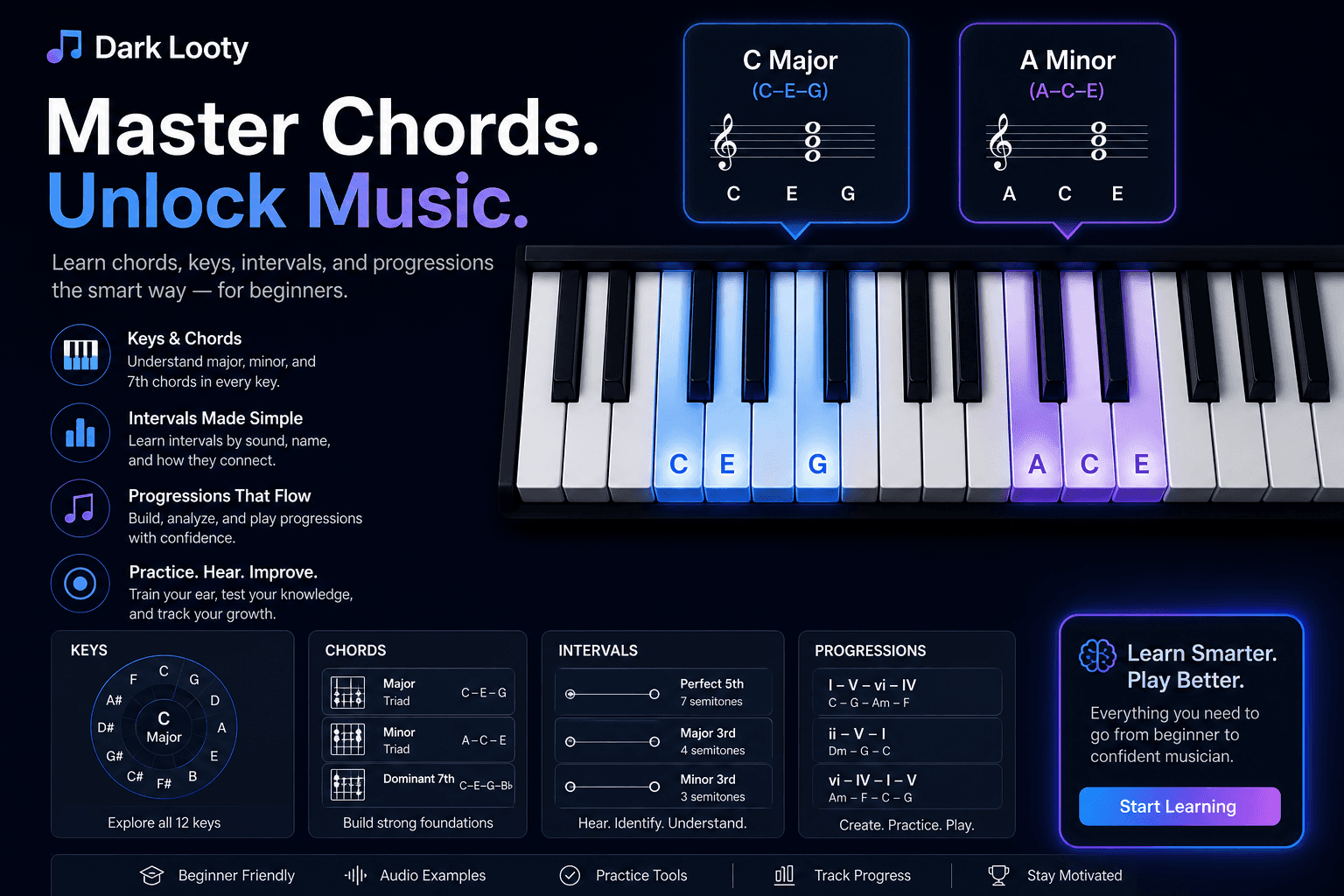
What Music Theory Beginners Actually Need First
Start with four ideas: note names, keys, chords, and chord progressions. You can add advanced topics—modes, extended harmony, voice leading—after your hands know common shapes.
Looty Chords is designed for this practical path. You learn chord names and keyboard shapes first, then deepen theory as patterns become familiar.
Reading standard notation is helpful but not required for chord-first playing. Many players learn chords by name and shape long before they sight-read melodies.
Notes, Keys, and Scales
Western music uses twelve pitch names that repeat across the keyboard: C, C sharp, D, and so on through B. A key is the tonal home a song feels centered around—like C major or G major.
A major scale is the seven-note pattern that defines a major key. In C major the scale is all white keys: C, D, E, F, G, A, B. Other keys introduce sharps or flats, but the relationships stay similar.
You do not need to memorize every scale before playing chords. Still, knowing that chords are built from scale notes helps you understand why certain chords belong together.
What Chords Are
A chord is multiple notes played together. Most beginner piano chords are triads—three notes built from a root note plus two stacked intervals.
Chord names tell you the root and quality: C means C major, Am means A minor, G7 means G dominant seventh. The name is the label your hands must recognize quickly.
Read the full introduction in What Are Piano Chords?.
Major and Minor Chords
Major chords usually sound bright and resolved. Minor chords sound darker or more reflective. That emotional contrast drives countless songs.
On piano, major and minor often differ by one note in the middle of the triad. Once you learn that pattern in one key, you repeat it in every other key.
See how intervals build chords in How Piano Chords Work.
Chords Inside a Key
Not every chord fits every song. In a major key, seven diatonic chords come from the scale notes. Songs mostly move among those chords—or closely related ones.
Understanding diatonic chords explains why G, C, and D feel natural together in the key of C, while random chords outside the key sound like a sudden detour.
Learn the full concept in Diatonic Chords Explained.
Circle of Fifths Basics
The circle of fifths arranges the twelve major keys in a circle. Each step shows how keys relate, which chords belong together, and where sharps or flats appear.
Beginners use it as a map—not something to memorize in one sitting. Click a key and study its scale notes, diatonic chords, and common progressions.
Explore keys interactively with the Circle of Fifths tool.
Chord Progressions
A chord progression is an ordered series of chords—like C to G to Am to F. Progressions create the harmonic movement you hear in pop, rock, worship, and countless other styles.
Roman numerals (I, IV, V, vi) describe progressions in any key. Once you know I–V–vi–IV in C, you can transpose the same pattern to G or F by swapping chord names.
Start with beginner-friendly patterns in Piano Chord Progressions for Beginners.
What to Practice Next
Pick one key and learn its seven essential chord types. Practice randomized changes with a metronome until shapes feel automatic. Then study progressions in that key before moving on.
Use the interactive Chords tool to review shapes, then open Practice Mode for timed drills.
Turn theory into practice
Use Looty Chords to practice the chords and keys you are learning—one key at a time, with timing built in.