
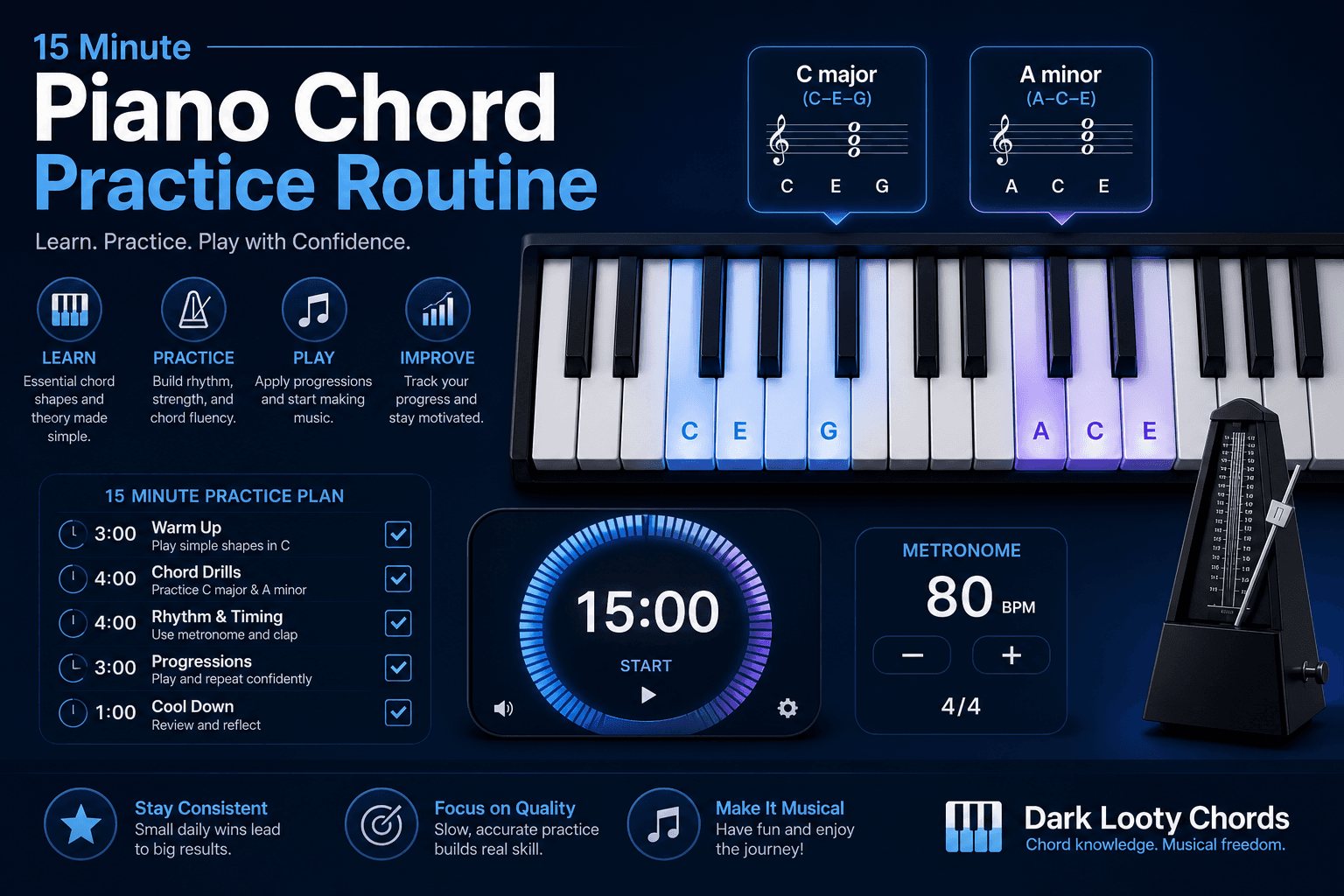
You do not need an hour at the keyboard to improve. A focused 15-minute piano chord practice routine—warm up, drill, transition work, and a musical finish—fits into a lunch break or morning routine and still builds muscle memory. Here is a minute-by-minute plan you can follow in Looty Chords today.
Why Fifteen Minutes Works
Motor learning responds to consistency more than duration. Fifteen minutes five days a week beats seventy-five minutes once a week. Your fingers get regular reinforcement without fatigue or mental drift.
A time-boxed routine also keeps practice honest. When you know you only have fifteen minutes, you skip noodling and focus on drills that matter.
For a longer framework you can expand, see the full Piano Chord Practice Routine guide.
Minutes 1–3: Warm-Up
Set the metronome to a comfortable tempo—slower than your target speed. Play four to six chord changes in a simple pattern you already know. No random prompts yet; just arrive at the keyboard with relaxed hands.
If yesterday's session revealed a weak chord, play it twice during the warm-up. Slow reps prime your fingers for harder work ahead.
New to chords? Review Piano Chords for Beginners so your warm-up shapes are correct before you speed up.
Minutes 4–11: Random Chord Drill
This is the core of your session. Open Looty Chords practice with randomized prompts and hold a steady tempo. Seven minutes of focused random drilling builds more memory than twenty minutes of playing only familiar shapes.
Do not increase tempo mid-session unless every change is clean. If you miss beats, drop five BPM and rebuild accuracy. The goal is clean landings, not hero speeds.
Launch Practice Mode and stay in your current key. Looty Chords cycles through all seven essential chord types so nothing gets skipped.
Minutes 12–14: Transition Pairs
Pick the two chord changes that slowed you down during the drill—maybe G to Am or F to C. Loop only those pairs for two minutes at the same tempo.
Pair practice trains the path between shapes, which is where most hesitation lives. Two focused minutes on a weak transition often does more than ten minutes of general drilling.
For more transition techniques, read How to Practice Chord Changes and How to Switch Piano Chords Faster.
Minute 15: Musical Finish
End with one loop of a short progression—four chords, played through twice at a tempo that feels musical. This connects your drills to real music and leaves the session on a satisfying note.
A simple I–V–vi–IV in your practice key works perfectly. Keep the metronome on and listen for smooth changes rather than speed.
The Chord Progressions guide lists common patterns you can use for this finish.
Before You Start: Know Your Shapes
A 15-minute routine assumes you know the basic shapes in your practice key. If a chord name still puzzles you, spend a minute on the reference tool before the clock starts.
Use the interactive Chords tool to confirm note names and finger positions for any unfamiliar shape. Visual clarity before drilling saves time during the session.
When to Scale Beyond Fifteen Minutes
As your routine becomes habitual, add five minutes to the core drill—not the warm-up or finish. Twenty to thirty minutes is a natural next step once fifteen feels easy to complete daily.
When your current key feels solid at a comfortable tempo, move to the next key using the same 15-minute structure.
The Chords in All 12 Keys guide explains how to expand key by key without losing momentum.
Try the 15-minute routine today
Explore chords visually with the interactive Chords tool, then build speed and accuracy in Practice Mode.