
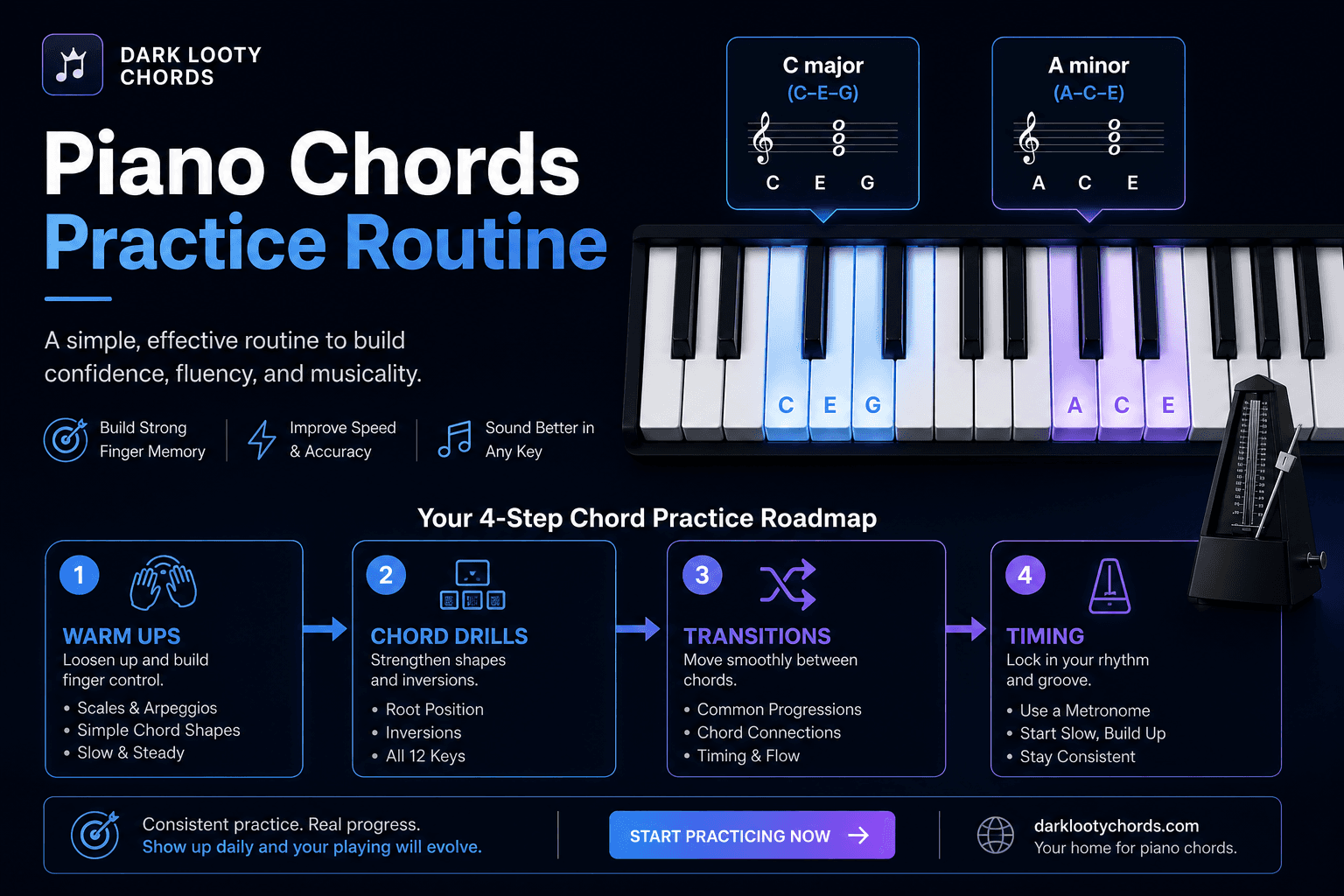
Without a routine, practice drifts. You might play familiar chords comfortably and avoid the ones that challenge you. A simple piano chord practice routine gives every session a shape: warm up, drill, review weak spots, and finish with something musical. This guide outlines a routine you can use daily or adapt to your schedule.
Why a Routine Matters
Routines reduce decision fatigue. When you sit down at the keyboard, you already know what to do instead of wondering where to start. That consistency is what separates steady progress from occasional bursts of effort.
A chord routine also balances skills: recognition, timing, transitions, and endurance. Neglecting any one area creates gaps that show up when you try to play real songs.
If you are just starting out, read Piano Chords for Beginners first, then return here to structure your sessions.
Step 1: Warm Up Slowly
Begin every session at a comfortable tempo—slower than your target speed. Play through a few chord changes without the pressure of random prompts. Let your hands find the keys and your ears tune into the metronome.
Two to three minutes is enough. The warm-up is not about difficulty; it is about arriving at the keyboard with focus and relaxed hands.
If a particular chord felt shaky in your last session, include it in the warm-up. Early reps at slow tempo prime your fingers for harder drills later.
Step 2: Core Chord Drill
This is the heart of your routine: randomized chord prompts with a metronome. Looty Chords handles the randomization so you practice every shape in your key—not just favorites.
Aim for ten to twenty minutes depending on your schedule. Stay at one tempo until every change lands cleanly, then increase by five BPM.
Open Practice Mode and work in your current key. Focus on landing each shape before the beat arrives—not after it.
Step 3: Focus on Weak Transitions
Notice which chord changes slow you down during the core drill. Spend a few minutes repeating only those pairs: C to F, G to Am, or whatever trips you up.
Transition practice is different from single-chord drills. Your fingers learn the path between two shapes, not just the destination.
The How to Practice Chord Changes guide goes deeper on pairing practice. For speed goals, see How to Switch Piano Chords Faster.
Step 4: Finish With a Progression
End your session by looping a short chord progression at a musical tempo. This connects isolated drills to real music and leaves you feeling like you played something meaningful.
Even a simple I–V–vi–IV loop in your practice key reinforces transitions in context. Keep the metronome on and play through the cycle until it feels smooth.
The Chord Progressions guide covers common patterns and how to practice them in Looty Chords.
Track Progress Over Weeks
Chord progress is gradual. Compare week to week, not day to day. Signs of improvement include faster tempo at the same accuracy, fewer hesitations on random prompts, and smoother transitions you used to fumble.
When one key feels solid—usually after two to three weeks of consistent practice—move to the next key using the same routine structure.
Our Chords in All 12 Keys guide explains how to expand systematically without overwhelming yourself.
Short on Time? Use a Condensed Version
On busy days, cut the warm-up to one minute and the progression finish to two minutes—but keep the core drill. Ten focused minutes beats skipping practice entirely.
For a timed breakdown, see the 15-Minute Piano Chord Practice Routine—a focused plan when you only have a quarter hour.
Use the interactive Chords tool before your routine to preview any new shapes you have not played yet.
Start your chord practice routine
Explore chords visually with the interactive Chords tool, then build speed and accuracy in Practice Mode.