
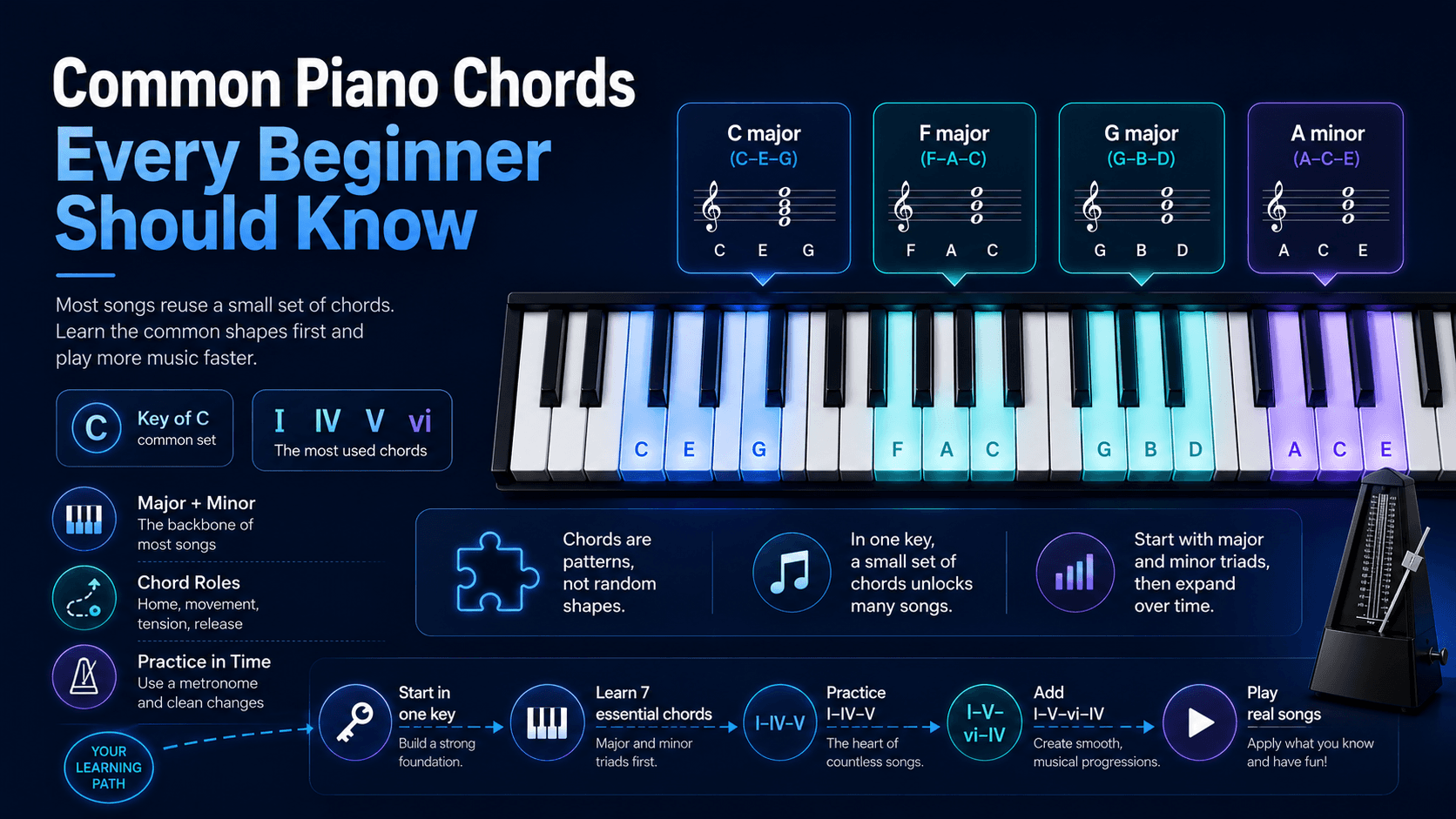
Common piano chords are not eighty-four random shapes memorized in isolation. They are patterns: major, minor, and a handful of other types repeated in every key. Beginners who focus on the most frequent chords—and practice changing between them on time—progress faster than players who collect diagrams without structure.
Start with Major and Minor Chords
Major chords sound bright and stable. Minor chords sound darker or more reflective. Together they cover the emotional backbone of countless pop, rock, folk, and worship songs.
On piano, both are three-note triads with slightly different middle notes. Learn the sound and shape together so when a chart says Am or F you know what to expect.
Go deeper on quality in Major Piano Chords Explained and Minor Piano Chords Explained.
The Most Common Beginner Chords
In any major key you repeatedly meet the same roles: the home chord (I), the subdominant (IV), the dominant (V), and the relative minor (vi). Those four appear in a huge percentage of beginner charts.
In the key of C that means C, F, G, and Am. In G major it means G, C, D, and Em. The names change with the key; the jobs stay the same.
Looty Chords teaches seven essential chord types per key so you cover the common set—not just three chords and stop.
Chords Inside a Key
Common chords in songs are usually diatonic—drawn from the seven chords of the key. That is why learning “chords in C” or “chords in G” as a set works better than memorizing random unrelated shapes.
Once you know which chords belong together, progressions become predictable. I–V–vi–IV is the same story in every key; only the chord names change.
Read Diatonic Chords Explained for the full picture.
Seventh Chords When You Are Ready
Dominant seventh chords (like G7 in C major) add tension that resolves toward the home chord. Major sevenths and minor sevenths appear in jazzier and R&B-influenced pop.
You do not need seventh chords on day one. Add them after major and minor triads feel comfortable in your first key.
Study shapes and use cases in Seventh Piano Chords.
Common Chords in Songs
Chord charts list song sections with letters—C, G, Am, F—above lyrics or measures. Your job is to move between those shapes on time while singing or playing melody elsewhere.
Songs in the same key reuse the same small chord pool. Learning one key deeply teaches you dozens of songs that share that key.
See how chords connect to repertoire in How Piano Chords Help You Play Songs.
How to Practice Common Chords
Pick one key. Drill all seven essential chord types with randomized order and a metronome. Slow tempo with clean changes beats fast tempo with hesitation.
Add progression loops after single chords feel solid. Practice I–IV–V and I–V–vi–IV until your hands anticipate the next change.
Use Practice Mode for timed drills and the chord reference to review any shape you forget.
Use the Chord Reference
The Looty Chords reference shows piano keyboard and guitar fretboard diagrams for any root and chord type. Select a key, pick a chord, and see notes and intervals instantly.
Use it when a song introduces a chord you have not played recently, then return to Practice Mode and work the shape into timed drills.
Open the Piano and Guitar Chords tool, or start in C with Piano Chords in C Major.
Learn the common chords in your first key
Start with one key in Looty Chords, master the seven essential chord types, and expand when you are ready.