
Major and minor chords appear in nearly every song you want to play. They share the same root-and-fifth skeleton—the third is what changes everything. This guide compares both qualities side by side: how they sound, how they are built, and how to practice them together. For the underlying theory of roots, intervals, and triads, see How Piano Chords Work.
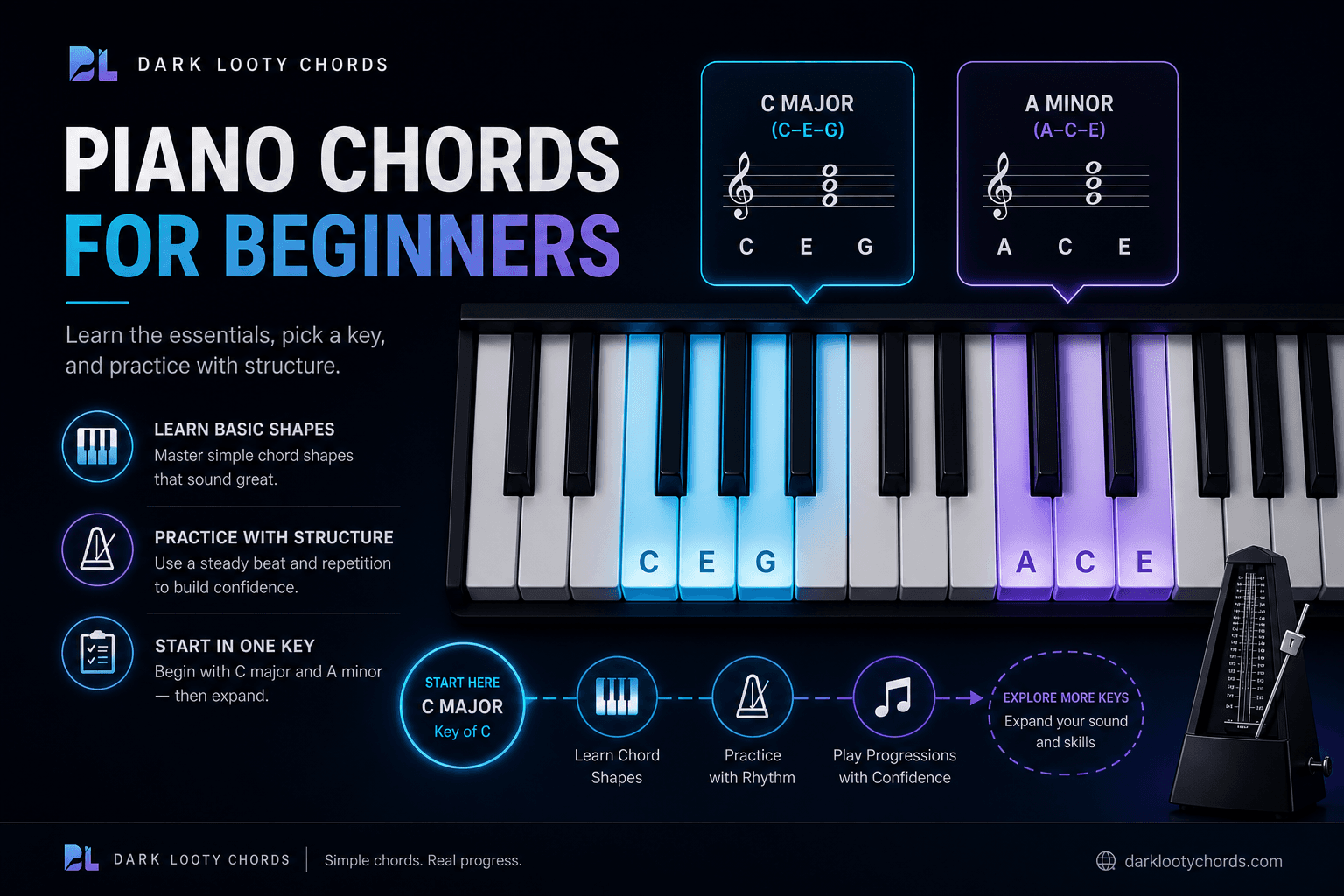
Major and Minor Side by Side
A major chord uses a major third above the root. A minor chord lowers that third by one half step. C major is C, E, G. C minor is C, Eb, G. One note changes the entire mood.
The fifth stays the same in both qualities—that shared note is why major and minor chords feel related even when they sound different.
On a chord chart, major chords are written as C, G, F. Minor chords add "m" or "min"—Am, Em, Dm. Learning to read both symbols is essential for following real music.
For roots, intervals, and triad theory behind these shapes, read How Piano Chords Work.
How They Sound Different
Major chords sound bright, open, and resolved. They anchor upbeat sections and often serve as the home chord in a key.
Minor chords sound darker, more introspective, or tense. They add emotional weight to verses and bridges.
The fastest way to hear the difference: play C major, then C minor. Then play Am after C major in a progression—that vi chord after I is one of the most recognizable moves in pop music.
Dive deeper in Major Piano Chords Explained and Minor Piano Chords Explained.
How Major and Minor Chords Are Built
Major triad formula: root, major 3rd, perfect 5th (1–3–5). Minor triad formula: root, minor 3rd, perfect 5th (1–b3–5).
That formula repeats in every key. G major is G, B, D. G minor is G, Bb, D. The interval pattern is constant; only the root position changes.
Use the interactive Chords tool to toggle between major and minor on the same root and watch how one key changes.
Major and Minor Roles in a Key
In any major key, the I, IV, and V chords are major. The ii, iii, and vi chords are minor. That mix creates the harmonic palette most songs draw from.
In C major: C (I) is major, Dm (ii) is minor, Em (iii) is minor, F (IV) is major, G (V) is major, Am (vi) is minor.
Progressions like I–V–vi–IV alternate major and minor chords—that contrast is part of what makes the pattern feel satisfying.
Practice Major and Minor Together
Do not master all major chords before touching minor chords. Songs use both constantly—practice them in the same key from the start.
Alternate between major and minor prompts in random drills. Looty Chords includes both qualities in every key so nothing gets neglected.
Pay attention to finger adjustments between qualities on the same root. C major to C minor is one note; C major to A minor is a bigger shift but a very common progression pair.
Structure your sessions with How to Practice Piano Chords and drill in Practice Mode.
Major and Minor in Common Progressions
I–V–vi–IV in C: C (major), G (major), Am (minor), F (major). You hear major-minor contrast in every loop.
I–vi–IV–V in C: C, Am, F, G—another staple that trains both qualities in sequence.
Practicing these loops in your key builds the major-minor fluency that chord charts assume you already have.
Carry Major and Minor Into Every Key
Each new key has its own major and minor shapes, but the formulas and relationships stay the same. Learning C major and A minor prepares you for G major and E minor—the pattern repeats.
Work through keys one at a time. Master both major and minor essential chords in each key before moving on.
The Chords in All 12 Keys guide explains the full expansion roadmap. Beginners should start with Piano Chords for Beginners if either quality is still new.
Practice major and minor chords
Explore chords visually with the interactive Chords tool, then build speed and accuracy in Practice Mode.