
Fingering is one of the most overlooked details in chord practice. The right finger on the right key makes changes faster and reduces strain. The wrong fingering forces awkward jumps and reinforces bad habits that slow you down later. This guide covers practical fingering principles for major, minor, seventh, and other common chord shapes on piano.
Why Fingering Matters for Chords
Fingering is not about following rigid rules from a method book—it is about finding consistent finger assignments that make each shape comfortable and repeatable. When your fingers always use the same keys for C major, your hand learns a reliable path.
Poor fingering shows up most during chord changes. If you use different fingers every time you play G major, the transition from C to G will always feel uncertain. Consistent fingering builds muscle memory faster.
Good hand position also prevents injury. Curved fingers, relaxed wrists, and minimal unnecessary movement keep practice sustainable over months and years.
Basic Hand Position for Chord Playing
Keep fingers curved and relaxed—not flat or tense. Your fingertips contact the keys, not the pads of your fingers.
Position your hand so each finger can reach its note without twisting the wrist. For triads, thumb, middle finger, and pinky often work well, but hand size and chord shape matter.
Stay close to the keys during changes. Lifting your entire hand high between chords wastes time. Move only the fingers that need to move.
Pair good position with structured practice in How to Practice Piano Chords and Practice Mode.
Fingering Major Triads
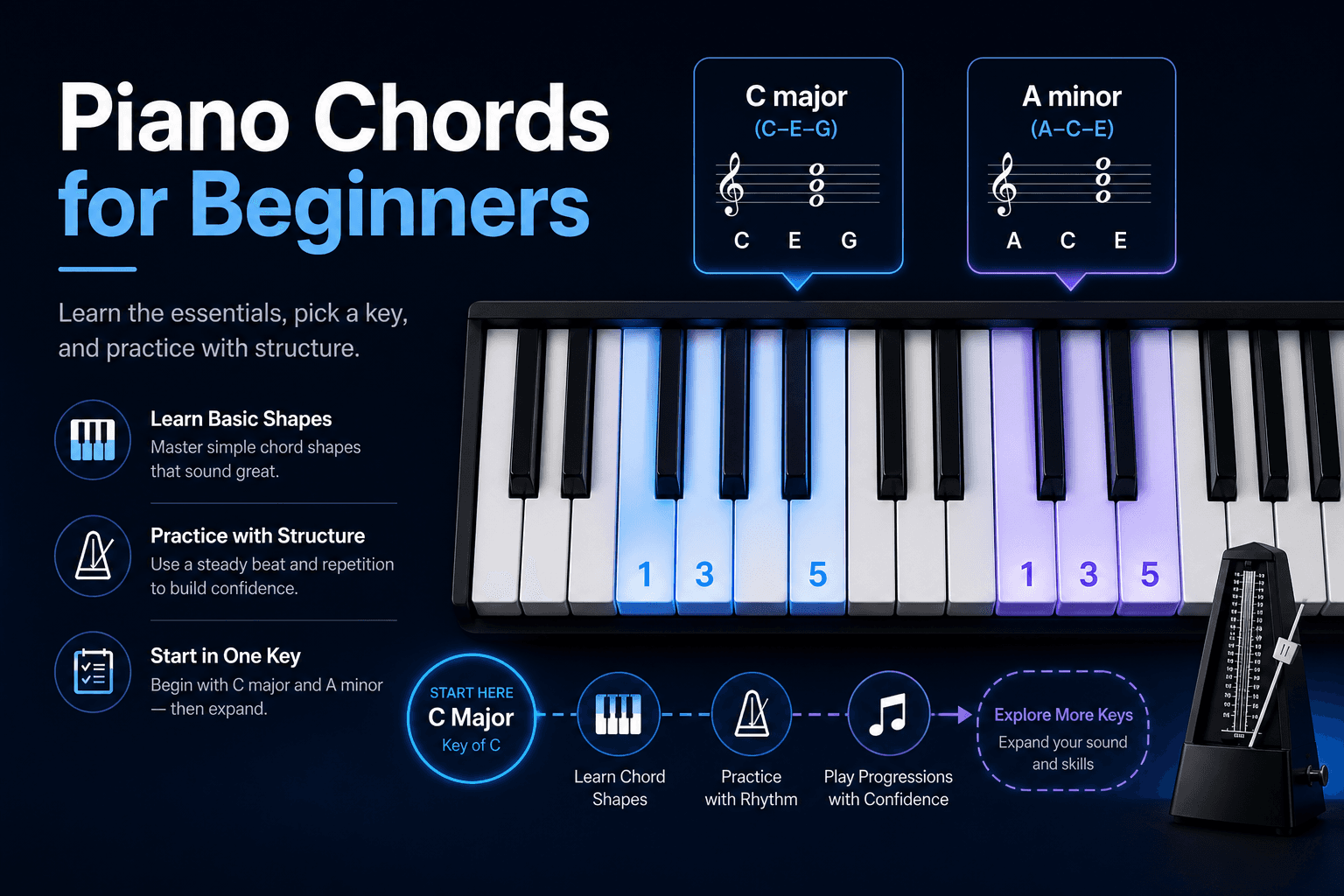
For root-position major triads in the middle of the keyboard, many players use thumb on the root, middle finger on the third, and pinky on the fifth—fingers 1, 3, and 5.
In C major (C, E, G), thumb on C, middle on E, pinky on G is a common starting choice. The same pattern works for G major, F major, and other white-key majors in similar positions.
Chords with black keys may need adjusted fingering. Gb major or Eb major might feel better with fingers 1, 2, and 4 depending on your hand span. Comfort and consistency matter more than a single universal rule.
For how major chords are built, see Major Piano Chords Explained.
Fingering Minor Triads
Minor triads often use the same 1–3–5 pattern as major triads in root position. A minor (A, C, E) fits naturally with thumb on A, middle on C, pinky on E.
The finger adjustment from major to minor is usually small—one note moves by a half step. Practice alternating between C major and A minor to feel how little your hand shifts.
Read Minor Piano Chords Explained for how minor chords differ in sound and construction. The Major and Minor Piano Chords Explained guide compares both side by side.
Fingering Seventh and Four-Note Chords
Seventh chords add a fourth note, which often requires finger 4 or a stretched hand shape. Cmaj7 (C, E, G, B) might use 1, 2, 3, 5 or 1, 2, 4, 5 depending on your reach.
Do not sacrifice hand health for a rigid fingering chart. If a shape feels cramped, try a different finger assignment or practice the chord in a higher or lower octave where the spacing fits your hand.
Four-note chords appear constantly in jazz, R&B, and pop. Consistent fingering for each seventh type—dominant, major 7th, minor 7th—speeds up changes in progressions.
Use the interactive Chords tool to see seventh chord note layouts and experiment with finger placement on your keyboard.
Fingering for Smoother Chord Changes
Look for common tones between two chords—notes that stay the same. Keep those fingers in place and move only what changes. C major to A minor shares C and E; your thumb and middle finger might not move at all.
Plan fingering for pairs you practice often. C to F, G to Am, and Dm to G each benefit from thinking through which fingers land where before you drill at tempo.
Slow practice is the best time to experiment with fingering. Find what feels natural, then repeat it consistently until it becomes automatic.
Fingering Tips for Beginners
Do not obsess over perfect fingering on day one. Learn the shape first, then refine finger choice as changes get faster.
Record which fingering you use for each chord in your practice key. A simple note—"C maj: 1-3-5"—prevents reinventing fingerings every session.
Start with Piano Chords for Beginners if you are new to chord practice. As you add keys, the Chords in All 12 Keys guide helps you carry consistent fingering habits into every tonal center.
Practice chords with better hand position
Explore chords visually with the interactive Chords tool, then build speed and accuracy in Practice Mode.