
Chord practice is simple in theory: learn shapes, play them on time, repeat until automatic. In practice, beginners often develop habits that feel productive but actually slow progress. Recognizing these common mistakes early saves weeks of frustration and builds a foundation that transfers to real songs.
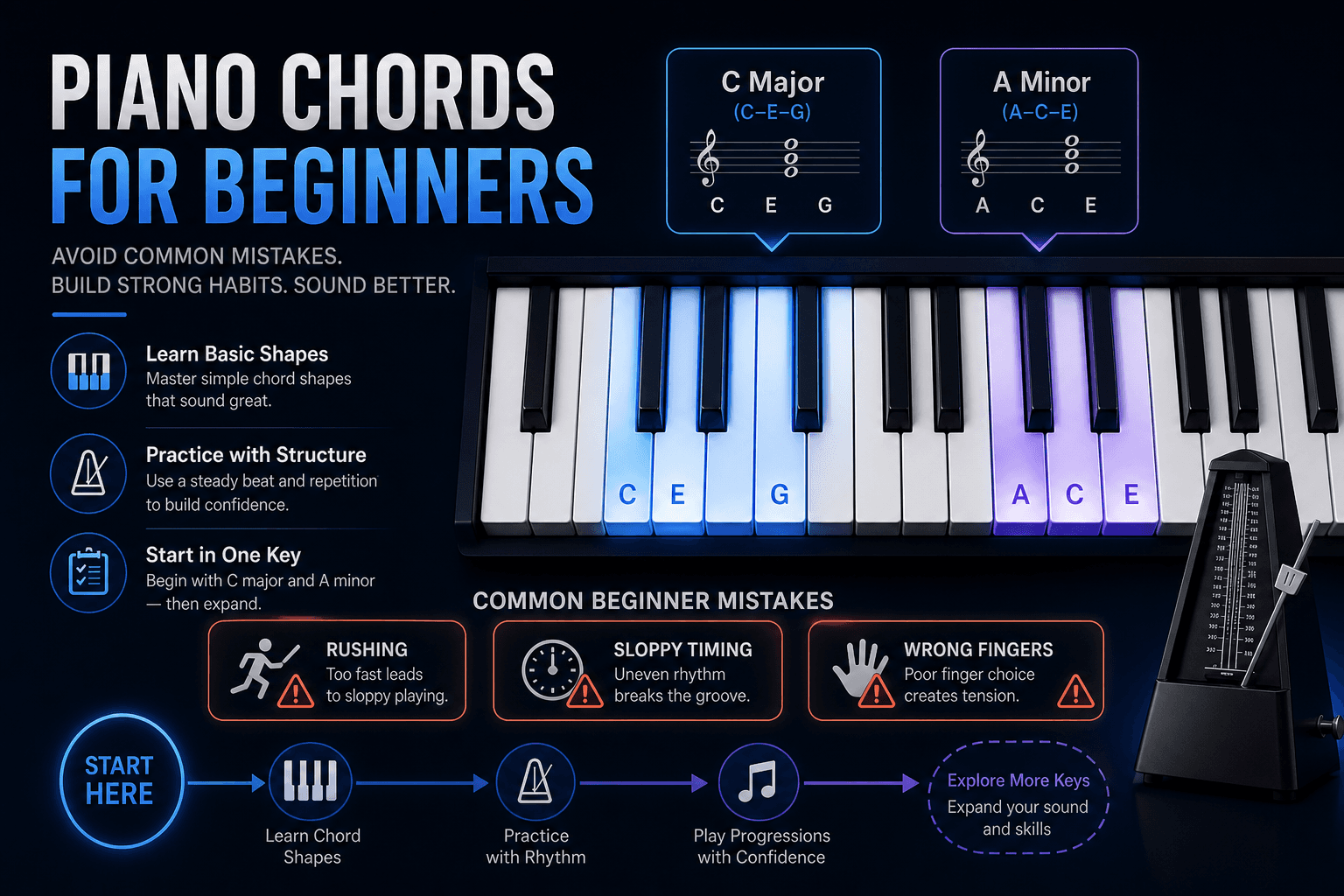
Mistake 1: Rushing the Tempo
Playing fast before you can play clean is the most common chord practice mistake. Sloppy changes at high tempo teach your fingers imprecise paths that are hard to unlearn.
If you miss beats, land notes late, or collapse hand shape, the metronome is telling you to slow down. Drop five to ten BPM and rebuild accuracy before creeping back up.
True speed is clean changes at a higher tempo—not frantic finger movement with missed notes.
For tempo discipline, see How to Practice Piano Chords and practice with Practice Mode at a speed you can hold.
Mistake 2: Ignoring the Metronome
Practicing without timing builds shape memory but not performance readiness. Songs move at a steady beat—your practice should too.
Some beginners turn the metronome off because it feels stressful. That stress is the point: mild time pressure trains the anticipation you need when playing chord charts.
Start slow. A metronome at 60 BPM with clean changes beats 100 BPM with hesitations every time.
Mistake 3: Practicing Chords in Fixed Order
Drilling C, then D, then E, then F teaches sequence memory. Songs do not play chords alphabetically—they jump unpredictably.
Randomized prompts force each shape to stand alone. Looty Chords randomizes chord order so you cannot rely on knowing what comes next.
If you only ever practice one progression loop, you are still building order memory—just for that loop. Mix random drills with progression practice.
Mistake 4: Jumping Across Too Many Keys
Spreading practice across multiple keys before finishing one dilutes muscle memory. Your fingers need deep repetition in a single tonal center.
Finish all seven essential chord types in one key before unlocking the next. Two to three weeks of focused work in one key beats a shallow pass through six keys.
Follow the one-key-at-a-time approach in Chords in All 12 Keys.
Mistake 5: Memorizing Shapes Without Context
Knowing C major in isolation is different from moving to G major on the beat inside a progression. Static shape drills alone do not train transitions.
Balance random single-chord drills with pair practice and progression loops. Changes are where songs live—not individual chords held in place.
Read Piano Chords for Beginners for a balanced starting path that includes both shapes and changes.
Mistake 6: Ignoring Fingering and Hand Position
Using different fingers every time you play the same chord forces your hand to relearn the path on every repetition. Consistent fingering accelerates muscle memory.
Flat fingers, tense wrists, and large hand lifts between chords slow changes and invite strain.
The Piano Chord Fingering Guide covers hand position and finger choices for major, minor, and seventh chords.
Mistake 7: Watching Diagrams Without Playing
Chord diagrams help you learn—but only playing builds memory. Screen time without key time creates recognition without reflex.
Use visual reference to confirm a shape, then play it repeatedly with timing. A MIDI keyboard with Looty Chords bridges screen and real keys for stronger memory.
Use the interactive Chords tool to explore shapes, then immediately drill them in Practice Mode. Pair looking with doing every session.
For major and minor quality, review Major Piano Chords Explained and Minor Piano Chords Explained so you practice with correct shapes from the start.
Build better chord practice habits
Explore chords visually with the interactive Chords tool, then build speed and accuracy in Practice Mode.