
New piano players often hear they should learn scales—and chords—and notation—and technique—all at once. That is overwhelming. Chords and scales are both fundamental, but they solve different problems. Understanding the difference helps you choose a starting path that keeps you motivated and playing music sooner.
What Chords Are
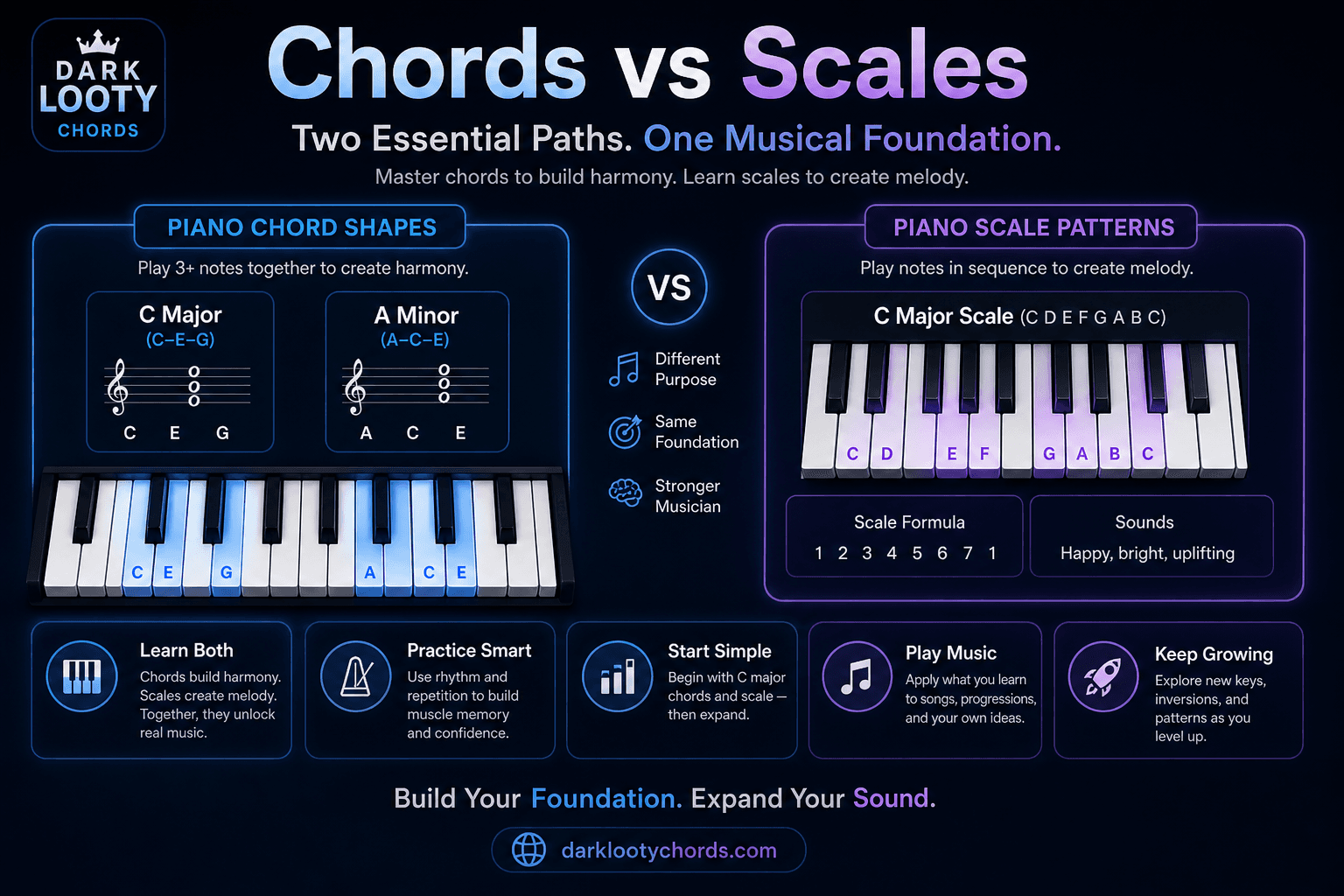
A chord is multiple notes played together. Chords provide harmony—the vertical stack of sound that supports melody and gives songs their emotional color.
Chord practice trains you to play named shapes on demand: C major, Am, G7. That skill maps directly to chord charts, lead sheets, and accompaniment.
Looty Chords focuses on chord practice because it connects quickly to playing real songs—not just exercises.
New to chords? Start with Piano Chords for Beginners.
What Scales Are
A scale is a sequence of notes played one at a time in ascending or descending order. C major scale runs C, D, E, F, G, A, B, C—each note separately.
Scales build finger dexterity, key awareness, and the note vocabulary used in melodies and improvisation. Classical training often emphasizes scales early for technique development.
Scales are horizontal—notes in a line. Chords are vertical—notes stacked together. Both describe the same key from different angles.
Different Skills, Different Goals
Learn chords first if your goal is to accompany songs, play from chord charts, or hold harmony in a band or worship setting. Chords get you musical fastest.
Learn scales first if your goal is classical repertoire, melodic improvisation, or technical finger independence from the start. Scales build the linear vocabulary melodies use.
Most players eventually need both. The question is sequencing—not whether to skip one forever.
The Case for Chords First
Chords produce full, musical sound immediately. A beginner playing C, F, and G together sounds like a song fragment within days—not months.
Popular music is chord-driven. The skills chord practice builds—shape recognition, timing, changes—are what most casual players actually use.
Motivation matters. Players who sound musical early tend to stick with practice long enough to add scales and notation later.
See How to Practice Piano Chords for structured habits, and use Practice Mode to drill shapes with timing.
Why Scales Still Matter
Scales teach you which notes belong in a key—knowledge that makes chord learning easier. The C major scale notes are the same pool C major chords draw from.
Melodic playing, fills, and improvisation lean on scale vocabulary. If you want to add right-hand melody over left-hand chords, scales become essential.
Finger strength and evenness developed through scale practice transfer to chord playing. They are complementary, not competing.
How Chords and Scales Connect
Every chord in a key uses notes from that key's scale. C major chord uses C, E, G—all notes in the C major scale. That overlap means learning one reinforces the other.
Roman numeral analysis links them: the I chord in C is C major; the notes of the C major scale define what I, ii, iii, and the rest can be.
Major and minor chords—the heart of most keys—are explained in Major Piano Chords Explained, Minor Piano Chords Explained, and Major and Minor Piano Chords Explained.
A Practical Recommendation for Beginners
Start with chords if you want to play songs. Build seven essential chord types in one key with timed practice. Add scales when you are ready for melody or want deeper key knowledge.
Fifteen to thirty minutes of daily chord practice in Looty Chords builds real skill within weeks. Scales can join your routine as a five-minute warm-up once chord changes feel comfortable.
Expand across keys with the Chords in All 12 Keys guide. Use the interactive Chords tool to explore chord shapes while your scale knowledge grows alongside.
Start with chords, grow from there
Explore chords visually with the interactive Chords tool, then build speed and accuracy in Practice Mode.