
Learning piano chords for beginners is easier when you can see the shape on the keyboard, hear the notes, and understand how chords relate within a key. The Looty Chords piano chords reference at /chords is a dedicated screen for exactly that. It is not a long theory course—it is a practical piano chord chart you can use while practicing, songwriting, or working through a chord sheet.
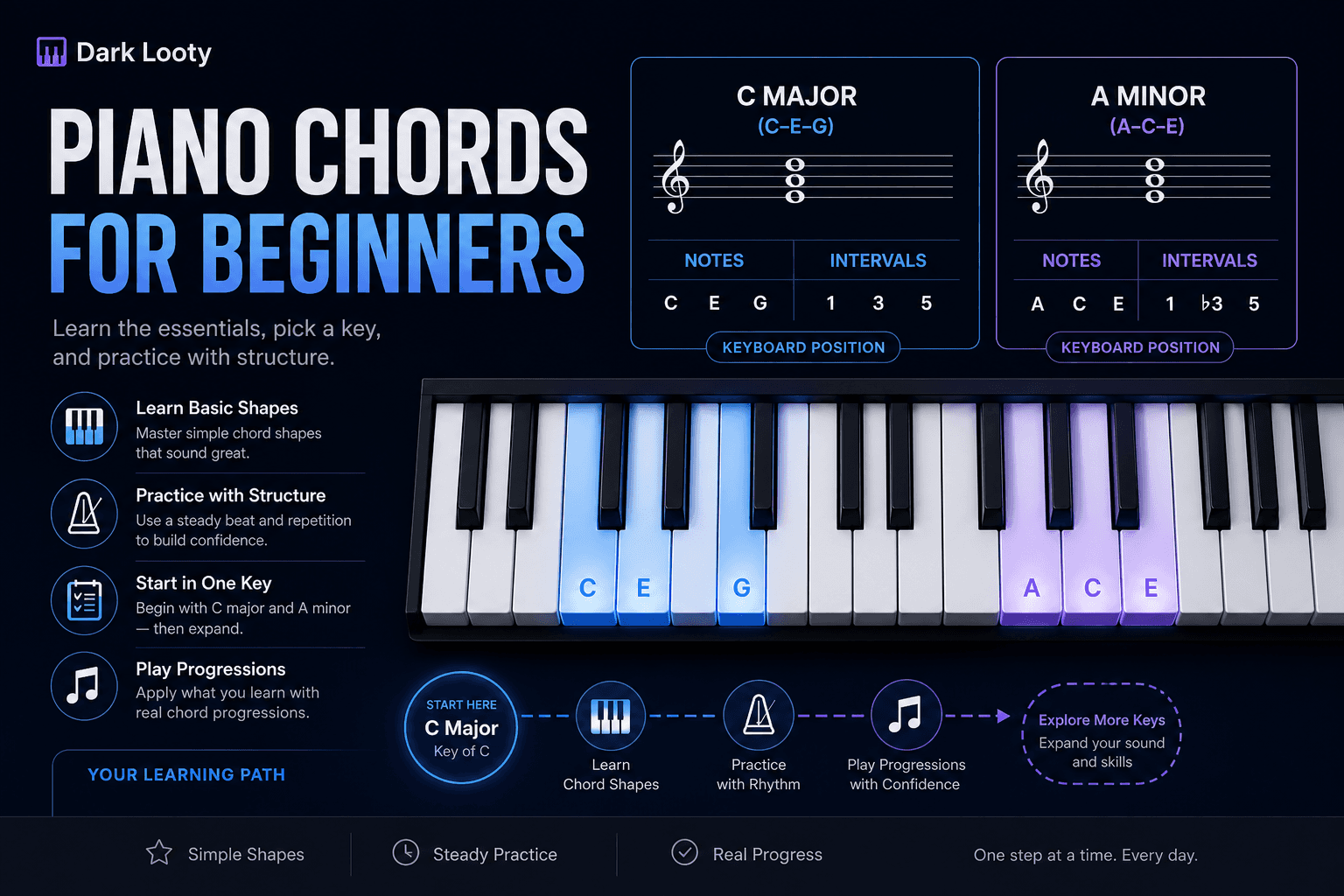
What is the chords reference screen?
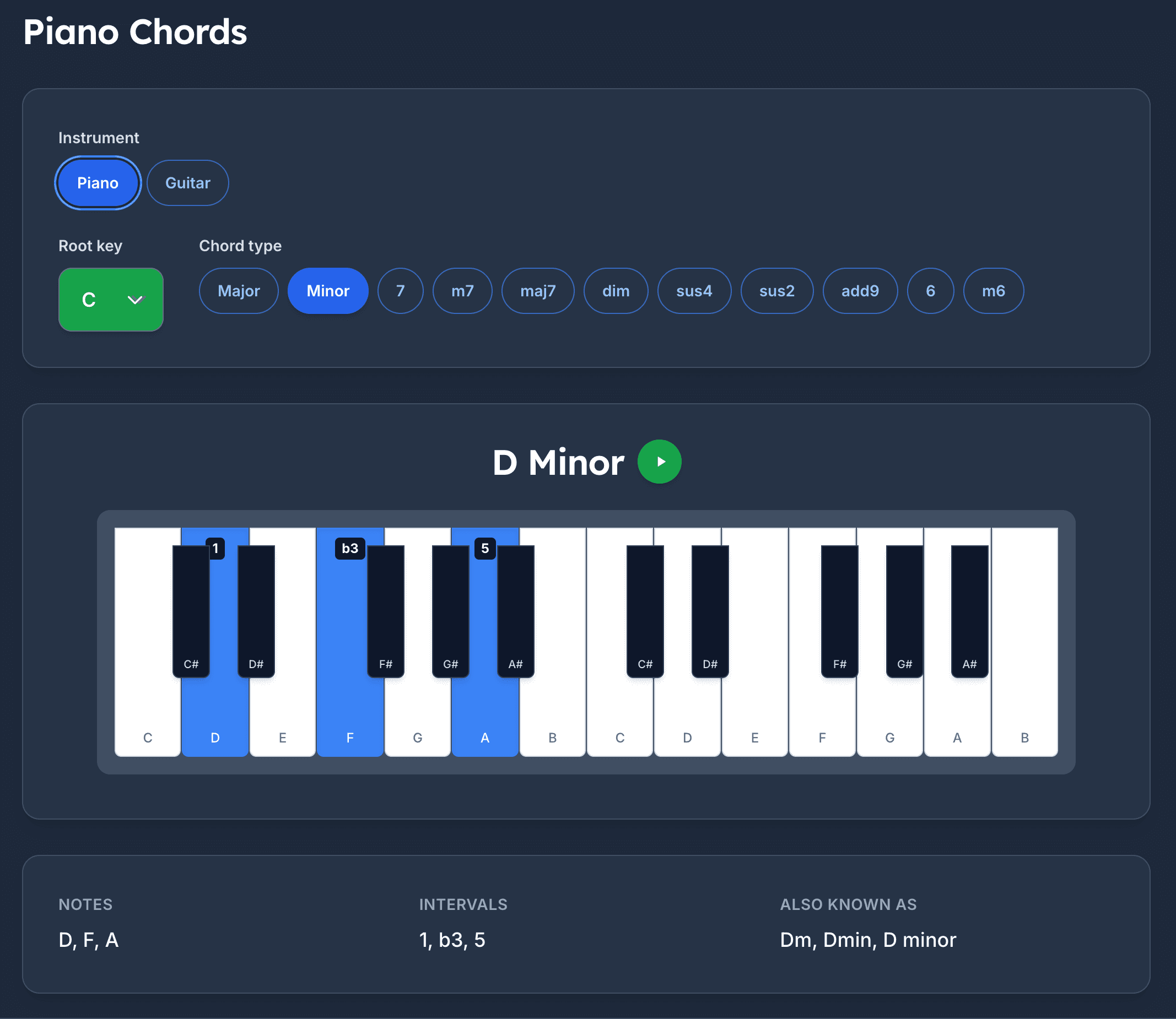
The chords reference is an interactive tool on Looty Chords where you pick a root key and a chord type, then instantly see how that chord looks on a piano keyboard. The screen highlights the exact notes in the chord, lists note names and intervals, and shows common alternate names musicians use for the same shape.
Piano is the default view when you open /chords. You can explore major piano chords, minor piano chords, seventh chords, suspended chords, and other common types without leaving the page. Think of it as a piano keyboard chord chart that updates every time you change the root or chord quality.
Open the chords reference and leave Piano selected to use the piano chords reference described on this page.
How the piano chords reference works
- Choose a root key from the dropdown—C, G, F#, or any of the twelve chromatic roots.
- Select a chord type such as Major, Minor, 7, m7, maj7, sus4, or other common qualities.
- Read the chord title (for example, C Major) and press the green play button to hear the chord tones on piano.
- Study the keyboard: highlighted keys show which notes belong to the chord, with interval labels on each key.
- Review the details card for note names, intervals, and “also known as” aliases.
- Use the “Chords in the Key of” grid to jump between diatonic chords that belong to the selected key.
Controls lock briefly while playback runs so you do not accidentally change the chord mid-preview. When playback finishes, you can switch keys, types, or chords in the key grid freely.
Why it helps beginners
Many beginners memorize isolated chord shapes without understanding how they connect. A piano chords by key approach fixes that. When you see I, ii, iii, IV, V, vi, and vii° chords listed for C major—or the same pattern transposed to G or F—you start to recognize families of chords instead of random symbols.
The highlighted keyboard answers the most common beginner question: “Which keys do I press?” Interval labels help you connect what you hear to music theory over time, without requiring a separate textbook.
If you are brand new to harmony, start with What Are Piano Chords? and Piano Chords for Beginners before diving deep into every chord type.
Benefits of using the piano chord reference
- See a clear piano chord chart for any supported root and chord type in seconds.
- Hear each chord on piano so ear training happens alongside visual learning.
- Learn note names and intervals for every shape—useful for transposing and songwriting.
- Discover alternate chord names (aliases) used on lead sheets and chord charts.
- Explore chords in a key to understand progressions before you play full songs.
- Move from memorizing random chords to understanding piano chords by key.
- Use the reference before or after piano chord practice sessions to reinforce memory.
See the piano chords reference in action
The piano view centers on a readable keyboard with the selected chord name and play button above it. Below the keyboard you will find note names, intervals, and aliases, followed by diatonic chords for the key you selected.
Chords in the key of…
At the bottom of the screen, the “Chords in the Key of {root}” section lists the diatonic triads built from the major scale of your selected key. Click any card to load that chord on the keyboard instantly.
This section is one of the most valuable parts of the piano chords reference for song learning. Popular music reuses the same chord relationships in different keys. Once you recognize that vi is often a minor chord and IV is often major, chord charts become much easier to read.
For a deeper look at working through all tonal centers, read Piano Chords by Key and Chords in All 12 Keys.
From reference to piano chord practice
The chords reference is ideal for learning and checking shapes. When you are ready to build speed and timing, move into Practice Mode with a metronome and randomized chord prompts.
Browse How to Practice Piano Chords and our Piano Chord Practice Routine for structured ways to use the reference alongside daily practice.
Review Major Piano Chords and Minor Piano Chords for focused guides on the two chord families you will use most often.
Open the piano chords reference
Explore piano chords by key, hear each shape on piano, and see how chords fit together—then take what you learn into timed practice.